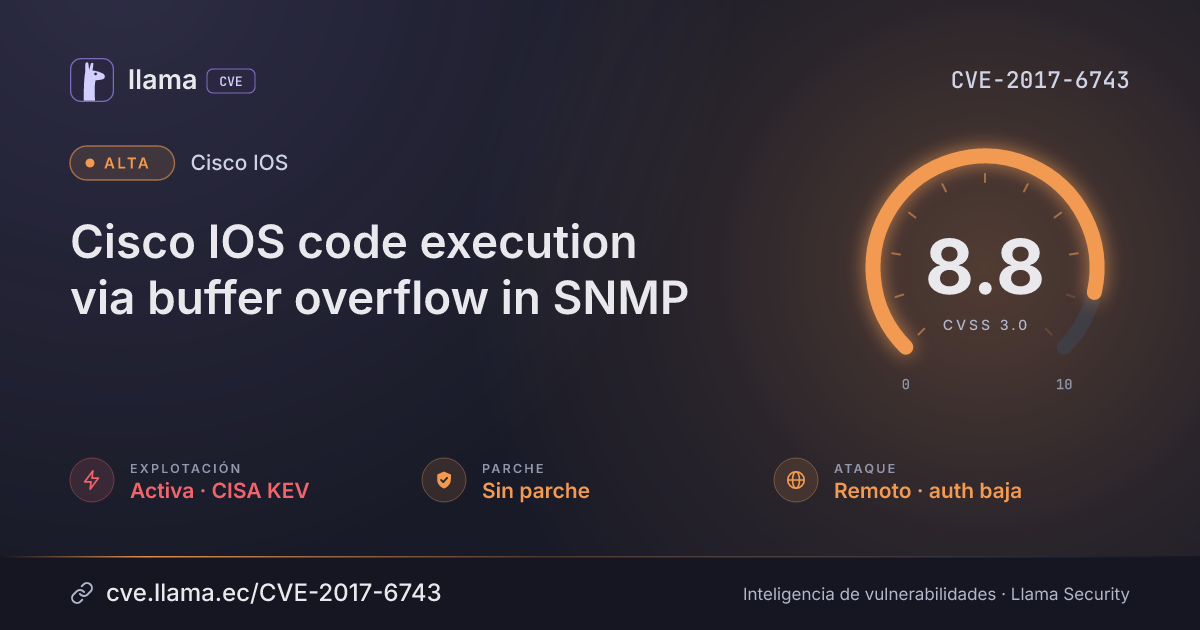
CVE-2017-6743
Cisco IOS code execution via buffer overflow in SNMP
An authenticated remote attacker can send a crafted SNMP packet to run code on the device or force it to reload.
CVSS:3.0/AV:N/AC:L/PR:L/UI:N/S:U/C:H/I:H/A:H
Fuente: CNA
Ciclo de vida de la vulnerabilidad
| Fecha | Fase | Evento | Detalle |
|---|---|---|---|
| Divulgación | Publicada | CVE-2017-6743 divulgada · CVSS 8.8 (CNA) | |
| Explotación | CISA KEV | Agregada al catálogo de vulnerabilidades explotadas | |
| Remediación | Plazo KEV | Fecha límite de remediación para agencias federales (EE. UU.) | |
| Divulgación | Modificada | Última actualización del registro | |
| Explotación | Umbral EPSS | La probabilidad de explotación supera el 10 % | |
| Monitoreo | Detectada | Ingresó al índice | |
| Monitoreo | Verificada | Última verificación contra las fuentes |
Cisco IOS and IOS XE Software with SNMP enabled has buffer overflow flaws that let an attacker run arbitrary code and take full control of the device, or make it reload. The attacker reaches it remotely over the network by sending a crafted SNMP packet, but needs valid login details such as an SNMP community string or user credentials, and attacks using these flaws are happening.
Affects Cisco IOS and IOS XE devices running a vulnerable release with SNMP (versions 1, 2c and 3) enabled and the affected MIBs not excluded. Fixed releases are listed in the Cisco IOS Software Checker.
Descripción original del registro
The Simple Network Management Protocol (SNMP) subsystem of Cisco IOS and IOS XE Software contains multiple vulnerabilities that could allow an authenticated, remote attacker to remotely execute code on an affected system or cause an affected system to reload. An attacker could exploit these vulnerabilities by sending a crafted SNMP packet to an affected system via IPv4 or IPv6. Only traffic directed to an affected system can be used to exploit these vulnerabilities. The vulnerabilities are due to a buffer overflow condition in the SNMP subsystem of the affected software. The vulnerabilities affect all versions of SNMP - Versions 1, 2c, and 3. To exploit these vulnerabilities via SNMP Version 2c or earlier, the attacker must know the SNMP read-only community string for the affected system. To exploit these vulnerabilities via SNMP Version 3, the attacker must have user credentials for the affected system. A successful exploit could allow the attacker to execute arbitrary code and obtain full control of the affected system or cause the affected system to reload. Customers are advised to apply the workaround as contained in the Workarounds section below. Fixed software information is available via the Cisco IOS Software Checker. All devices that have enabled SNMP and have not explicitly excluded the affected MIBs or OIDs should be considered vulnerable. There are workarounds that address these vulnerabilities.
Condiciones y alcance
Desglose de métricas
Versiones afectadas
12.1(3)XI12.2(1b)DA12.2(5)DA12.2(7)DA12.2(12)DA12.2(10)DA512.2(12)DA1012.2(10)DA12.2(12)DA112.2(12)DA612.2(10)DA812.2(12)DA812.2(12)DA1112.2(12)DA912.2(12)DA412.2(10)DA312.2(5)DA112.2(12)DA1312.2(12)DA1212.2(12)DA712.2(1b)DA112.2(10)DA112.2(10)DA612.2(10)DA412.2(12)DA212.2(12)DA312.2(10)DA212.2(12)DA512.2(10)DA712.2(10)DA912.2(4)XL212.2(4)XM12.2(4)XM312.2(4)XM212.2(4)XM412.2(4)XM112.2(3d)12.2(5b)12.2(1)XS1a12.2(4)YA12.2(4)YA612.2(4)YA312.2(4)YA412.2(4)YA112.2(4)YA1112.2(4)YA212.2(4)YA912.2(4)YA812.2(4)YA512.2(4)YA1212.2(4)YA1012.2(4)YA712.2(4)YG12.2(2)XF212.2(2)DD212.2(1)XD12.2(1)XD412.2(1)XD312.2(1)XD112.2(2)XHEstado del parche por paquete
| Paquete / producto | Estado | Corregida en | Desde divulgación | Última versión |
|---|---|---|---|---|
IOS |
Sin parche | — | — | — |
Universal Product |
Sin parche | — | — | — |
Arsenal público
Sin exploits, módulos ni PoC públicos conocidos a la fecha de verificación.
https://sec.cloudapps.cisco.com/security/center/content/CiscoSecurityAdvisory/cisco-sa-20170629-snmpLas referencias externas se muestran para copiar: cve.llama.ec no lo redirige a otros sitios.