llamaCVEVulnerability Intelligence
/
Vulnerabilidad

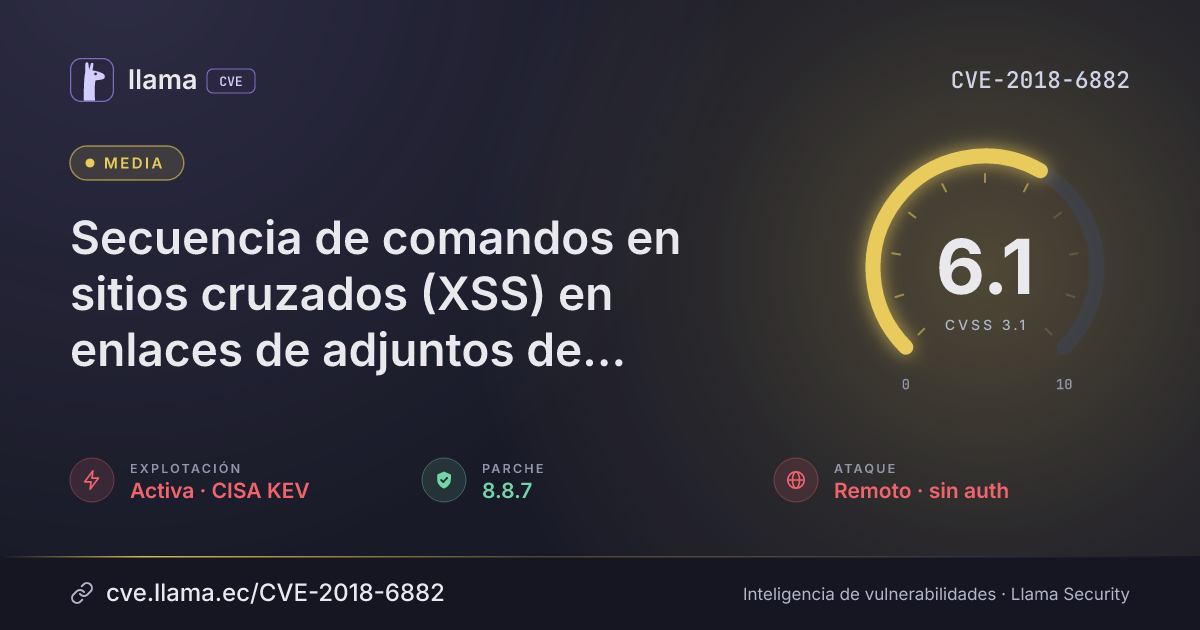
CVE-2018-6882

Cross-site scripting (XSS) in webmail attachment links

An attacker can send a crafted email attachment that runs malicious scripts in a user's browser within webmail.

Texto original en inglés · Ver en español

CISA KEV · explotación activaCrítica · en CISA KEVParche disponible
Descargar PNG JSON
CVSS 3.1
6.1
Media
CVSS:3.1/AV:N/AC:L/PR:N/UI:R/S:C/C:L/I:L/A:N Fuente: CISA-ADP
ExplotaciónActivaEn CISA KEV desde 19 abr 2022
Exploits públicos0Explotada, pero sin código público enlazado
Parche1 versión8.8.7
Exposición3.160 dDesde la divulgación, 27 mar 2018, 11:00 a. m.
EPSS ≥ 10 %22 oct 2026Fecha en que la probabilidad de explotación superó el umbral
Decisión SSVCAtender
Priorizar en el próximo ciclo de cambios
Explotación activa (CISA KEV), no automatizable e impacto técnico total. Plazo KEV: 10 may 2022.
Te dejo mi extintor por si acaso.Algún pentester ya está tomando notas de esto.
Timeline

Ciclo de vida de la vulnerabilidad

Hoy
Divulgación
Publicada
Evaluación SSVC
Modificada
Explotación
CISA KEV
Umbral EPSS
Remediación
Plazo KEV
Monitoreo
Detectada
Fuente: OSV
Verificada
27 mar 18
19 abr 22
10 may 22
13 ago 26
1 oct 26
22 oct 26
24 oct 26
18 nov 26
21 nov 26
27 mar 18
25 may 20
25 jul 22
22 sept 24
21 nov 26
FechaFaseEventoDetalle
Divulgación Publicada CVE-2018-6882 divulgada · CVSS 6.1 (CISA-ADP)
Explotación CISA KEV Agregada al catálogo de vulnerabilidades explotadas
Remediación Plazo KEV Fecha límite de remediación para agencias federales (EE. UU.)
Divulgación Evaluación SSVC CISA-ADP · explotación activa
Divulgación Modificada Última actualización del registro
Explotación Umbral EPSS La probabilidad de explotación supera el 10 %
Monitoreo Detectada Ingresó al índice
Monitoreo Fuente: OSV Registro visto por primera vez en OSV
Monitoreo Verificada Última verificación contra las fuentes
Resumen
Resumen generado por IA · CC-BY 4.0 · 17 nov 2026

A cross-site scripting flaw in Zimbra Collaboration Suite lets a remote attacker, without logging in, run script or HTML in a victim's session by sending an email whose attachment has a crafted Content-Location header, which works once the victim opens the email. The attacker can then act on the victim's behalf or show a fake login screen to collect usernames and passwords, and this bug is being exploited in attacks.

Affects Zimbra Collaboration Suite, confirmed on 8.7.11 and likely all versions from 8.5.0, when a victim opens an email with a crafted attachment header. Fixed in 8.8.7.

¿Qué significa?The attachment link in Zimbra's mail view takes its address straight from the message's Content-Location header without cleaning it. A crafted email can therefore run script or HTML in the victim's ZCS session, letting an attacker act on the victim's behalf or show a fake login screen to collect usernames and passwords.
¿Quién está afectado?The advisory tested version 8.7.11 and says the issue is likely present in all ZCS versions from 8.5.0 on. The risk arises when a user opens an email whose attachment carries a crafted Content-Location header. The installed ZCS version can be checked with the zmcontrol -v command on the server.
¿Qué hacer?Upgrade Zimbra Collaboration Suite to version 8.8.7, which the advisory lists as the fix. No workaround is given.
Descripción original del registro

Cross-site scripting (XSS) vulnerability in the ZmMailMsgView.getAttachmentLinkHtml function in Zimbra Collaboration Suite (ZCS) before 8.7 Patch 1 and 8.8.x before 8.8.7 might allow remote attackers to inject arbitrary web script or HTML via a Content-Location header in an email attachment.

Contexto

Condiciones y alcance

Condiciones necesarias para que el fallo sea explotable
01
Zimbra Collaboration Suite (ZCS) is in use; likely present in all versions from 8.5.0 on, tested on 8.7.11“It is however likely that this issue is present in all versions of ZCS from version 8.5.0 on.”
02
The victim opens an email whose attachment carries a crafted Content-Location header, which is used unsanitized in the attachment link“the value for params.href is taken directly from the Content-Location header in the message. No sanitization is performed”
¿Quién debe revisar?Teams running Zimbra Collaboration Suite (ZCS) web mail, likely all versions from 8.5.0 on, before 8.7.11 Patch 1 or 8.8.7.
Vector CVSS 3.1

Desglose de métricas

Opción resaltada = valor del vector · izquierda = peor caso · CISA-ADP
Vector de ataqueAV:N
RedAdyacenteLocalFísica
ComplejidadAC:L
BajaAlta
PrivilegiosPR:N
NingunoBajosAltos
InteracciónUI:R
NingunaRequerida
AlcanceS:C
CambiadoSin cambio
ConfidencialidadC:L
AltoBajoNinguno
IntegridadI:L
AltoBajoNinguno
DisponibilidadA:N
AltoBajoNinguno
Score de explotaciónQué tan fácil y probable es que la exploten
10.0/ 10Muy alto
Vector 8.3 (muy fácil) · +1.7 por explotación activa.
Remediación

Estado del parche por paquete

Paquete / productoEstadoCorregida enDesde divulgaciónÚltima versión
—
Corregida 8.8.7 — —
Versiones corregidas8.8.7
Explotación

Arsenal público

Sin exploits, módulos ni PoC públicos conocidos a la fecha de verificación.

Referencias
Análisishttp://seclists.org/fulldisclosure/2018/Mar/52
Otrahttps://www.securify.nl/advisory/SFY20180101/cross-site-scripting-vulnerability-in-zimbra-collaboration-suite-due-to-the-way-it-handles-attachment-links.html
Otrahttps://wiki.zimbra.com/wiki/Zimbra_Releases/8.8.7
Otrahttps://bugzilla.zimbra.com/show_bug.cgi?id=108786
Otrahttp://www.securityfocus.com/archive/1/541891/100/0/threaded
Otrahttps://wiki.zimbra.com/wiki/Zimbra_Security_Advisories

Las referencias externas se muestran para copiar: cve.llama.ec no lo redirige a otros sitios.