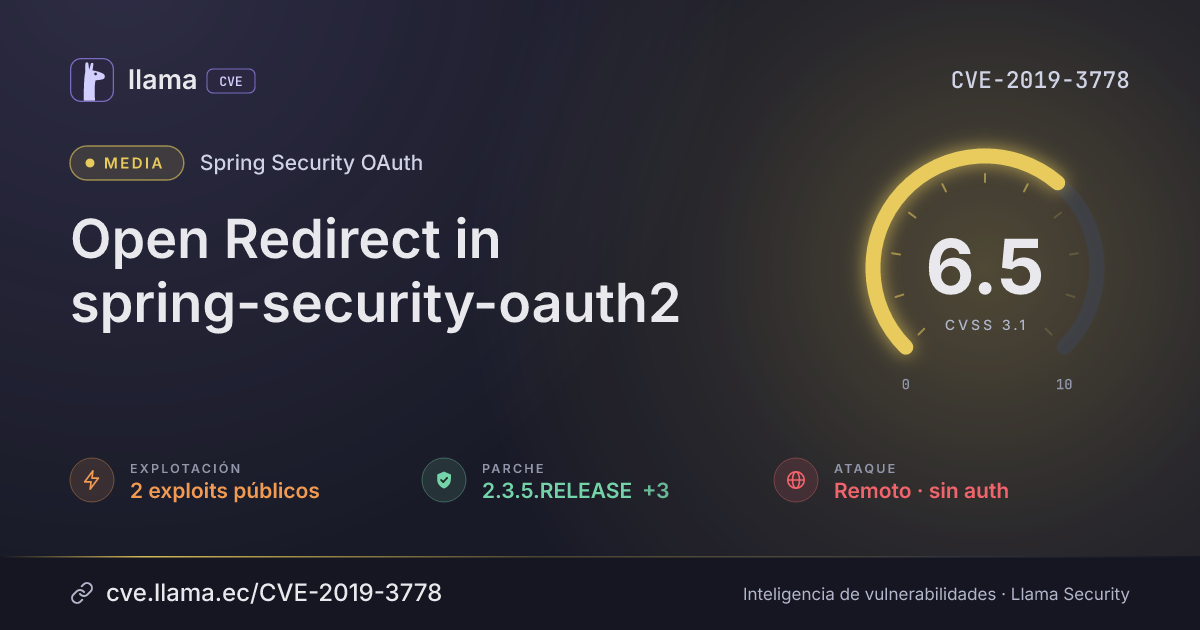
CVE-2019-3778
Open Redirect in spring-security-oauth2
CVSS:3.1/AV:N/AC:L/PR:N/UI:N/S:U/C:L/I:L/A:N
Fuente: NVD
Ciclo de vida de la vulnerabilidad
| Fecha | Fase | Evento | Detalle |
|---|---|---|---|
| Divulgación | Publicada | CVE-2019-3778 divulgada · CVSS 6.5 (NVD) | |
| Explotación | Exploit-DB | 1 exploit público | |
| Remediación | Parche 2.0.17.RELEASE | org.springframework.security.oauth:spring-security-oauth · 245 d desde divulgación | |
| Remediación | Parche 2.1.4.RELEASE | org.springframework.security.oauth:spring-security-oauth · 245 d desde divulgación | |
| Remediación | Parche 2.2.4.RELEASE | org.springframework.security.oauth:spring-security-oauth · 245 d desde divulgación | |
| Remediación | Parche 2.3.5.RELEASE | org.springframework.security.oauth:spring-security-oauth · 245 d desde divulgación | |
| Divulgación | Modificada | Última actualización del registro | |
| Explotación | Umbral EPSS | La probabilidad de explotación supera el 10 % | |
| Monitoreo | Detectada | Ingresó al índice | |
| Monitoreo | Verificada | Última verificación contra las fuentes |
Spring Security OAuth, versions 2.3 prior to 2.3.5, and 2.2 prior to 2.2.4, and 2.1 prior to 2.1.4, and 2.0 prior to 2.0.17, and older unsupported versions could be susceptible to an open redirector attack that can leak an authorization code. A malicious user or attacker can craft a request to the authorization endpoint using the authorization code grant type, and specify a manipulated redirection URI via the "redirect_uri" parameter. This can cause the authorization server to redirect the resource owner user-agent to a URI under the control of the attacker with the leaked authorization code. This vulnerability exposes applications that meet all of the following requirements: Act in the role of an Authorization Server (e.g. @EnableAuthorizationServer) and uses the DefaultRedirectResolver in the AuthorizationEndpoint. This vulnerability does not expose applications that: Act in the role of an Authorization Server and uses a different RedirectResolver implementation other than DefaultRedirectResolver, act in the role of a Resource Server only (e.g. @EnableResourceServer), act in the role of a Client only (e.g. @EnableOAuthClient).
Desglose de métricas
Rangos afectados
Estado del parche por paquete
| Paquete / producto | Estado | Corregida en | Desde divulgación | Última versión |
|---|---|---|---|---|
mavenorg.springframework.security.oauth:spring-security-oauth |
Corregida | 2.0.17.RELEASE, 2.1.4.RELEASE, 2.2.4.RELEASE, 2.3.5.RELEASE | 245 d · 245 d · 245 d · 245 d | 2.5.2.RELEASE no afectada |
mavenorg.springframework.security.oauth:spring-security-oauth2 |
Corregida | 2.0.17.RELEASE, 2.1.4.RELEASE, 2.2.4.RELEASE, 2.3.5.RELEASE | 245 d · 245 d · 245 d · 245 d | 2.5.2.RELEASE no afectada |
2.0.17.RELEASE2.1.4.RELEASE2.2.4.RELEASE2.3.5.RELEASEArsenal público
Ver los 1 repositorios de GitHub
Los repositorios públicos incluyen exploits, escáneres, laboratorios y reglas de detección. No ejecute código de terceros sin revisarlo en un entorno aislado.
http://packetstormsecurity.com/files/153299/Spring-Security-OAuth-2.3-Open-Redirection.htmlhttps://www.exploit-db.com/exploits/47000https://github.com/BBB-man/CVE-2019-3778-Spring-Security-OAuth-2.3-Open-Redirectionhttp://www.securityfocus.com/bid/107153https://www.oracle.com/security-alerts/cpujan2021.htmlhttps://pivotal.io/security/cve-2019-3778Las referencias externas se muestran para copiar: cve.llama.ec no lo redirige a otros sitios.