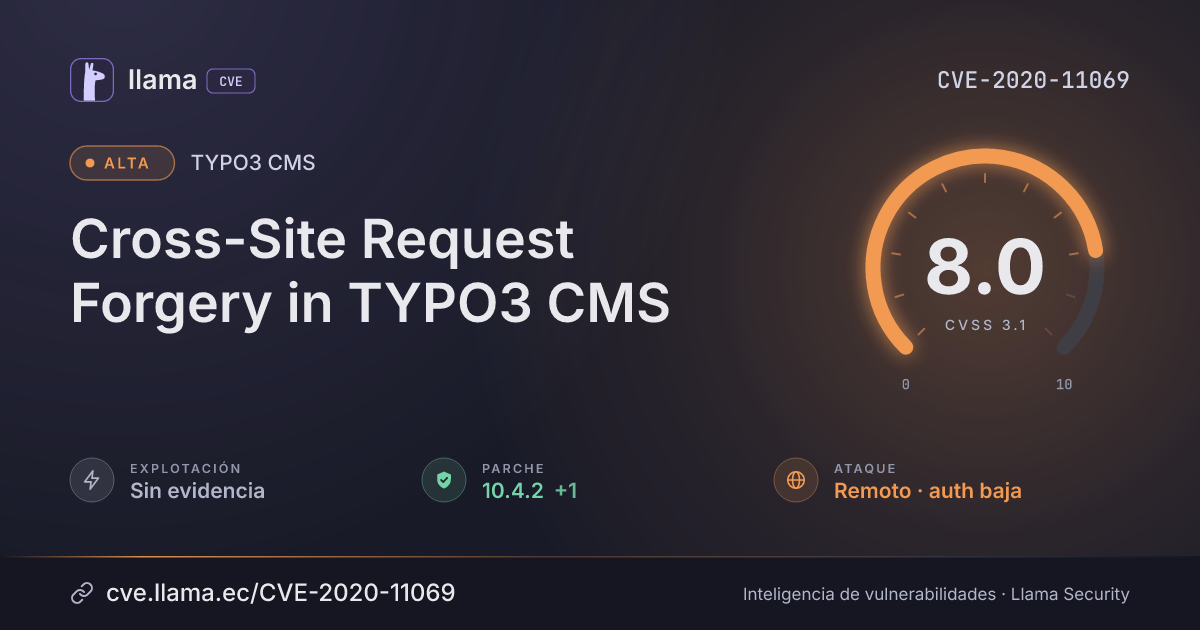
CVE-2020-11069
Cross-Site Request Forgery in TYPO3 CMS
CVSS:3.1/AV:N/AC:L/PR:L/UI:R/S:U/C:H/I:H/A:H
Fuente: CNA
Ciclo de vida de la vulnerabilidad
| Fecha | Fase | Evento | Detalle |
|---|---|---|---|
| Divulgación | Publicada | CVE-2020-11069 divulgada · CVSS 8 (CNA) | |
| Divulgación | Modificada | Última actualización del registro | |
| Monitoreo | Detectada | Ingresó al índice |
In TYPO3 CMS 9.0.0 through 9.5.16 and 10.0.0 through 10.4.1, it has been discovered that the backend user interface and install tool are vulnerable to a same-site request forgery. A backend user can be tricked into interacting with a malicious resource an attacker previously managed to upload to the web server. Scripts are then executed with the privileges of the victims' user session. In a worst-case scenario, new admin users can be created which can directly be used by an attacker. The vulnerability is basically a cross-site request forgery (CSRF) triggered by a cross-site scripting vulnerability (XSS) - but happens on the same target host - thus, it's actually a same-site request forgery. Malicious payload such as HTML containing JavaScript might be provided by either an authenticated backend user or by a non-authenticated user using a third party extension, e.g. file upload in a contact form with knowing the target location. To be successful, the attacked victim requires an active and valid backend or install tool user session at the time of the attack. This has been fixed in 9.5.17 and 10.4.2. The deployment of additional mitigation techniques is suggested as described below. - Sudo Mode Extension This TYPO3 extension intercepts modifications to security relevant database tables, e.g. those storing user accounts or storages of the file abstraction layer. Modifications need to confirmed again by the acting user providing their password again. This technique is known as sudo mode. This way, unintended actions happening in the background can be mitigated. - https://github.com/FriendsOfTYPO3/sudo-mode - https://extensions.typo3.org/extension/sudo_mode - Content Security Policy Content Security Policies tell (modern) browsers how resources served a particular site are handled. It is also possible to disallow script executions for specific locations. In a TYPO3 context, it is suggested to disallow direct script execution at least for locations /fileadmin/ and /uploads/.
Desglose de métricas
Rangos afectados
Estado del parche por paquete
| Paquete / producto | Estado | Corregida en | Desde divulgación | Última versión |
|---|---|---|---|---|
TYPO3 CMS |
Corregida | 9.5.17, 10.4.2 | — | — |
9.5.1710.4.2Arsenal público
Sin exploits, módulos ni PoC públicos conocidos a la fecha de verificación.
https://github.com/TYPO3/TYPO3.CMS/security/advisories/GHSA-pqg8-crx9-g8m4Las referencias externas se muestran para copiar: cve.llama.ec no lo redirige a otros sitios.