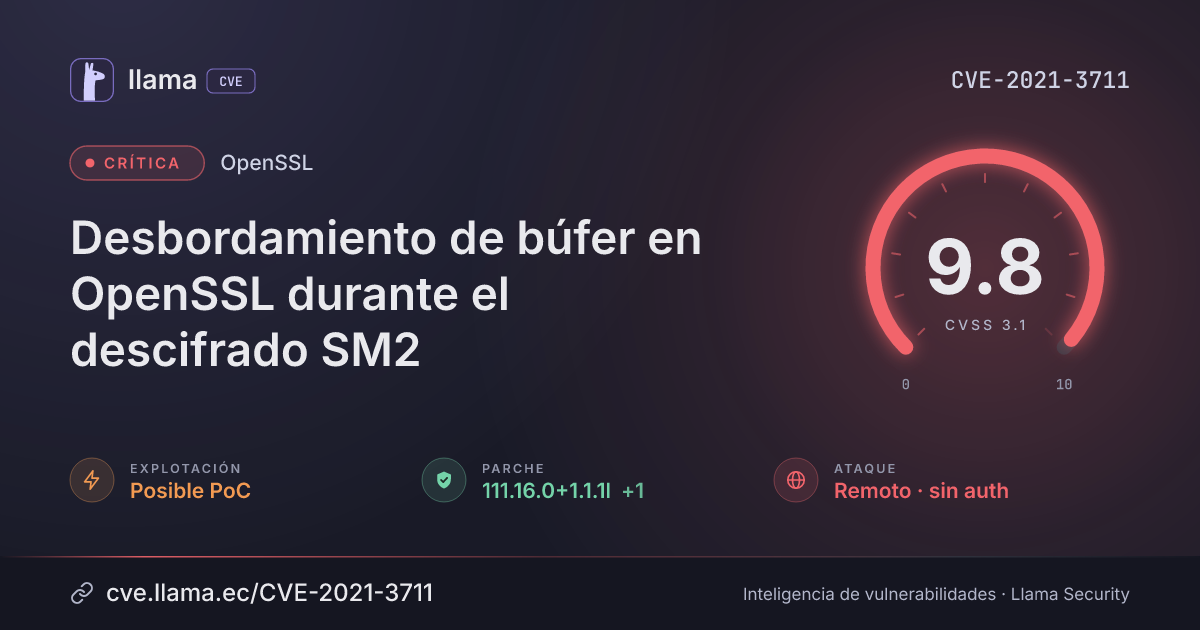
CVE-2021-3711
OpenSSL buffer overflow in SM2 decryption
Attackers can send crafted SM2 data to overflow a buffer by up to 62 bytes, altering nearby data or crashing.
Texto original en inglés · Ver en español
CVSS:3.1/AV:N/AC:L/PR:N/UI:N/S:U/C:H/I:H/A:H
Fuente: NVD
Ciclo de vida de la vulnerabilidad
| Fecha | Fase | Evento | Detalle |
|---|---|---|---|
| Divulgación | Publicada | CVE-2021-3711 divulgada · CVSS 9.8 (NVD) | |
| Remediación | Parche 111.16.0+1.1.1l | openssl-src · 0 d desde divulgación | |
| Divulgación | Evaluación SSVC | CISA-ADP · explotación ninguna | |
| Divulgación | Modificada | Última actualización del registro | |
| Explotación | Umbral EPSS | La probabilidad de explotación supera el 10 % | |
| Monitoreo | Detectada | Ingresó al índice | |
| Monitoreo | Fuente: PoC-in-GitHub | Registro visto por primera vez en PoC-in-GitHub | |
| Monitoreo | Verificada | Última verificación contra las fuentes |
In order to decrypt SM2 encrypted data an application is expected to call the API function EVP_PKEY_decrypt(). Typically an application will call this function twice. The first time, on entry, the "out" parameter can be NULL and, on exit, the "outlen" parameter is populated with the buffer size required to hold the decrypted plaintext. The application can then allocate a sufficiently sized buffer and call EVP_PKEY_decrypt() again, but this time passing a non-NULL value for the "out" parameter. A bug in the implementation of the SM2 decryption code means that the calculation of the buffer size required to hold the plaintext returned by the first call to EVP_PKEY_decrypt() can be smaller than the actual size required by the second call. This can lead to a buffer overflow when EVP_PKEY_decrypt() is called by the application a second time with a buffer that is too small. A malicious attacker who is able present SM2 content for decryption to an application could cause attacker chosen data to overflow the buffer by up to a maximum of 62 bytes altering the contents of other data held after the buffer, possibly changing application behaviour or causing the application to crash. The location of the buffer is application dependent but is typically heap allocated. Fixed in OpenSSL 1.1.1l (Affected 1.1.1-1.1.1k).
Desglose de métricas
Rangos afectados
Estado del parche por paquete
| Paquete / producto | Estado | Corregida en | Desde divulgación | Última versión |
|---|---|---|---|---|
crates.ioopenssl-src |
Corregida | 111.16.0+1.1.1l | 0 d | 110.0.0 afectada |
111.16.0111.16.0+1.1.1lArsenal público
Ver los 1 repositorios de GitHub
Los repositorios públicos incluyen exploits, escáneres, laboratorios y reglas de detección. No ejecute código de terceros sin revisarlo en un entorno aislado.
https://www.debian.org/security/2021/dsa-4963https://security.gentoo.org/glsa/202209-02https://security.gentoo.org/glsa/202210-02https://www.openssl.org/news/secadv/20210824.txthttps://git.openssl.org/gitweb/?p=openssl.git%3Ba=commitdiff%3Bh=59f5e75f3bced8fc0e130d72a3f582cf7b480b46http://www.openwall.com/lists/oss-security/2021/08/26/2https://github.com/federiconbaez/cortex9-openssl-sm2-plaintext-size-modelhttps://lists.apache.org/thread.html/r18995de860f0e63635f3008fd2a6aca82394249476d21691e7c59c9e%40%3Cdev.tomcat.apache.org%3Ehttps://lists.apache.org/thread.html/rad5d9f83f0d11fb3f8bb148d179b8a9ad7c6a17f18d70e5805a713d1%40%3Cdev.tomcat.apache.org%3Ehttps://security.netapp.com/advisory/ntap-20210827-0010/https://www.oracle.com/security-alerts/cpuoct2021.htmlhttps://www.tenable.com/security/tns-2021-16Ver 6 referencias más
https://www.oracle.com/security-alerts/cpujan2022.htmlhttps://security.netapp.com/advisory/ntap-20211022-0003/https://www.tenable.com/security/tns-2022-02https://www.oracle.com/security-alerts/cpuapr2022.htmlhttps://cert-portal.siemens.com/productcert/pdf/ssa-389290.pdfhttps://security.netapp.com/advisory/ntap-20240621-0006/Las referencias externas se muestran para copiar: cve.llama.ec no lo redirige a otros sitios.