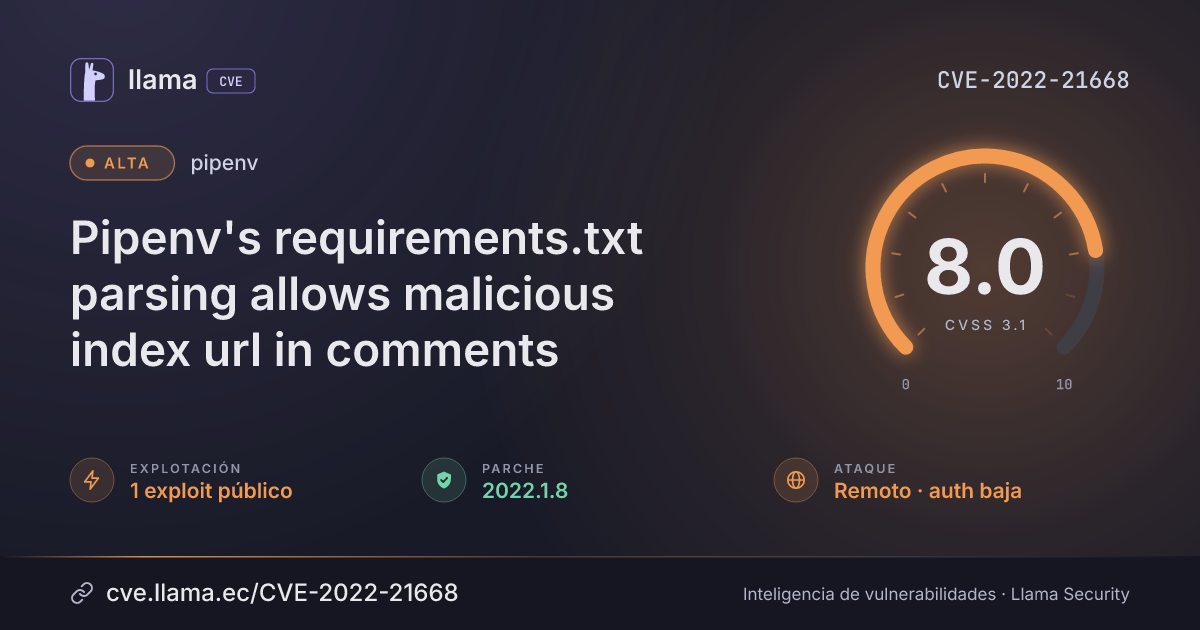
CVE-2022-21668
Pipenv's requirements.txt parsing allows malicious index url in comments
CVSS:3.1/AV:N/AC:H/PR:L/UI:R/S:C/C:H/I:H/A:H
Fuente: CNA
Ciclo de vida de la vulnerabilidad
| Fecha | Fase | Evento | Detalle |
|---|---|---|---|
| Remediación | Parche 2022.1.8 | pipenv · -2 d desde divulgación | |
| Divulgación | Publicada | CVE-2022-21668 divulgada · CVSS 8 (CNA) | |
| Divulgación | Modificada | Última actualización del registro | |
| Monitoreo | Detectada | Ingresó al índice |
pipenv is a Python development workflow tool. Starting with version 2018.10.9 and prior to version 2022.1.8, a flaw in pipenv's parsing of requirements files allows an attacker to insert a specially crafted string inside a comment anywhere within a requirements.txt file, which will cause victims who use pipenv to install the requirements file to download dependencies from a package index server controlled by the attacker. By embedding malicious code in packages served from their malicious index server, the attacker can trigger arbitrary remote code execution (RCE) on the victims' systems. If an attacker is able to hide a malicious `--index-url` option in a requirements file that a victim installs with pipenv, the attacker can embed arbitrary malicious code in packages served from their malicious index server that will be executed on the victim's host during installation (remote code execution/RCE). When pip installs from a source distribution, any code in the setup.py is executed by the install process. This issue is patched in version 2022.1.8. The GitHub Security Advisory contains more information about this vulnerability.
Desglose de métricas
Rangos afectados
Estado del parche por paquete
| Paquete / producto | Estado | Corregida en | Desde divulgación | Última versión |
|---|---|---|---|---|
pypipipenv |
Corregida | 2022.1.8 | -2 d | 2026.11.0 no afectada |
2022.1.8Arsenal público
Ver los 1 repositorios de GitHub
Los repositorios públicos incluyen exploits, escáneres, laboratorios y reglas de detección. No ejecute código de terceros sin revisarlo en un entorno aislado.
https://lists.fedoraproject.org/archives/list/package-announce%40lists.fedoraproject.org/message/QHQRIWKDP3SVJABAPEXBIQPKDI6UP7G4/https://lists.fedoraproject.org/archives/list/package-announce%40lists.fedoraproject.org/message/KCROBYHUS6DKQPCXBRPCZ5CDBNQTYAWT/https://lists.fedoraproject.org/archives/list/package-announce%40lists.fedoraproject.org/message/56HBA3EOSLEDNCCBJVHE6DO34P56EOUM/https://github.com/pypa/pipenv/security/advisories/GHSA-qc9x-gjcv-465whttps://github.com/sreeram281997/CVE-2022-21668-Pipenv-RCE-vulnerabilityhttps://github.com/pypa/pipenv/commit/439782a8ae36c4762c88e43d5f0d8e563371b46fhttps://github.com/pypa/pipenv/releases/tag/v2022.1.8Las referencias externas se muestran para copiar: cve.llama.ec no lo redirige a otros sitios.