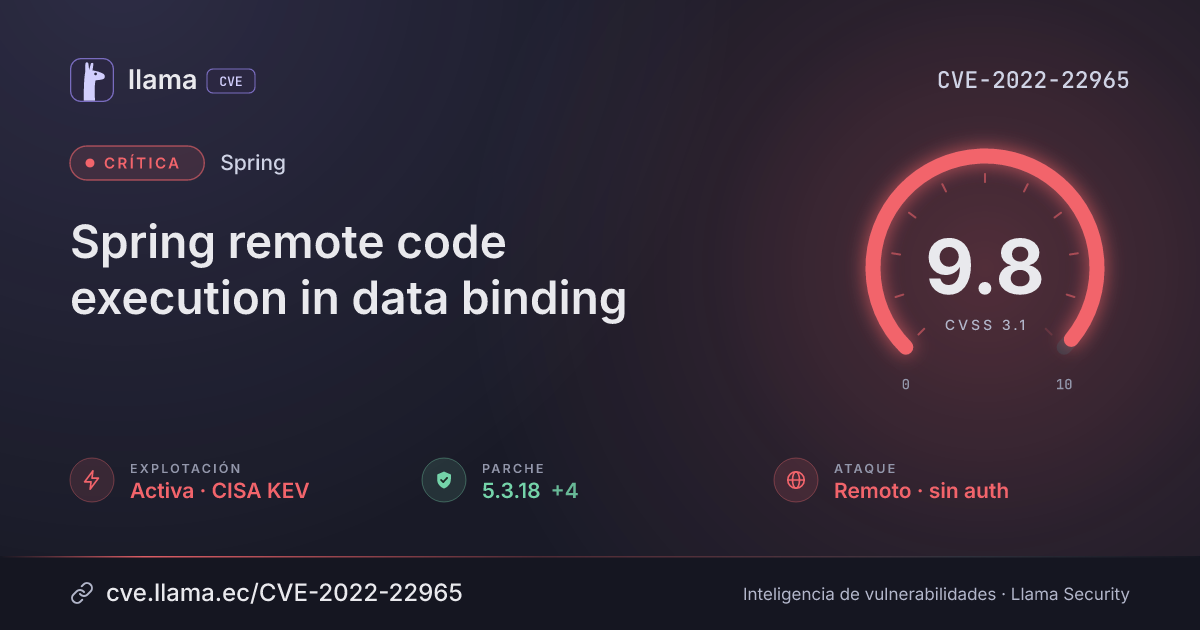
CVE-2022-22965
Spring remote code execution in data binding
An attacker can run arbitrary code on the server by sending crafted requests that abuse data binding.
CVSS:3.1/AV:N/AC:L/PR:N/UI:N/S:U/C:H/I:H/A:H
Fuente: NVD
Ciclo de vida de la vulnerabilidad
| Fecha | Fase | Evento | Detalle |
|---|---|---|---|
| Remediación | Parche 5.2.20.RELEASE | org.springframework:spring-beans · -1 d desde divulgación | |
| Remediación | Parche 5.3.18 | org.springframework:spring-beans · -1 d desde divulgación | |
| Remediación | Parche 2.5.12 | org.springframework.boot:spring-boot-starter-web · -1 d desde divulgación | |
| Remediación | Parche 2.6.6 | org.springframework.boot:spring-boot-starter-web · -1 d desde divulgación | |
| Divulgación | Publicada | CVE-2022-22965 divulgada · CVSS 9.8 (NVD) | |
| Explotación | CISA KEV | Agregada al catálogo de vulnerabilidades explotadas | |
| Remediación | Plazo KEV | Fecha límite de remediación para agencias federales (EE. UU.) | |
| Divulgación | Modificada | Última actualización del registro | |
| Explotación | Umbral EPSS | La probabilidad de explotación supera el 10 % | |
| Monitoreo | Detectada | Ingresó al índice | |
| Monitoreo | Verificada | Última verificación contra las fuentes |
Spring Framework applications using Spring MVC or Spring WebFlux on JDK 9 or later can be taken over through data binding, letting an attacker run code on the application server remotely without logging in. The known exploit needs a non-default setup, with the app deployed as a WAR on Tomcat rather than as a Spring Boot executable jar, and attacks are happening, since the bug is listed in CISA's Known Exploited Vulnerabilities catalog.
Affects Spring MVC and WebFlux applications on JDK 9+ using Spring Framework 5.3.0-5.3.17 or 5.2.19 and earlier; the known exploit needs Tomcat as a WAR. Fixed in 5.3.18 and 5.2.20.RELEASE.
Descripción original del registro
A Spring MVC or Spring WebFlux application running on JDK 9+ may be vulnerable to remote code execution (RCE) via data binding. The specific exploit requires the application to run on Tomcat as a WAR deployment. If the application is deployed as a Spring Boot executable jar, i.e. the default, it is not vulnerable to the exploit. However, the nature of the vulnerability is more general, and there may be other ways to exploit it.
Condiciones y alcance
Desglose de métricas
Rangos afectados
Estado del parche por paquete
| Paquete / producto | Estado | Corregida en | Desde divulgación | Última versión |
|---|---|---|---|---|
mavenorg.springframework:spring-beans |
Corregida | 5.2.20.RELEASE, 5.3.18 | -1 d · -1 d | 7.1.0 no afectada |
mavenorg.springframework:spring-webmvc |
Corregida | 5.2.20.RELEASE, 5.3.18 | -1 d · -1 d | 7.1.0 no afectada |
mavenorg.springframework.boot:spring-boot-starter-web |
Corregida | 2.5.12, 2.6.6 | -1 d · -1 d | 4.2.0 no afectada |
mavenorg.springframework:spring-webflux |
Corregida | 5.2.20.RELEASE, 5.3.18 | -1 d · -1 d | 7.1.0 no afectada |
mavenorg.springframework.boot:spring-boot-starter-webflux |
Corregida | 2.5.12, 2.6.6 | -1 d · -1 d | 4.2.0 no afectada |
2.5.122.6.65.1.25.2.20.RELEASE5.3.18Arsenal público
Sin exploits, módulos ni PoC públicos conocidos a la fecha de verificación.
https://tools.cisco.com/security/center/content/CiscoSecurityAdvisory/cisco-sa-java-spring-rce-Zx9GUc67http://packetstormsecurity.com/files/166713/Spring4Shell-Code-Execution.htmlhttp://packetstormsecurity.com/files/167011/Spring4Shell-Spring-Framework-Class-Property-Remote-Code-Execution.htmlhttps://tanzu.vmware.com/security/cve-2022-22965https://www.oracle.com/security-alerts/cpuapr2022.htmlhttps://psirt.global.sonicwall.com/vuln-detail/SNWLID-2022-0005https://cert-portal.siemens.com/productcert/pdf/ssa-254054.pdfhttps://www.oracle.com/security-alerts/cpujul2022.htmlLas referencias externas se muestran para copiar: cve.llama.ec no lo redirige a otros sitios.