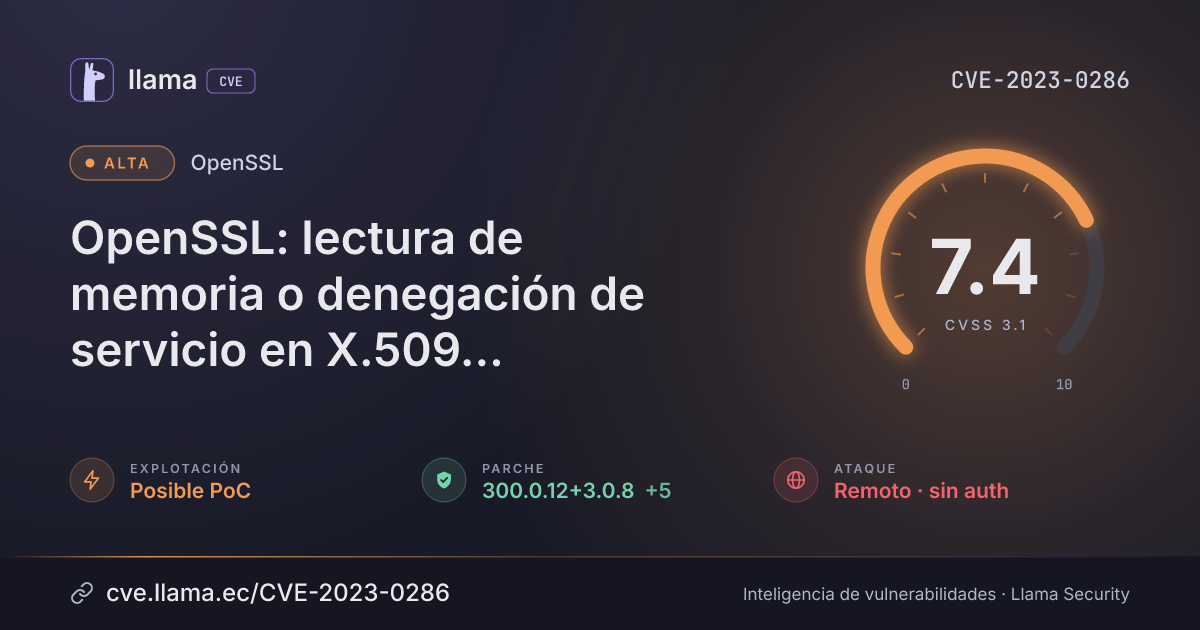
CVE-2023-0286
OpenSSL memory read or denial of service in X.509 GeneralName
A remote attacker can read memory or crash via a crafted certificate chain and CRL when CRL checking is on.
CVSS:3.1/AV:N/AC:H/PR:N/UI:N/S:U/C:H/I:N/A:H
Fuente: CISA-ADP
Ciclo de vida de la vulnerabilidad
| Fecha | Fase | Evento | Detalle |
|---|---|---|---|
| Remediación | Parche 39.0.1 | cryptography · -1 d desde divulgación | |
| Remediación | Parche 111.25.0+1.1.1t | openssl-src · -1 d desde divulgación | |
| Remediación | Parche 300.0.12+3.0.8 | openssl-src · -1 d desde divulgación | |
| Divulgación | Publicada | CVE-2023-0286 divulgada · CVSS 7.4 (CISA-ADP) | |
| Divulgación | Evaluación SSVC | CISA-ADP · explotación ninguna | |
| Divulgación | Modificada | Última actualización del registro | |
| Explotación | Umbral EPSS | La probabilidad de explotación supera el 10 % | |
| Monitoreo | Detectada | Ingresó al índice | |
| Monitoreo | Fuente: PoC-in-GitHub | Registro visto por primera vez en PoC-in-GitHub |
A type confusion bug in OpenSSL's handling of X.400 addresses inside X.509 GeneralName structures can be reached remotely, without logging in, by an attacker who supplies a certificate chain and CRL. When CRL checking is enabled, it can let the attacker read memory or cause a denial of service.
Affects OpenSSL 3.0, 1.1.1 and 1.0.2 when CRL checking is enabled, most likely in applications that fetch CRLs themselves. Fixed in OpenSSL 3.0.8.
Descripción original del registro
There is a type confusion vulnerability relating to X.400 address processing inside an X.509 GeneralName. X.400 addresses were parsed as an ASN1_STRING but the public structure definition for GENERAL_NAME incorrectly specified the type of the x400Address field as ASN1_TYPE. This field is subsequently interpreted by the OpenSSL function GENERAL_NAME_cmp as an ASN1_TYPE rather than an ASN1_STRING. When CRL checking is enabled (i.e. the application sets the X509_V_FLAG_CRL_CHECK flag), this vulnerability may allow an attacker to pass arbitrary pointers to a memcmp call, enabling them to read memory contents or enact a denial of service. In most cases, the attack requires the attacker to provide both the certificate chain and CRL, neither of which need to have a valid signature. If the attacker only controls one of these inputs, the other input must already contain an X.400 address as a CRL distribution point, which is uncommon. As such, this vulnerability is most likely to only affect applications which have implemented their own functionality for retrieving CRLs over a network.
Condiciones y alcance
Desglose de métricas
Rangos afectados
Estado del parche por paquete
| Paquete / producto | Estado | Corregida en | Desde divulgación | Última versión |
|---|---|---|---|---|
pypicryptography |
Corregida | 39.0.1 | -1 d | 50.0.2 no afectada |
crates.ioopenssl-src |
Corregida | 111.25.0+1.1.1t, 300.0.12+3.0.8 | -1 d · -1 d | 110.0.0 afectada |
1.0.2zg1.1.1t3.0.839.0.1111.25.0+1.1.1t300.0.12+3.0.8Arsenal público
Ver los 1 repositorios de GitHub
Los repositorios públicos incluyen exploits, escáneres, laboratorios y reglas de detección. No ejecute código de terceros sin revisarlo en un entorno aislado.
https://www.openssl.org/news/secadv/20230207.txthttps://git.openssl.org/gitweb/?p=openssl.git;a=commitdiff;h=2f7530077e0ef79d98718138716bc51ca0cad658https://git.openssl.org/gitweb/?p=openssl.git;a=commitdiff;h=2c6c9d439b484e1ba9830d8454a34fa4f80fdfe9https://git.openssl.org/gitweb/?p=openssl.git;a=commitdiff;h=fd2af07dc083a350c959147097003a14a5e8ac4dhttps://github.com/federiconbaez/cortex9-openssl-x400-generalname-type-confusion-modelhttps://ftp.openbsd.org/pub/OpenBSD/patches/7.2/common/018_x509.patch.sighttps://ftp.openbsd.org/pub/OpenBSD/LibreSSL/libressl-3.6.2-relnotes.txthttps://security.gentoo.org/glsa/202402-08https://psirt.global.sonicwall.com/vuln-detail/SNWLID-2023-0003https://cert-portal.siemens.com/productcert/html/ssa-203374.htmlhttps://cert-portal.siemens.com/productcert/html/ssa-794697.htmlhttps://cert-portal.siemens.com/productcert/html/ssa-561322.htmlVer 6 referencias más
https://cert-portal.siemens.com/productcert/html/ssa-264815.htmlhttps://cert-portal.siemens.com/productcert/html/ssa-398330.htmlhttps://cert-portal.siemens.com/productcert/html/ssa-943925.htmlhttps://cert-portal.siemens.com/productcert/html/ssa-455250.htmlhttps://cert-portal.siemens.com/productcert/html/ssa-556635.htmlhttps://cert-portal.siemens.com/productcert/html/ssa-879734.htmlLas referencias externas se muestran para copiar: cve.llama.ec no lo redirige a otros sitios.