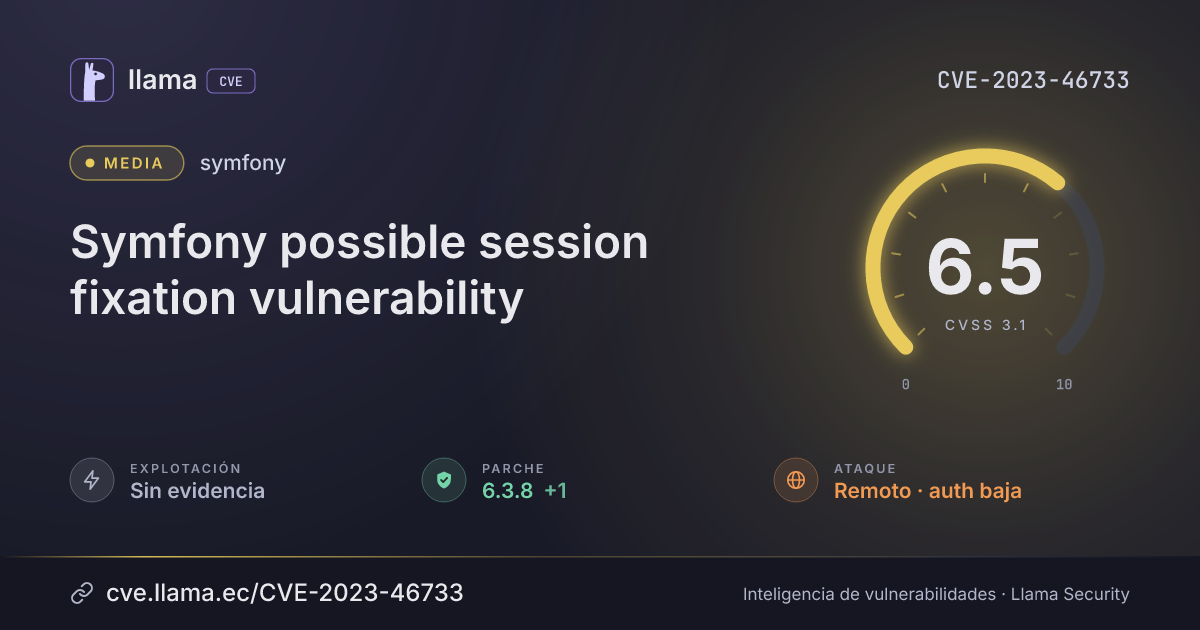
CVE-2023-46733
Symfony possible session fixation vulnerability
CVSS:3.1/AV:N/AC:L/PR:L/UI:N/S:U/C:N/I:H/A:N
Fuente: CNA
Ciclo de vida de la vulnerabilidad
| Fecha | Fase | Evento | Detalle |
|---|---|---|---|
| Divulgación | Publicada | CVE-2023-46733 divulgada · CVSS 6.5 (CNA) | |
| Divulgación | Evaluación SSVC | CISA-ADP · explotación ninguna | |
| Divulgación | Modificada | Última actualización del registro | |
| Monitoreo | Detectada | Ingresó al índice |
Symfony is a PHP framework for web and console applications and a set of reusable PHP components. Starting in versions 5.4.21 and 6.2.7 and prior to versions 5.4.31 and 6.3.8, `SessionStrategyListener` does not migrate the session after every successful login. It does so only in case the logged in user changes by means of checking the user identifier. In some use cases, the user identifier doesn't change between the verification phase and the successful login, while the token itself changes from one type (partially-authenticated) to another (fully-authenticated). When this happens, the session id should be regenerated to prevent possible session fixations, which is not the case at the moment. As of versions 5.4.31 and 6.3.8, Symfony now checks the type of the token in addition to the user identifier before deciding whether the session id should be regenerated.
Desglose de métricas
Rangos afectados
Estado del parche por paquete
| Paquete / producto | Estado | Corregida en | Desde divulgación | Última versión |
|---|---|---|---|---|
symfony |
Corregida | 5.4.31, 6.3.8 | — | — |
5.4.316.3.8Arsenal público
Sin exploits, módulos ni PoC públicos conocidos a la fecha de verificación.
https://github.com/symfony/symfony/security/advisories/GHSA-m2wj-r6g3-fxfxhttps://github.com/symfony/symfony/commit/7467bd7e3f888b333102bc664b5e02ef1e7f88b9https://github.com/symfony/symfony/commit/dc356499d5ceb86f7cf2b4c7f032eca97061ed74Las referencias externas se muestran para copiar: cve.llama.ec no lo redirige a otros sitios.