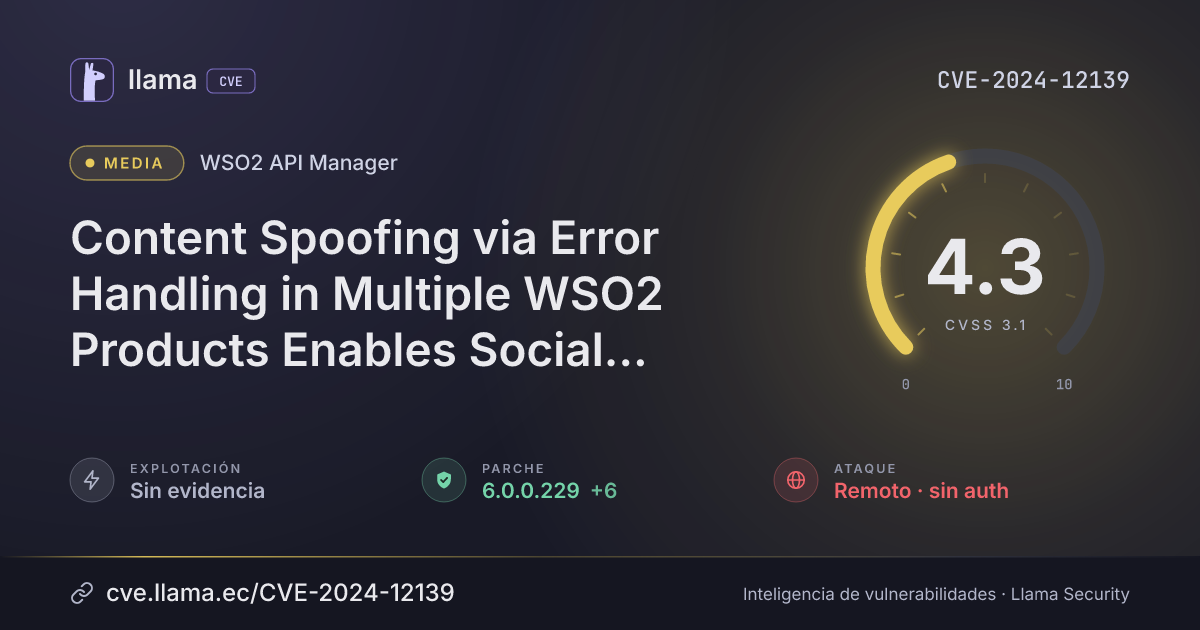
CVE-2024-12139
Content Spoofing via Error Handling in Multiple WSO2 Products Enables Social Engineering Attacks
CVSS:3.1/AV:N/AC:L/PR:N/UI:R/S:U/C:N/I:L/A:N
Fuente: CNA
Ciclo de vida de la vulnerabilidad
| Fecha | Fase | Evento | Detalle |
|---|---|---|---|
| Divulgación | Publicada | CVE-2024-12139 divulgada · CVSS 4.3 (CNA) | |
| Monitoreo | Detectada | Ingresó al índice | |
| Monitoreo | Fuente: NIST NVD | Registro visto por primera vez en NIST NVD | |
| Divulgación | Evaluación SSVC | CISA-ADP · explotación ninguna | |
| Divulgación | Modificada | Última actualización del registro | |
| Monitoreo | Fuente: ENISA EUVD | Registro visto por primera vez en ENISA EUVD | |
| Monitoreo | Verificada | Última verificación contra las fuentes |
This vulnerability affects multiple WSO2 products, which are enterprise identity and API management software. Attackers can abuse the error handling in these products by injecting arbitrary content into error messages through URL parameters, which can be used to trick users into revealing credentials or taking harmful actions.
Descripción original del registro (WSO2)
The error handling implementation fails to properly sanitize or validate user-supplied input within URL parameters under specific conditions. This allows end-users to manipulate the error messages that are displayed by the application. By exploiting this vulnerability, malicious actors can inject arbitrary content into error messages. This enables them to perform social engineering attacks, such as phishing or credential theft, by replacing legitimate error messages with malicious content, misleading users into compromising sensitive information or taking harmful actions.
Desglose de métricas
Rangos afectados
Estado del parche por paquete
| Paquete / producto | Estado | Corregida en | Desde divulgación | Última versión |
|---|---|---|---|---|
WSO2 API Manager |
Corregida | 3.2.1.49, 4.1.0.210, 4.2.0.148 | — | — |
WSO2 Identity Server |
Corregida | 5.10.0.346, 5.11.0.385, 6.0.0.229 | — | — |
WSO2 Identity Server as Key Manager |
Corregida | 5.10.0.339 | — | — |
3.2.1.494.1.0.2104.2.0.1485.10.0.3395.10.0.3465.11.0.3856.0.0.229Arsenal público
Sin exploits, módulos ni PoC públicos conocidos a la fecha de verificación.
https://security.docs.wso2.com/en/latest/security-announcements/security-advisories/2026/WSO2-2024-3805/Las referencias externas se muestran para copiar: cve.llama.ec no lo redirige a otros sitios.