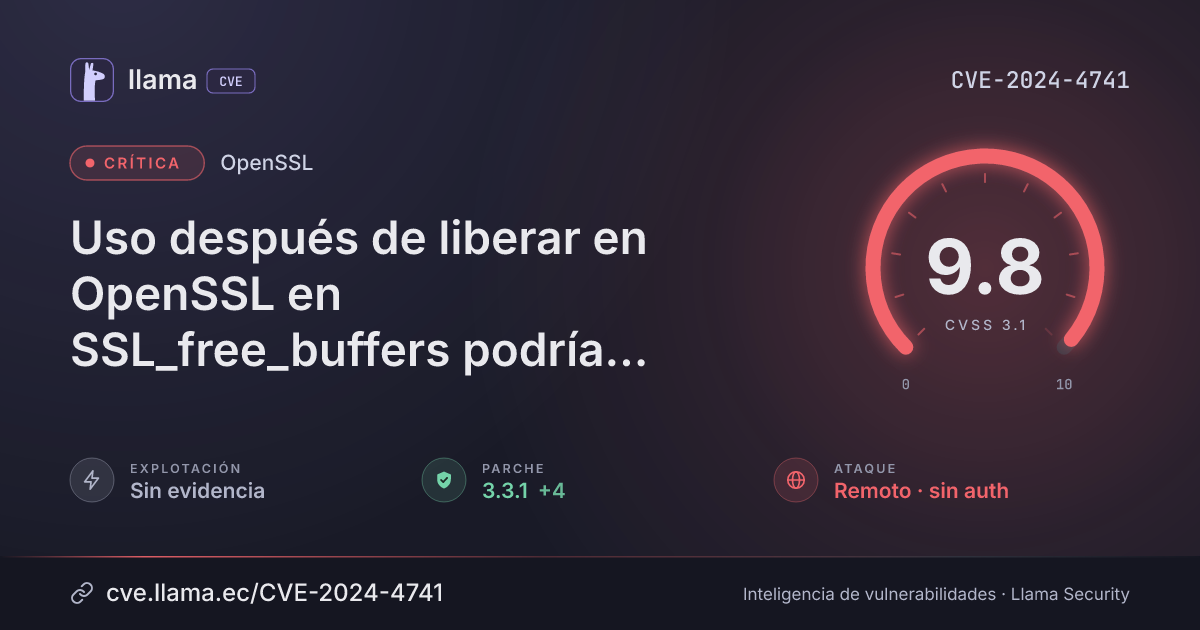
CVE-2024-4741
OpenSSL use-after-free in SSL_free_buffers risks code execution
A remote attacker can corrupt data, crash apps, or possibly run code in apps that call SSL_free_buffers.
CVSS:3.1/AV:N/AC:L/PR:N/UI:N/S:U/C:H/I:H/A:H
Fuente: CISA-ADP
Ciclo de vida de la vulnerabilidad
| Fecha | Fase | Evento | Detalle |
|---|---|---|---|
| Divulgación | Publicada | CVE-2024-4741 divulgada · CVSS 9.8 (CISA-ADP) | |
| Monitoreo | Detectada | Ingresó al índice | |
| Divulgación | Evaluación SSVC | CISA-ADP · explotación ninguna | |
| Divulgación | Modificada | Última actualización del registro | |
| Monitoreo | Fuente: OSV | Registro visto por primera vez en OSV | |
| Monitoreo | Verificada | Última verificación contra las fuentes |
Applications that use OpenSSL and directly call the rarely used SSL_free_buffers function can be made to access freed memory, which an attacker could use to corrupt data, crash the application, or potentially run arbitrary code. The attack can be carried out remotely over the network without logging in, but it only works in a non-default setup where the application calls that function while a network record is only partly processed or partly read.
Only affects applications that directly call SSL_free_buffers, on OpenSSL 3.0 to 3.3 and 1.1.1; 1.0.2 and the FIPS modules are not affected. Fixed in 3.3.1, 3.2.2, 3.1.6, 3.0.14 and 1.1.1y.
Descripción original del registro (openssl)
Issue summary: Calling the OpenSSL API function SSL_free_buffers may cause memory to be accessed that was previously freed in some situations Impact summary: A use after free can have a range of potential consequences such as the corruption of valid data, crashes or execution of arbitrary code. However, only applications that directly call the SSL_free_buffers function are affected by this issue. Applications that do not call this function are not vulnerable. Our investigations indicate that this function is rarely used by applications. The SSL_free_buffers function is used to free the internal OpenSSL buffer used when processing an incoming record from the network. The call is only expected to succeed if the buffer is not currently in use. However, two scenarios have been identified where the buffer is freed even when still in use. The first scenario occurs where a record header has been received from the network and processed by OpenSSL, but the full record body has not yet arrived. In this case calling SSL_free_buffers will succeed even though a record has only been partially processed and the buffer is still in use. The second scenario occurs where a full record containing application data has been received and processed by OpenSSL but the application has only read part of this data. Again a call to SSL_free_buffers will succeed even though the buffer is still in use. While these scenarios could occur accidentally during normal operation a malicious attacker could attempt to engineer a stituation where this occurs. We are not aware of this issue being actively exploited. The FIPS modules in 3.3, 3.2, 3.1 and 3.0 are not affected by this issue.
Condiciones y alcance
Desglose de métricas
Rangos afectados
Estado del parche por paquete
| Paquete / producto | Estado | Corregida en | Desde divulgación | Última versión |
|---|---|---|---|---|
OpenSSL |
Corregida | 1.1.1y, 3.0.14, 3.1.6, 3.2.2, 3.3.1 | — | — |
1.1.1y3.0.143.1.63.2.23.3.1Arsenal público
Sin exploits, módulos ni PoC públicos conocidos a la fecha de verificación.
https://www.openssl.org/news/secadv/20240528.txthttps://github.openssl.org/openssl/extended-releases/commit/f7a045f3143fc6da2ee66bf52d8df04829590dd4https://github.com/openssl/openssl/commit/e5093133c35ca82874ad83697af76f4b0f7e3bd8https://github.com/openssl/openssl/commit/c88c3de51020c37e8706bf7a682a162593053aachttps://github.com/openssl/openssl/commit/704f725b96aa373ee45ecfb23f6abfe8be8d9177https://github.com/openssl/openssl/commit/b3f0eb0a295f58f16ba43ba99dad70d4ee5c437dhttps://lists.debian.org/debian-lts-announce/2024/11/msg00000.htmlhttps://lists.debian.org/debian-lts-announce/2024/10/msg00033.htmlhttps://security.netapp.com/advisory/ntap-20240621-0004/Las referencias externas se muestran para copiar: cve.llama.ec no lo redirige a otros sitios.