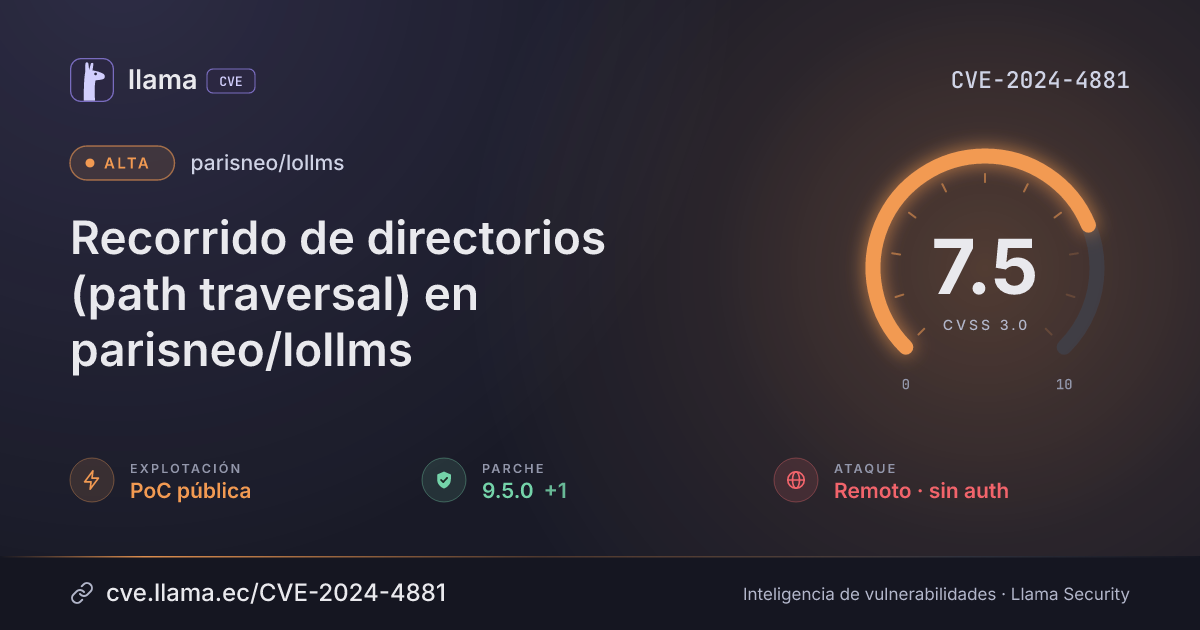
CVE-2024-4881
Path Traversal in parisneo/lollms
CVSS:3.0/AV:N/AC:L/PR:N/UI:N/S:U/C:H/I:N/A:N
Fuente: CNA
Ciclo de vida de la vulnerabilidad
| Fecha | Fase | Evento | Detalle |
|---|---|---|---|
| Divulgación | Publicada | CVE-2024-4881 divulgada · CVSS 7.5 (CNA) | |
| Divulgación | Evaluación SSVC | CISA-ADP · explotación PoC pública | |
| Remediación | Parche 9.5.0 | lollms · 4 d desde divulgación | |
| Divulgación | Modificada | Última actualización del registro | |
| Monitoreo | Detectada | Ingresó al índice |
A path traversal vulnerability exists in the parisneo/lollms application, affecting version 9.4.0 and potentially earlier versions, but fixed in version 5.9.0. The vulnerability arises due to improper validation of file paths between Windows and Linux environments, allowing attackers to traverse beyond the intended directory and read any file on the Windows system. Specifically, the application fails to adequately sanitize file paths containing backslashes (`\`), which can be exploited to access the root directory and read, or even delete, sensitive files. This issue was discovered in the context of the `/user_infos` endpoint, where a crafted request using backslashes to reference a file (e.g., `\windows\win.ini`) could result in unauthorized file access. The impact of this vulnerability includes the potential for attackers to access sensitive information such as environment variables, database files, and configuration files, which could lead to further compromise of the system.
Desglose de métricas
Rangos afectados
Estado del parche por paquete
| Paquete / producto | Estado | Corregida en | Desde divulgación | Última versión |
|---|---|---|---|---|
pypilollms |
Corregida | 9.5.0 | 4 d | 11.0.0 no afectada |
5.9.09.5.0Arsenal público
Sin exploits, módulos ni PoC públicos conocidos a la fecha de verificación.
https://huntr.com/bounties/94f7f901-80b0-4cf5-b545-ac5c1e7635e9https://github.com/parisneo/lollms/commit/95ad36eeffc6a6be3e3f35ed35a384d768f0ecf6Las referencias externas se muestran para copiar: cve.llama.ec no lo redirige a otros sitios.