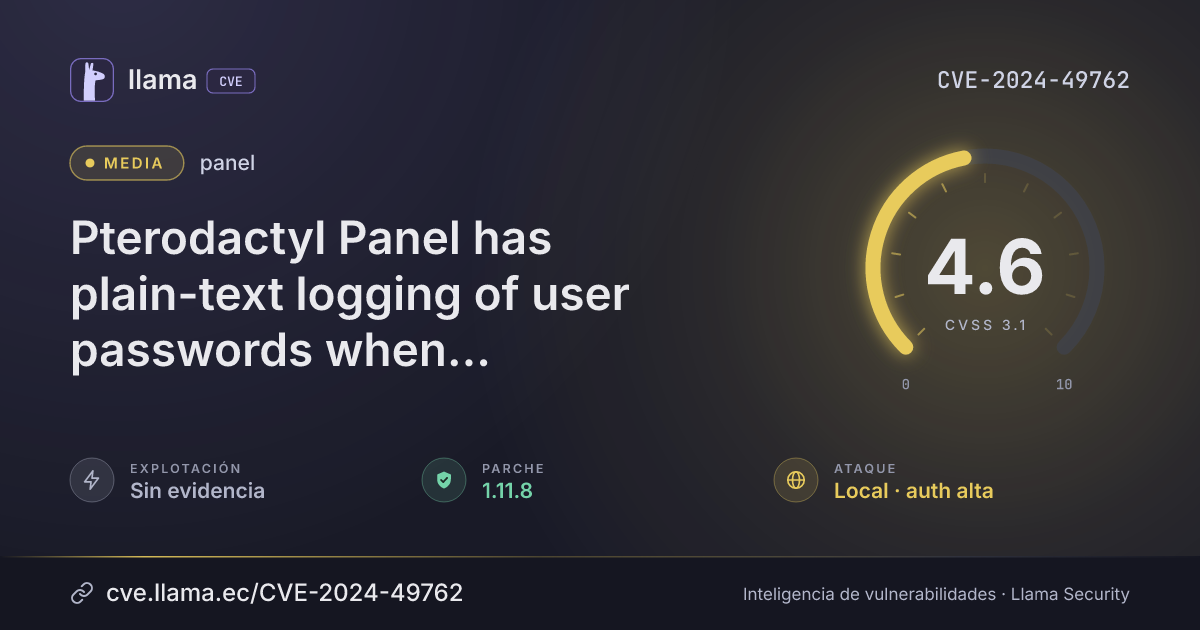
CVE-2024-49762
Pterodactyl Panel has plain-text logging of user passwords when two-factor authentication is disabled
CVSS:3.1/AV:L/AC:L/PR:H/UI:N/S:C/C:L/I:L/A:N
Fuente: CNA
Ciclo de vida de la vulnerabilidad
| Fecha | Fase | Evento | Detalle |
|---|---|---|---|
| Divulgación | Publicada | CVE-2024-49762 divulgada · CVSS 4.6 (CNA) | |
| Divulgación | Evaluación SSVC | CISA-ADP · explotación ninguna | |
| Divulgación | Modificada | Última actualización del registro | |
| Monitoreo | Detectada | Ingresó al índice |
Pterodactyl is a free, open-source game server management panel. When a user disables two-factor authentication via the Panel, a `DELETE` request with their current password in a query parameter will be sent. While query parameters are encrypted when using TLS, many webservers (including ones officially documented for use with Pterodactyl) will log query parameters in plain-text, storing a user's password in plain text. Prior to version 1.11.8, if a malicious user obtains access to these logs they could potentially authenticate against a user's account; assuming they are able to discover the account's email address or username separately. This problem has been patched in version 1.11.8. There are no workarounds at this time. There is not a direct vulnerability within the software as it relates to logs generated by intermediate components such as web servers or Layer 7 proxies. Updating to `v1.11.8` or adding the linked patch manually are the only ways to avoid this problem. As this vulnerability relates to historical logging of sensitive data, users who have ever disabled 2FA on a Panel (self-hosted or operated by a company) should change their passwords and consider enabling 2FA if it was left disabled. While it's unlikely that their account swill be compromised by this vulnerability, it's not impossible. Panel administrators should consider clearing any access logs that may contain sensitive data.
Desglose de métricas
Rangos afectados
Estado del parche por paquete
| Paquete / producto | Estado | Corregida en | Desde divulgación | Última versión |
|---|---|---|---|---|
panel |
Corregida | 1.11.8 | — | — |
1.11.8Arsenal público
Sin exploits, módulos ni PoC públicos conocidos a la fecha de verificación.
https://github.com/pterodactyl/panel/security/advisories/GHSA-c479-wq8g-57hrhttps://github.com/pterodactyl/panel/commit/75b59080e2812ced677dab516222b2a3bb34e3a4https://github.com/pterodactyl/panel/commit/8be2b892c3940bdc0157ccdab16685a72d105dd1Las referencias externas se muestran para copiar: cve.llama.ec no lo redirige a otros sitios.