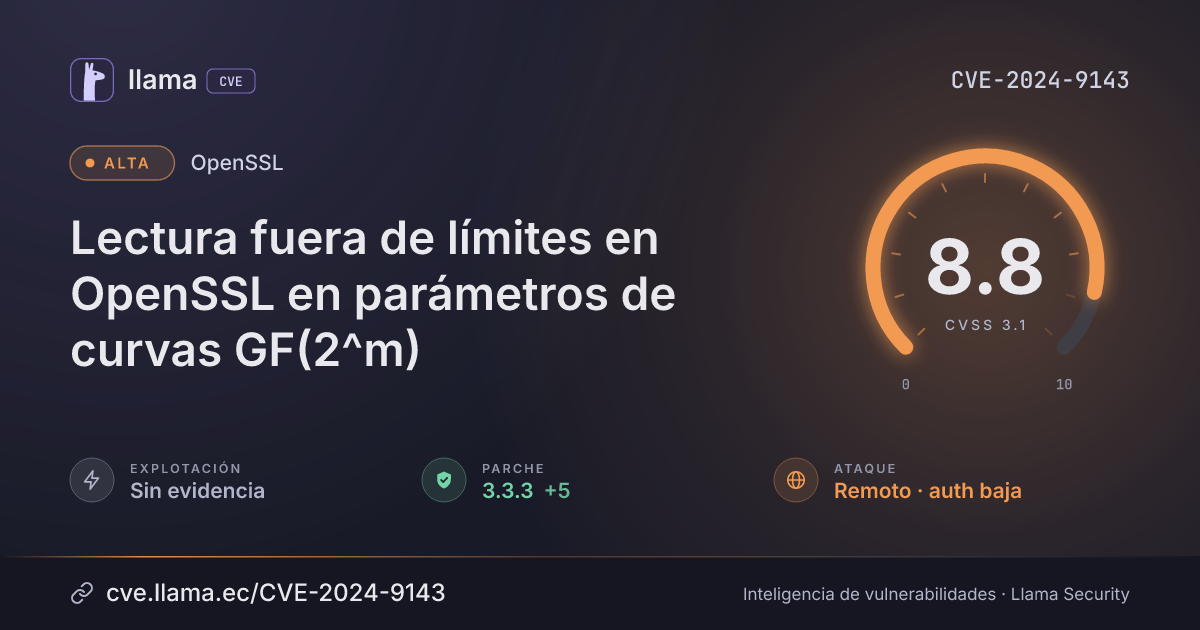
CVE-2024-9143
OpenSSL out-of-bounds read in GF(2^m) curve parameters
An attacker supplying crafted explicit binary curve parameters can crash an application or possibly run code remotely.
Texto original en inglés · Ver en español
CVSS:3.1/AV:N/AC:L/PR:L/UI:N/S:U/C:H/I:H/A:H
Fuente: CISA-ADP
Ciclo de vida de la vulnerabilidad
| Fecha | Fase | Evento | Detalle |
|---|---|---|---|
| Divulgación | Publicada | CVE-2024-9143 divulgada · CVSS 8.8 (CISA-ADP) | |
| Monitoreo | Detectada | Ingresó al índice | |
| Monitoreo | Fuente: OSV | Registro visto por primera vez en OSV | |
| Divulgación | Evaluación SSVC | CISA-ADP · explotación ninguna | |
| Divulgación | Modificada | Última actualización del registro | |
| Explotación | Umbral EPSS | La probabilidad de explotación supera el 10 % | |
| Monitoreo | Verificada | Última verificación contra las fuentes |
The OpenSSL elliptic curve APIs for binary (GF(2^m)) curves can be made to read or write outside array bounds when given untrusted, explicitly specified field polynomials. An attacker who can reach such an application over the network, with low-privilege login and no user action, could crash it or potentially execute code, though exploitation is considered unlikely because standard protocols and X.509 certificates cannot express the problematic values.
Only applications calling OpenSSL's low-level GF(2^m) elliptic curve APIs with untrusted explicit curve parameters are affected. Fixed in 3.3.3, 3.2.4, 3.1.8, 3.0.16, 1.1.1zb and 1.0.2zl.
Descripción original del registro (openssl)
Issue summary: Use of the low-level GF(2^m) elliptic curve APIs with untrusted explicit values for the field polynomial can lead to out-of-bounds memory reads or writes. Impact summary: Out of bound memory writes can lead to an application crash or even a possibility of a remote code execution, however, in all the protocols involving Elliptic Curve Cryptography that we're aware of, either only "named curves" are supported, or, if explicit curve parameters are supported, they specify an X9.62 encoding of binary (GF(2^m)) curves that can't represent problematic input values. Thus the likelihood of existence of a vulnerable application is low. In particular, the X9.62 encoding is used for ECC keys in X.509 certificates, so problematic inputs cannot occur in the context of processing X.509 certificates. Any problematic use-cases would have to be using an "exotic" curve encoding. The affected APIs include: EC_GROUP_new_curve_GF2m(), EC_GROUP_new_from_params(), and various supporting BN_GF2m_*() functions. Applications working with "exotic" explicit binary (GF(2^m)) curve parameters, that make it possible to represent invalid field polynomials with a zero constant term, via the above or similar APIs, may terminate abruptly as a result of reading or writing outside of array bounds. Remote code execution cannot easily be ruled out. The FIPS modules in 3.3, 3.2, 3.1 and 3.0 are not affected by this issue.
Condiciones y alcance
Desglose de métricas
Rangos afectados
Estado del parche por paquete
| Paquete / producto | Estado | Corregida en | Desde divulgación | Última versión |
|---|---|---|---|---|
OpenSSL |
Corregida | 1.0.2zl, 1.1.1zb, 3.0.16, 3.1.8, 3.2.4, 3.3.3 | — | — |
1.0.2zl1.1.1zb3.0.163.1.83.2.43.3.3Arsenal público
Sin exploits, módulos ni PoC públicos conocidos a la fecha de verificación.
https://openssl-library.org/news/secadv/20241016.txthttps://github.openssl.org/openssl/extended-releases/commit/8efc0cbaa8ebba8e116f7b81a876a4123594d86ahttps://github.openssl.org/openssl/extended-releases/commit/9d576994cec2b7aa37a91740ea7e680810957e41https://github.com/openssl/openssl/commit/c0d3e4d32d2805f49bec30547f225bc4d092e1f4https://github.com/openssl/openssl/commit/bc7e04d7c8d509fb78fc0e285aa948fb0da04700https://github.com/openssl/openssl/commit/fdf6723362ca51bd883295efe206cb5b1cfa5154https://github.com/openssl/openssl/commit/72ae83ad214d2eef262461365a1975707f862712http://www.openwall.com/lists/oss-security/2024/10/16/1http://www.openwall.com/lists/oss-security/2024/10/23/1http://www.openwall.com/lists/oss-security/2024/10/24/1https://security.netapp.com/advisory/ntap-20241101-0001/https://lists.debian.org/debian-lts-announce/2024/11/msg00000.htmlVer 5 referencias más
https://lists.debian.org/debian-lts-announce/2024/10/msg00033.htmlhttps://cert-portal.siemens.com/productcert/html/ssa-398330.htmlhttps://cert-portal.siemens.com/productcert/html/ssa-265688.htmlhttps://cert-portal.siemens.com/productcert/html/ssa-769027.htmlhttps://cert-portal.siemens.com/productcert/html/ssa-277137.htmlLas referencias externas se muestran para copiar: cve.llama.ec no lo redirige a otros sitios.