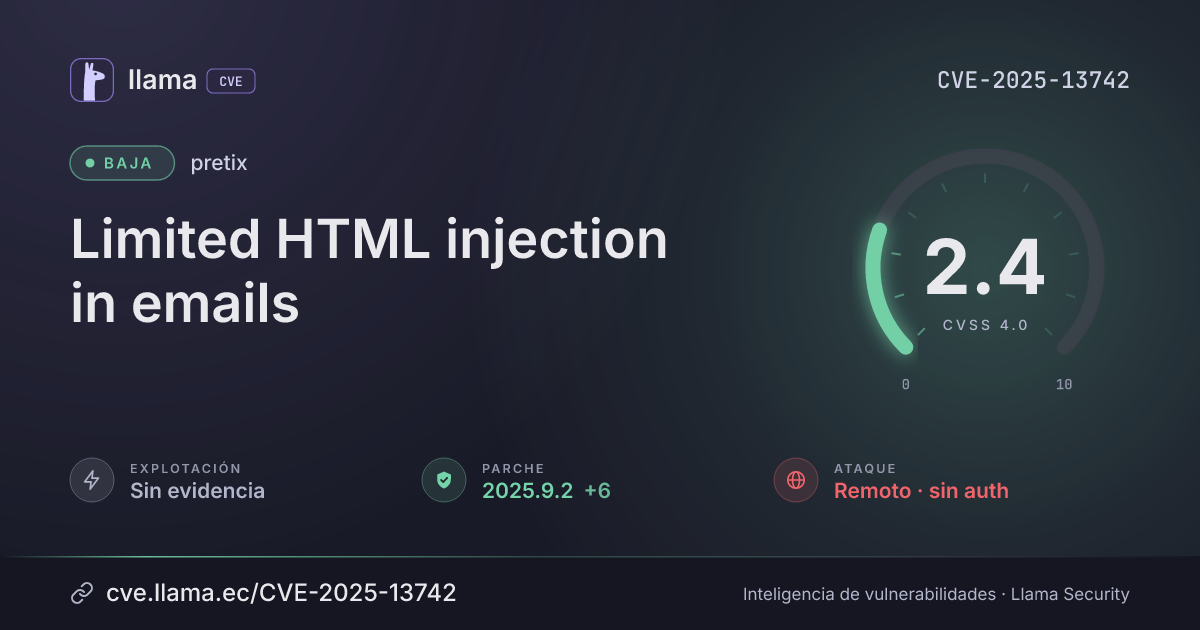
CVSS:4.0/AV:N/AC:L/AT:P/PR:N/UI:P/VC:H/VI:L/VA:L/SC:N/SI:L/SA:L/E:U
Fuente: CNA
CVSS:3.1/AV:N/AC:L/PR:N/UI:R/S:C/C:L/I:L/A:NCiclo de vida de la vulnerabilidad
| Fecha | Fase | Evento | Detalle |
|---|---|---|---|
| Divulgación | Publicada | CVE-2025-13742 divulgada · CVSS 2.4 (CNA) | |
| Remediación | Parche 2025.7.3 | pretix · 0 d desde divulgación | |
| Remediación | Parche 2025.8.2 | pretix · 0 d desde divulgación | |
| Remediación | Parche 2025.9.2 | pretix · 0 d desde divulgación | |
| Divulgación | Evaluación SSVC | CISA-ADP · explotación ninguna | |
| Divulgación | Modificada | Última actualización del registro | |
| Monitoreo | Detectada | Ingresó al índice | |
| Monitoreo | Verificada | Última verificación contra las fuentes |
Emails sent by pretix can utilize placeholders that will be filled with customer data. For example, when {name} is used in an email template, it will be replaced with the buyer's name for the final email. If the name of the attendee contained HTML or Markdown formatting, this was rendered as HTML in the resulting email. This way, a user could inject links or other formatted text through a maliciously formatted name. Since pretix applies a strict allow list approach to allowed HTML tags, this could not be abused for XSS or similarly dangerous attack chains. However, it can be used to manipulate emails in a way that makes user-provided content appear in a trustworthy and credible way, which can be abused for phishing.
Desglose de métricas
Rangos afectados
Estado del parche por paquete
| Paquete / producto | Estado | Corregida en | Desde divulgación | Última versión |
|---|---|---|---|---|
pypipretix |
Corregida | 2025.7.3, 2025.8.2, 2025.9.2 | 0 d · 0 d · 0 d | 2026.9.1 no afectada |
2025.7.02025.7.22025.7.32025.8.12025.8.22025.9.12025.9.2Arsenal público
Sin exploits, módulos ni PoC públicos conocidos a la fecha de verificación.
https://pretix.eu/about/en/blog/20251126-release-2025-9-1/Las referencias externas se muestran para copiar: cve.llama.ec no lo redirige a otros sitios.