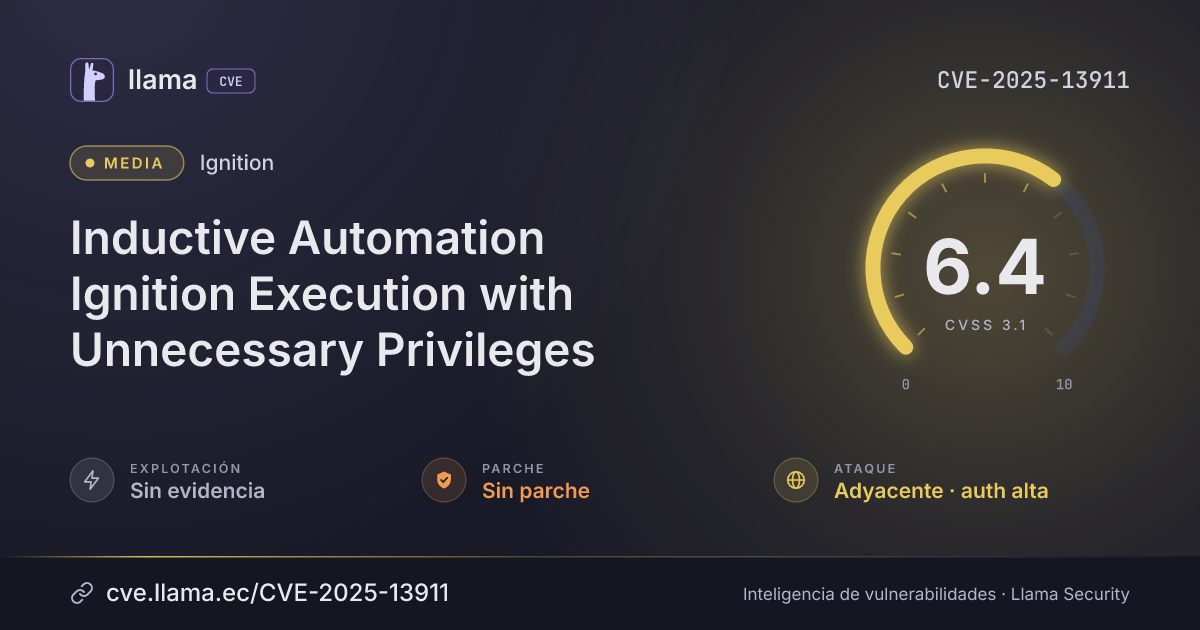
ExplotaciónSin evidenciaSSVC: none · no figura en CISA KEV
Exploits públicos0Ninguno conocido
ParcheSin parcheEl fabricante no ha publicado corrección
Exposición335 dDesde la divulgación, 18 dic 2025, 3:24 p. m.
Detección333 dDesde la divulgación hasta su ingreso al índice
Decisión SSVCSeguir de cerca
Monitorear y programar la remediación
Sin explotación conocida, no automatizable e impacto técnico total. No hay versión corregida: aplique mitigaciones.
Timeline
Ciclo de vida de la vulnerabilidad
Hoy
Divulgación
Publicada +1
Modificada
Explotación
Remediación
Monitoreo
Detectada
18 dic 25
27 ago 26
17 nov 26
19 nov 26
18 dic 25
12 mar 26
4 jun 26
27 ago 26
19 nov 26
Fecha
Fase
Evento
Detalle
Divulgación
Publicada
CVE-2025-13911 divulgada · CVSS 6.4 (CNA)
Divulgación
Evaluación SSVC
CISA-ADP · explotación ninguna
Divulgación
Modificada
Última actualización del registro
Monitoreo
Detectada
Ingresó al índice
Resumen
Ignition by Inductive Automation, when installed with default OS service
account settings, may expose the host system to an elevated code
execution risk via the gateway backup restore functionality. An
authenticated user with Gateway Administrator privileges can import a
malicious gateway backup (.gwbk) file containing crafted project
resources, scripts, or modules, resulting in code execution on the host
system. This affects both Windows and Linux installations. On Windows,
default installations often run the Ignition service as NT
AUTHORITY\SYSTEM, resulting in code execution with full local system
privileges. On Linux, default installations commonly run the Ignition
service as root or with elevated privileges. Specific privilege level
depends on installation configuration.
Vector CVSS 3.1
Desglose de métricas
Opción resaltada = valor del vector · izquierda = peor caso · CNA
Vector de ataqueAV:A
RedAdyacenteLocalFísica
ComplejidadAC:H
BajaAlta
PrivilegiosPR:H
NingunoBajosAltos
InteracciónUI:N
NingunaRequerida
AlcanceS:U
CambiadoSin cambio
ConfidencialidadC:H
AltoBajoNinguno
IntegridadI:H
AltoBajoNinguno
DisponibilidadA:H
AltoBajoNinguno
Versiones
Versiones afectadas
8.1.x8.3.x
Remediación
Estado del parche por paquete
Paquete / producto
Estado
Corregida en
Desde divulgación
Última versión
Ignition
Sin parche
—
—
—
Explotación
Arsenal público
Sin exploits, módulos ni PoC públicos conocidos a la fecha de verificación.
Registro
EscenarioGENERALicscert
MitigaciónInductive Automation encourages users to do the following in order to reduce the risk of this vulnerability:
* Create a new dedicated local Windows account that will be used
exclusively for the Ignition service (e.g. svc-ign) (this should not be a
domain account).
*
Remove all group memberships from the service account (including Users and Administrators).
* Add to security policy to log in as a service.
* Add to “Deny log on locally” security policy.
*
Provide full read/write access only to the Ignition installation directory for the service account created in step 1.
*
Add read/write permissions to other directories in the local filesystem
as needed (e.g: if configured to use optional Enterprise Administration
Module to write automated backups to the file system).
*
Set deny access settings for service account on other directories not needed by the Ignition service.
*
Specifically the C:\Windows, C:\Users, and directories for any other
applications in the Program Files or Program Files (x86) directories.
*
Use java param to change temp directory to a location within the
Ignition install directory so the Users folder can be denied access to
the Ignition service account.
*
Restrict project imports to verified and trusted sources only, ideally using checksums or digital signatures.
*
Use multiple environments (e.g. Dev, Test, Prod) with a staging workflow
so that new data is never introduced directly to Production
environments. See Ignition Deployment Best Practices.
*
When feasible, segment or isolate Ignition gateways from corporate resources and Windows Domains.
*
The Ignition service account or AD server object should never need
Windows Domain or Windows Active Directory privileges. This would only
be needed if an Asset Owners IT or OT department uses this for
management outside Ignition.
*
Ignition may be federated with Active Directory environments (e.g. OT
domains) by entering “Authentication Profile” credentials within the
Ignition gateway itself. This could use secure LDAP, SAML, or OpenID
Connect.
*
When feasible, enforce strong credential management and MFA for all
users with Designer permissions (8.1.x and 8.3.x), Config Page
permissions (8.1.x), and Config Write permissions (8.3.x).
*
When feasible, deploy Ignition within hardened or containerized environments.icscert
MitigaciónMitigation guidance covering OS-level service account hardening for both
Windows and Linux is available in Annex A of the Ignition Security
Hardening Guide. Application-level controls under a default installation
are in development.icscert
MitigaciónFor more information and updates, users should refer to Inductive Automation's Trust Portal https://security.inductiveautomation.com .icscert
Usamos cookies propias estrictamente necesarias para que el sitio funcione y sea seguro. Con tu permiso, también usamos almacenamiento local para recordar tus preferencias y medir el uso del sitio de forma agregada. Puedes aceptar, rechazar o configurar cada categoría, y cambiar tu decisión cuando quieras desde el enlace “Preferencias de cookies” del pie de página. Más información
Preferencias de cookies
Elige qué permites
Solo usamos tecnologías propias de este dominio. Sin publicidad ni rastreadores de terceros. Detalle en la Política de cookies.