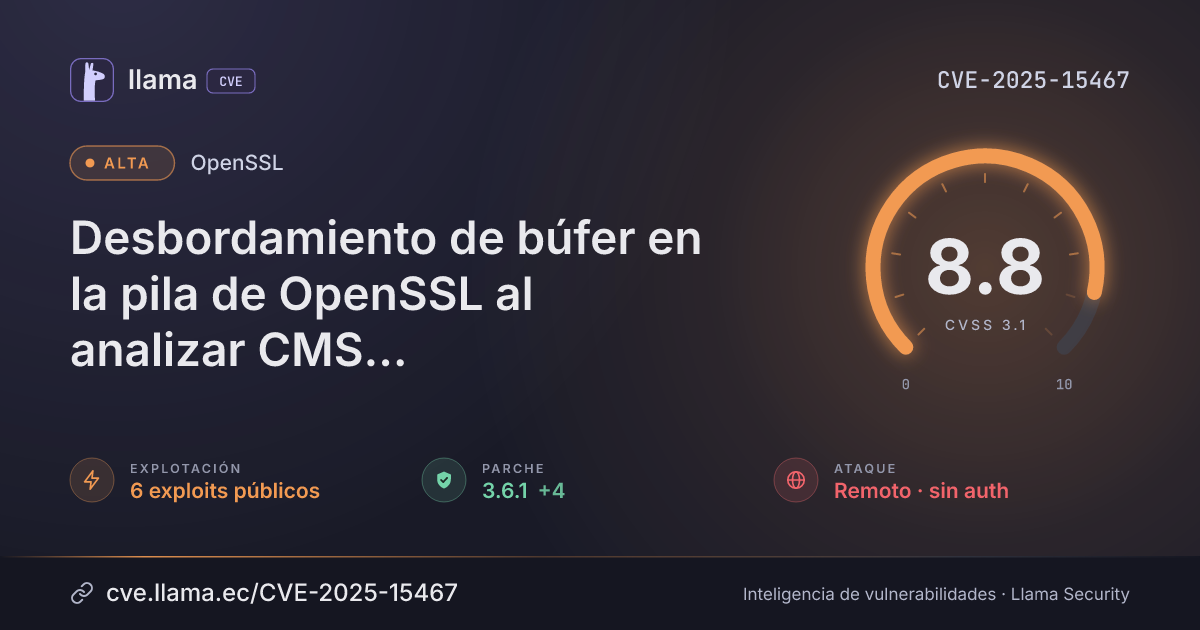
CVE-2025-15467
OpenSSL stack buffer overflow in CMS EnvelopedData parsing
A remote attacker can send a crafted message that crashes the application or may allow code execution.
Texto original en inglés · Ver en español
CVSS:3.1/AV:N/AC:L/PR:N/UI:R/S:U/C:H/I:H/A:H
Fuente: CISA-ADP
CVSS:3.1/AV:N/AC:L/PR:N/UI:N/S:U/C:H/I:H/A:HCiclo de vida de la vulnerabilidad
| Fecha | Fase | Evento | Detalle |
|---|---|---|---|
| Divulgación | Publicada | CVE-2025-15467 divulgada · CVSS 8.8 (CISA-ADP) | |
| Divulgación | Evaluación SSVC | CISA-ADP · explotación PoC pública | |
| Explotación | Umbral EPSS | La probabilidad de explotación supera el 10 % | |
| Monitoreo | Detectada | Ingresó al índice | |
| Monitoreo | Fuente: OSV | Registro visto por primera vez en OSV | |
| Divulgación | Modificada | Última actualización del registro | |
| Monitoreo | Fuente: PoC-in-GitHub | Registro visto por primera vez en PoC-in-GitHub | |
| Explotación | Exploit en GitHub | googlesky/CVE-2026-128027 | |
| Monitoreo | Verificada | Última verificación contra las fuentes |
OpenSSL's parsing of CMS (Auth)EnvelopedData messages contains a stack buffer overflow that a crafted message with an oversized AEAD initialization vector can trigger. An attacker can reach it remotely, without logging in but with some user action, and the overflow can crash the application or potentially lead to remote code execution.
Affects OpenSSL 3.0, 3.3, 3.4, 3.5 and 3.6 when parsing CMS (Auth)EnvelopedData messages that use AEAD ciphers such as AES-GCM. Red Hat rates it high. Fixed in 3.6.1, 3.5.5, 3.4.4, 3.3.6 and 3.0.19.
Descripción original del registro (openssl)
Issue summary: Parsing CMS AuthEnvelopedData or EnvelopedData message with maliciously crafted AEAD parameters can trigger a stack buffer overflow. Impact summary: A stack buffer overflow may lead to a crash, causing Denial of Service, or potentially remote code execution. When parsing CMS (Auth)EnvelopedData structures that use AEAD ciphers such as AES-GCM, the IV (Initialization Vector) encoded in the ASN.1 parameters is copied into a fixed-size stack buffer without verifying that its length fits the destination. An attacker can supply a crafted CMS message with an oversized IV, causing a stack-based out-of-bounds write before any authentication or tag verification occurs. Applications and services that parse untrusted CMS or PKCS#7 content using AEAD ciphers (e.g., S/MIME (Auth)EnvelopedData with AES-GCM) are vulnerable. Because the overflow occurs prior to authentication, no valid key material is required to trigger it. While exploitability to remote code execution depends on platform and toolchain mitigations, the stack-based write primitive represents a severe risk. The FIPS modules in 3.6, 3.5, 3.4, 3.3 and 3.0 are not affected by this issue, as the CMS implementation is outside the OpenSSL FIPS module boundary. OpenSSL 3.6, 3.5, 3.4, 3.3 and 3.0 are vulnerable to this issue. OpenSSL 1.1.1 and 1.0.2 are not affected by this issue.
Condiciones y alcance
Desglose de métricas
Rangos afectados
Estado del parche por paquete
| Paquete / producto | Estado | Corregida en | Desde divulgación | Última versión |
|---|---|---|---|---|
OpenSSL |
Corregida | 3.0.19, 3.3.6, 3.4.4, 3.5.5, 3.6.1 | — | — |
3.0.193.3.63.4.43.5.53.6.1Arsenal público
Ver los 6 repositorios de GitHub (1 con exploit confirmado)
Los repositorios públicos incluyen exploits, escáneres, laboratorios y reglas de detección. No ejecute código de terceros sin revisarlo en un entorno aislado.
https://access.redhat.com/errata/RHSA-2026:3415https://access.redhat.com/errata/RHSA-2026:2974https://openssl-library.org/news/secadv/20260127.txthttps://github.com/openssl/openssl/commit/2c8f0e5fa9b6ee5508a0349e4572ddb74db5a703https://github.com/openssl/openssl/commit/d0071a0799f20cc8101730145349ed4487c268dchttps://github.com/openssl/openssl/commit/6ced0fe6b10faa560e410e3ee8d6c82f06c65ea3https://github.com/openssl/openssl/commit/5f26d4202f5b89664c5c3f3c62086276026ba9a9https://github.com/openssl/openssl/commit/ce39170276daec87f55c39dad1f629b56344429ehttp://www.openwall.com/lists/oss-security/2026/01/27/10http://www.openwall.com/lists/oss-security/2026/02/25/6https://bugzilla.redhat.com/show_bug.cgi?id=2430376https://github.com/guiimoraes/CVE-2025-15467Ver 9 referencias más
https://github.com/WostGit/cve-2025-15467-crashhttps://github.com/balgan/CVE-2025-15467https://github.com/googlesky/CVE-2026-128027https://github.com/materaj2/cve-2025-15467https://github.com/mr-r3b00t/CVE-2025-15467https://cert-portal.siemens.com/productcert/html/ssa-434797.htmlhttps://cert-portal.siemens.com/productcert/html/ssa-734552.htmlhttps://access.redhat.com/security/cve/CVE-2025-15467https://security.access.redhat.com/data/csaf/v2/vex/2025/cve-2025-15467.jsonLas referencias externas se muestran para copiar: cve.llama.ec no lo redirige a otros sitios.