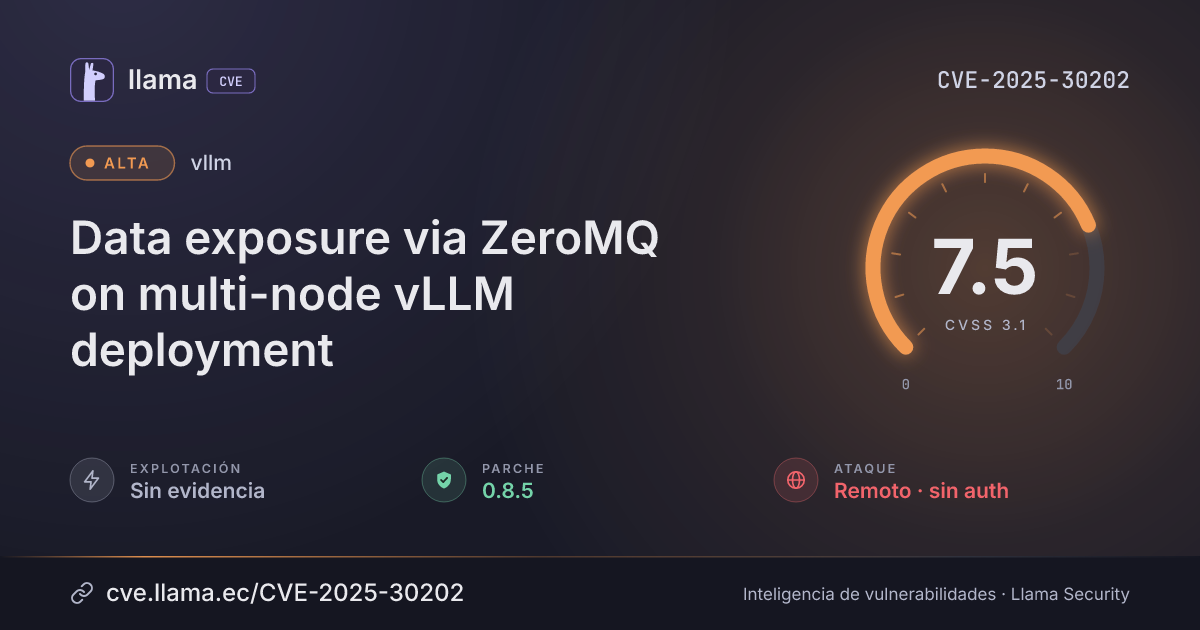
CVE-2025-30202
Data exposure via ZeroMQ on multi-node vLLM deployment
CVSS:3.1/AV:N/AC:L/PR:N/UI:N/S:U/C:N/I:N/A:H
Fuente: CNA
Ciclo de vida de la vulnerabilidad
| Fecha | Fase | Evento | Detalle |
|---|---|---|---|
| Remediación | Parche 0.8.5 | vllm · -2 d desde divulgación | |
| Divulgación | Publicada | CVE-2025-30202 divulgada · CVSS 7.5 (CNA) | |
| Divulgación | Evaluación SSVC | CISA-ADP · explotación ninguna | |
| Divulgación | Modificada | Última actualización del registro | |
| Monitoreo | Detectada | Ingresó al índice |
vLLM is a high-throughput and memory-efficient inference and serving engine for LLMs. Versions starting from 0.5.2 and prior to 0.8.5 are vulnerable to denial of service and data exposure via ZeroMQ on multi-node vLLM deployment. In a multi-node vLLM deployment, vLLM uses ZeroMQ for some multi-node communication purposes. The primary vLLM host opens an XPUB ZeroMQ socket and binds it to ALL interfaces. While the socket is always opened for a multi-node deployment, it is only used when doing tensor parallelism across multiple hosts. Any client with network access to this host can connect to this XPUB socket unless its port is blocked by a firewall. Once connected, these arbitrary clients will receive all of the same data broadcasted to all of the secondary vLLM hosts. This data is internal vLLM state information that is not useful to an attacker. By potentially connecting to this socket many times and not reading data published to them, an attacker can also cause a denial of service by slowing down or potentially blocking the publisher. This issue has been patched in version 0.8.5.
Desglose de métricas
Rangos afectados
Estado del parche por paquete
| Paquete / producto | Estado | Corregida en | Desde divulgación | Última versión |
|---|---|---|---|---|
pypivllm |
Corregida | 0.8.5 | -2 d | 0.33.0 no afectada |
0.8.5Arsenal público
Sin exploits, módulos ni PoC públicos conocidos a la fecha de verificación.
https://github.com/vllm-project/vllm/security/advisories/GHSA-9f8f-2vmf-885jhttps://github.com/vllm-project/vllm/pull/6183https://github.com/vllm-project/vllm/commit/a0304dc504c85f421d38ef47c64f83046a13641cLas referencias externas se muestran para copiar: cve.llama.ec no lo redirige a otros sitios.