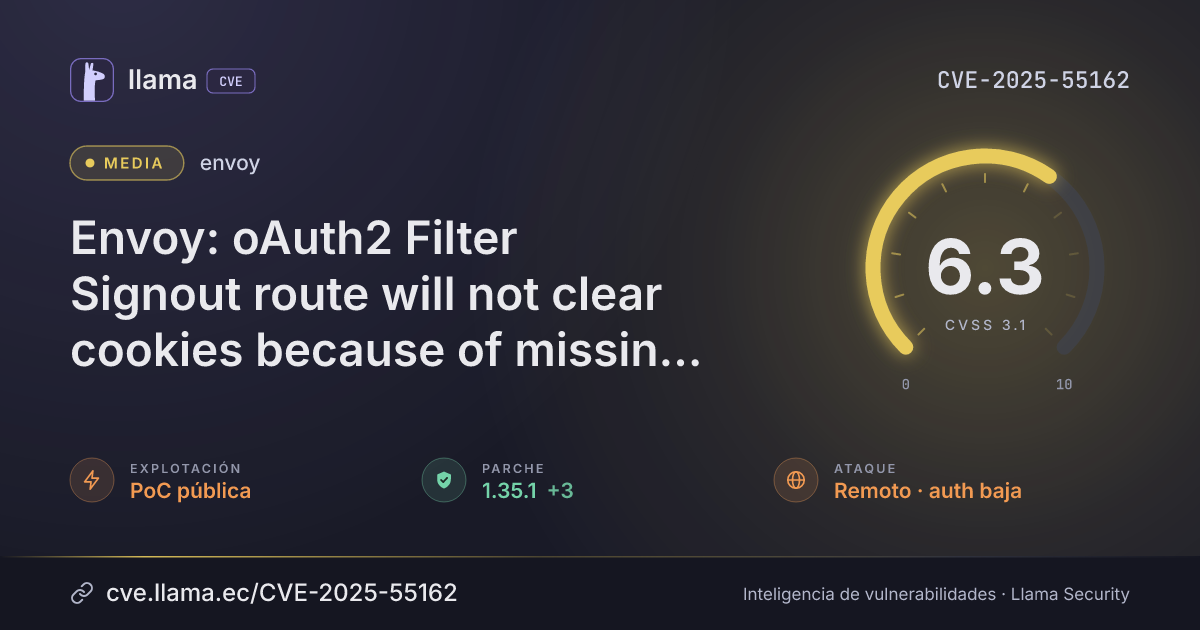
CVE-2025-55162
Envoy: oAuth2 Filter Signout route will not clear cookies because of missing "secure;" flag
CVSS:3.1/AV:N/AC:L/PR:L/UI:R/S:U/C:H/I:L/A:N
Fuente: CNA
CVSS:3.1/AV:N/AC:L/PR:L/UI:N/S:U/C:H/I:H/A:HCiclo de vida de la vulnerabilidad
| Fecha | Fase | Evento | Detalle |
|---|---|---|---|
| Divulgación | Publicada | CVE-2025-55162 divulgada · CVSS 6.3 (CNA) | |
| Divulgación | Evaluación SSVC | CISA-ADP · explotación PoC pública | |
| Divulgación | Modificada | Última actualización del registro | |
| Monitoreo | Detectada | Ingresó al índice | |
| Monitoreo | Fuente: OSV | Registro visto por primera vez en OSV | |
| Monitoreo | Verificada | Última verificación contra las fuentes |
Envoy is an open source L7 proxy and communication bus designed for large modern service oriented architectures. In versions below 1.32.10 and 1.33.0 through 1.33.6, 1.34.0 through 1.34.4 and 1.35.0, insufficient Session Expiration in the Envoy OAuth2 filter leads to failed logout operations. When configured with __Secure- or __Host- prefixed cookie names, the filter fails to append the required Secure attribute to the Set-Cookie header during deletion. Modern browsers ignore this invalid request, causing the session cookie to persist. This allows a user to remain logged in after they believe they have logged out, creating a session hijacking risk on shared computers. The current implementation iterates through the configured cookie names to generate deletion headers but does not check for these prefixes. This failure to properly construct the deletion header means the user's session cookies are never removed by the browser, leaving the session active and allowing the next user of the same browser to gain unauthorized access to the original user's account and data. This is fixed in versions 1.32.10, 1.33.7, 1.34.5 and 1.35.1.
Desglose de métricas
Rangos afectados
Estado del parche por paquete
| Paquete / producto | Estado | Corregida en | Desde divulgación | Última versión |
|---|---|---|---|---|
envoy |
Corregida | 1.32.10, 1.33.7, 1.34.5, 1.35.1 | — | — |
1.32.101.33.71.34.51.35.1Arsenal público
Sin exploits, módulos ni PoC públicos conocidos a la fecha de verificación.
https://github.com/envoyproxy/envoy/security/advisories/GHSA-95j4-hw7f-v2rhhttps://github.com/envoyproxy/envoy/releases/tag/v1.35.1Las referencias externas se muestran para copiar: cve.llama.ec no lo redirige a otros sitios.