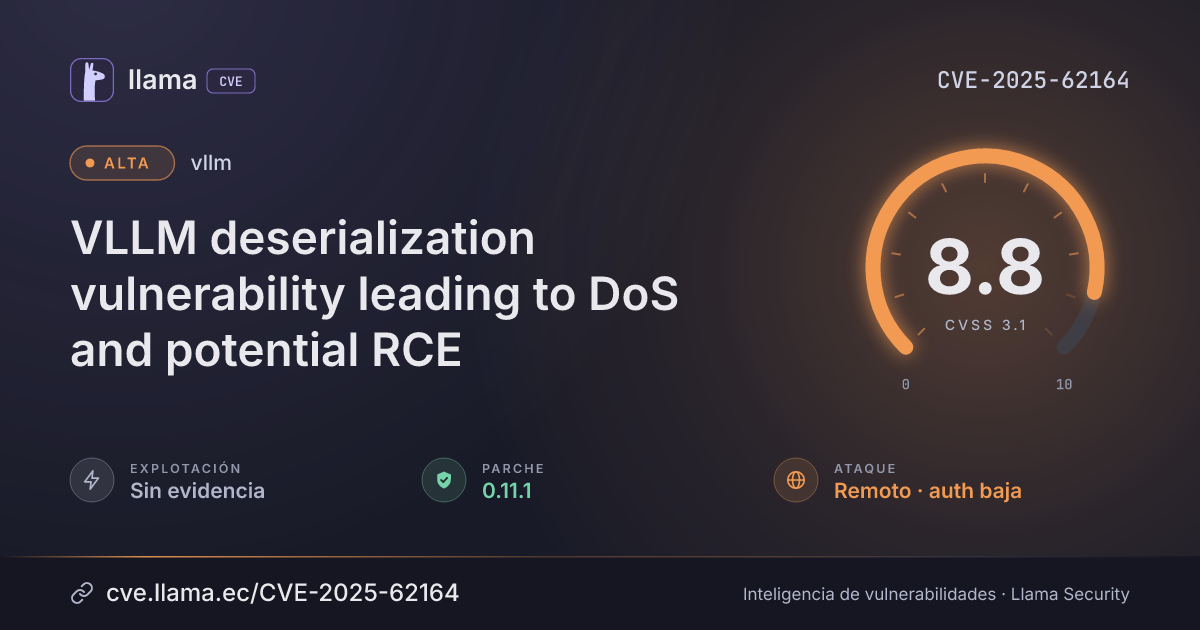
CVE-2025-62164
VLLM deserialization vulnerability leading to DoS and potential RCE
CVSS:3.1/AV:N/AC:L/PR:L/UI:N/S:U/C:H/I:H/A:H
Fuente: CNA
Ciclo de vida de la vulnerabilidad
| Fecha | Fase | Evento | Detalle |
|---|---|---|---|
| Remediación | Parche 0.11.1 | vllm · -2 d desde divulgación | |
| Divulgación | Publicada | CVE-2025-62164 divulgada · CVSS 8.8 (CNA) | |
| Divulgación | Evaluación SSVC | CISA-ADP · explotación ninguna | |
| Divulgación | Modificada | Última actualización del registro | |
| Monitoreo | Detectada | Ingresó al índice |
vLLM is an inference and serving engine for large language models (LLMs). From versions 0.10.2 to before 0.11.1, a memory corruption vulnerability could lead to a crash (denial-of-service) and potentially remote code execution (RCE), exists in the Completions API endpoint. When processing user-supplied prompt embeddings, the endpoint loads serialized tensors using torch.load() without sufficient validation. Due to a change introduced in PyTorch 2.8.0, sparse tensor integrity checks are disabled by default. As a result, maliciously crafted tensors can bypass internal bounds checks and trigger an out-of-bounds memory write during the call to to_dense(). This memory corruption can crash vLLM and potentially lead to code execution on the server hosting vLLM. This issue has been patched in version 0.11.1.
Desglose de métricas
Rangos afectados
Estado del parche por paquete
| Paquete / producto | Estado | Corregida en | Desde divulgación | Última versión |
|---|---|---|---|---|
pypivllm |
Corregida | 0.11.1 | -2 d | 0.33.0 no afectada |
0.11.1Arsenal público
Sin exploits, módulos ni PoC públicos conocidos a la fecha de verificación.
https://github.com/vllm-project/vllm/security/advisories/GHSA-mrw7-hf4f-83pfhttps://github.com/vllm-project/vllm/pull/27204https://github.com/vllm-project/vllm/commit/58fab50d82838d5014f4a14d991fdb9352c9c84bLas referencias externas se muestran para copiar: cve.llama.ec no lo redirige a otros sitios.