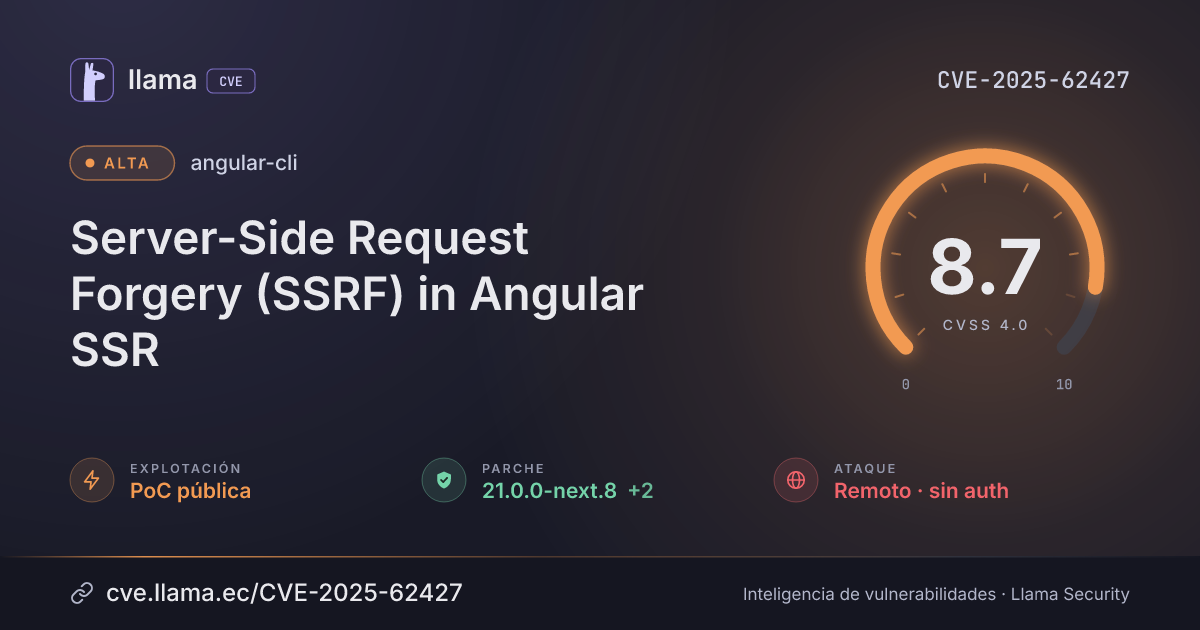
CVE-2025-62427
Server-Side Request Forgery (SSRF) in Angular SSR
CVSS:4.0/AV:N/AC:L/AT:N/PR:N/UI:N/VC:H/VI:N/VA:N/SC:N/SI:N/SA:N
Fuente: CNA
Ciclo de vida de la vulnerabilidad
| Fecha | Fase | Evento | Detalle |
|---|---|---|---|
| Remediación | Parche 19.2.18 | @angular/ssr · -1 d desde divulgación | |
| Remediación | Parche 20.3.6 | @angular/ssr · -1 d desde divulgación | |
| Remediación | Parche 21.0.0-next.8 | @angular/ssr · -1 d desde divulgación | |
| Divulgación | Publicada | CVE-2025-62427 divulgada · CVSS 8.7 (CNA) | |
| Divulgación | Evaluación SSVC | CISA-ADP · explotación PoC pública | |
| Divulgación | Modificada | Última actualización del registro | |
| Monitoreo | Detectada | Ingresó al índice |
The Angular SSR is a server-rise rendering tool for Angular applications. The vulnerability is a Server-Side Request Forgery (SSRF) flaw within the URL resolution mechanism of Angular's Server-Side Rendering package (@angular/ssr) before 19.2.18, 20.3.6, and 21.0.0-next.8. The function createRequestUrl uses the native URL constructor. When an incoming request path (e.g., originalUrl or url) begins with a double forward slash (//) or backslash (\\), the URL constructor treats it as a schema-relative URL. This behavior overrides the security-intended base URL (protocol, host, and port) supplied as the second argument, instead resolving the URL against the scheme of the base URL but adopting the attacker-controlled hostname. This allows an attacker to specify an external domain in the URL path, tricking the Angular SSR environment into setting the page's virtual location (accessible via DOCUMENT or PlatformLocation tokens) to this attacker-controlled domain. Any subsequent relative HTTP requests made during the SSR process (e.g., using HttpClient.get('assets/data.json')) will be incorrectly resolved against the attacker's domain, forcing the server to communicate with an arbitrary external endpoint. This vulnerability is fixed in 19.2.18, 20.3.6, and 21.0.0-next.8.
Desglose de métricas
Rangos afectados
Estado del parche por paquete
| Paquete / producto | Estado | Corregida en | Desde divulgación | Última versión |
|---|---|---|---|---|
npm@angular/ssr |
Corregida | 19.2.18, 20.3.6, 21.0.0-next.8 | -1 d · -1 d · -1 d | 22.2.7 no afectada |
19.2.1820.3.621.0.0-next.8Arsenal público
Sin exploits, módulos ni PoC públicos conocidos a la fecha de verificación.
https://github.com/angular/angular-cli/security/advisories/GHSA-q63q-pgmf-mxhrhttps://github.com/angular/angular-cli/commit/5271547c80662de10cb3bcb648779a83f6efedfbLas referencias externas se muestran para copiar: cve.llama.ec no lo redirige a otros sitios.