Exposición191 dDesde la divulgación, 13 may 2026, 12:40 p. m.
Detección162 dDesde la divulgación hasta su ingreso al índice
Decisión SSVCSeguir de cerca
Monitorear y programar la remediación
Sin explotación conocida, no automatizable e impacto técnico total. Hay versiones corregidas disponibles.
Timeline
Ciclo de vida de la vulnerabilidad
Hoy
Divulgación
Evaluación SSVC +1
Modificada
Explotación
Exploit en GitHub
Remediación
Monitoreo
Detectada
Fuente: PoC-in-GitHub
Verificada
13 may 26
15 oct 26
22 oct 26
6 nov 26
12 nov 26
21 nov 26
13 may 26
30 jun 26
17 ago 26
4 oct 26
21 nov 26
Fecha
Fase
Evento
Detalle
Divulgación
Evaluación SSVC
CISA-ADP · explotación ninguna
Divulgación
Publicada
CVE-2026-0264 divulgada · CVSS 7.2 (CNA)
Divulgación
Modificada
Última actualización del registro
Monitoreo
Detectada
Ingresó al índice
Explotación
Exploit en GitHub
iam-s21-caece/PoC-CVE-2026-0264
Monitoreo
Fuente: PoC-in-GitHub
Registro visto por primera vez en PoC-in-GitHub
Monitoreo
Verificada
Última verificación contra las fuentes
Resumen
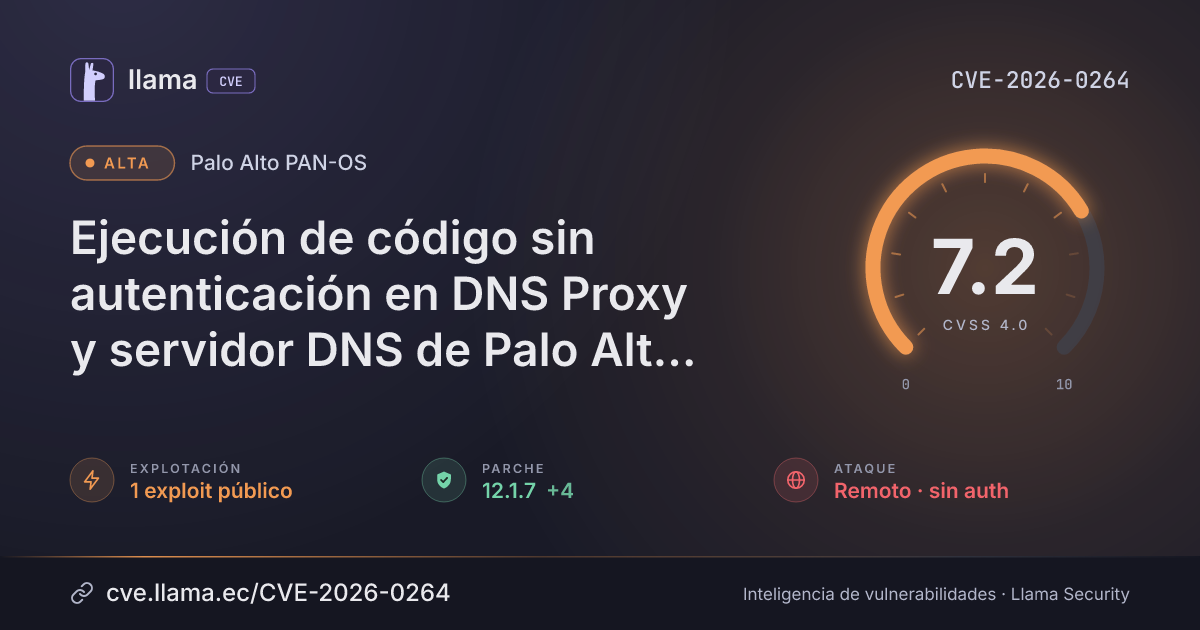
A buffer overflow vulnerability in the DNS proxy and DNS Server features of Palo Alto Networks PAN-OS® Software allows an unauthenticated attacker with network access to cause a denial of service (DoS) condition (all PAN-OS platforms except Cloud NGFW and Prisma Access) or potentially execute arbitrary code by sending specially crafted network traffic (PA-Series hardware only).
Panorama, Cloud NGFW, and Prisma® Access are not impacted by this vulnerability.
¿Qué significa?A heap-based buffer overflow in the DNS Proxy and DNS server features of PAN-OS can be triggered by specially crafted network traffic. It causes denial of service on all affected PAN-OS platforms and, on PA-Series hardware, may allow arbitrary code execution.
¿Quién está afectado?Affected PAN-OS releases are 10.2.0 to before 10.2.7-h34, 11.1.0 to before 11.1.4-h33, 11.2.0 to before 11.2.4-h17, and 12.1.0 to before 12.1.4-h5. The setup also matters: DNS Proxy must be enabled with a network interface attached, and the configured DNS server must be a compromised public untrusted IP address. To check, compare the PAN-OS version on the firewall and review its DNS Proxy settings.
Contexto
Condiciones y alcance
Condiciones necesarias para que el fallo sea explotable
01
DNS Proxy is enabled and a network interface is attached to DNS Proxy“a network interface is attached to DNS Proxy”
02
The DNS server configured on the NGFW is a compromised public untrusted IP address“configured on NGFW is a compromised public untrusted IP address”
03
Affects PAN-OS firewalls; Panorama, Cloud NGFW and Prisma Access are not impacted“are not impacted by this vulnerability”
MitigaciónDisassociate DNS Proxy from externally accessible interfaces and configure the DNS server with an RFC1918 or public trusted IP address
Vector CVSS 3.1
Desglose de métricas
Opción resaltada = valor del vector · izquierda = peor caso · NVD
Ver los 1 repositorios de GitHub (1 con exploit confirmado)
iam-s21-caece/PoC-CVE-2026-0264exploit
Los repositorios públicos incluyen exploits, escáneres, laboratorios y reglas de detección. No ejecute código de terceros sin revisarlo en un entorno aislado.
Registro
EscenarioThe risk is highest for PA-Series hardware firewalls as there is a potential risk of arbitrary code executionpalo_alto
EscenarioThe risk is lower for VM-Series firewalls, as the impact is limited to a Denial of Service conditionpalo_alto
configurationThis issue is applicable only to PAN-OS firewalls if either of the following conditions are true:
1. DNS Proxy is enabled (Network > DNS Proxy) AND a network interface is attached to DNS Proxy.
OR
2. The DNS server (Device > Setup > Services) configured on NGFW is a compromised public untrusted IP address.
The risk is higher if the interface is externally exposed to an untrusted network. Further documentation on configuring DNS Proxy can be found here (https://knowledgebase.paloaltonetworks.com/KCSArticleDetail?id=kA10g000000ClFcCAK).palo_alto
MitigaciónCustomers can mitigate the risk of this issue by taking either of the following actions:
Action 1:
* Disassociate DNS Proxy from externally accessible interfaces in order to reduce your attack surface; AND
* Configure DNS server with a RFC1918 or a public trusted IP address.
OR Action 2:
* Disable the DNS Proxy feature (Network > DNS Proxy) if it is not being used; AND
* Configure DNS server with a RFC1918 or a public trusted IP address.
Customers with a Threat Prevention subscription can block attacks for this vulnerability by enabling Threat ID 510027 from Applications and Threats content version 9100-10044 and later.palo_alto
solutionVERSION MINOR VERSION SUGGESTED SOLUTION
Cloud NGFW No action needed
PAN-OS 12.1 12.1.5 through 12.1.6 Upgrade to 12.1.7 or later.
12.1.2 through 12.1.4-h* Upgrade to 12.1.4-h5 or 12.1.7 or later.
PAN-OS 11.2 11.2.11 or later Upgrade to 11.2.12 or later.
11.2.8 through 11.2.10-h* Upgrade to 11.2.10-h6 or 11.2.12 or later.
11.2.5 through 11.2.7-h* Upgrade to 11.2.7-h13 or 11.2.10 or later.
11.2.0 through 11.2.4-h* Upgrade to 11.2.4-h17 or 11.2.7 or later.
PAN-OS 11.1 11.1.14 or later Upgrade to 11.1.15 or later.
11.1.11 through 11.1.13-h* Upgrade to 11.1.13-h5 or 11.1.15 or later.
11.1.8 through 11.1.10-h* Upgrade to 11.1.10-h25 or 11.1.15 or later.
11.1.7 through 11.1.7-h* Upgrade to 11.1.7-h6 or 11.1.15 or later.
11.1.5 through 11.1.6-h* Upgrade to 11.1.6-h32 or 11.1.15 or later.
11.1.0 through 11.1.4-h* Upgrade to 11.1.4-h33 or 11.1.15 or later.
PAN-OS 10.2 10.2.17 through 10.2.18-h* Upgrade to 10.2.18-h6 or later.
10.2.14 through 10.2.16-h* Upgrade to 10.2.16-h7 or 10.2.18-h6 or later.
10.2.11 through 10.2.13-h* Upgrade to 10.2.13-h21 or 10.2.18-h6 or later.
10.2.8 through 10.2.10-h* Upgrade to 10.2.10-h36 or 10.2.18-h6 or later.
10.2.0 through 10.2.7-h* Upgrade to 10.2.7-h34 or 10.2.18-h6 or later.
Prisma Access No action needed.
All older unsupported PAN-OS versions Upgrade to a supported fixed version.palo_alto
Usamos cookies propias estrictamente necesarias para que el sitio funcione y sea seguro. Con tu permiso, también usamos almacenamiento local para recordar tus preferencias y medir el uso del sitio de forma agregada. Puedes aceptar, rechazar o configurar cada categoría, y cambiar tu decisión cuando quieras desde el enlace “Preferencias de cookies” del pie de página. Más información
Preferencias de cookies
Elige qué permites
Solo usamos tecnologías propias de este dominio. Sin publicidad ni rastreadores de terceros. Detalle en la Política de cookies.