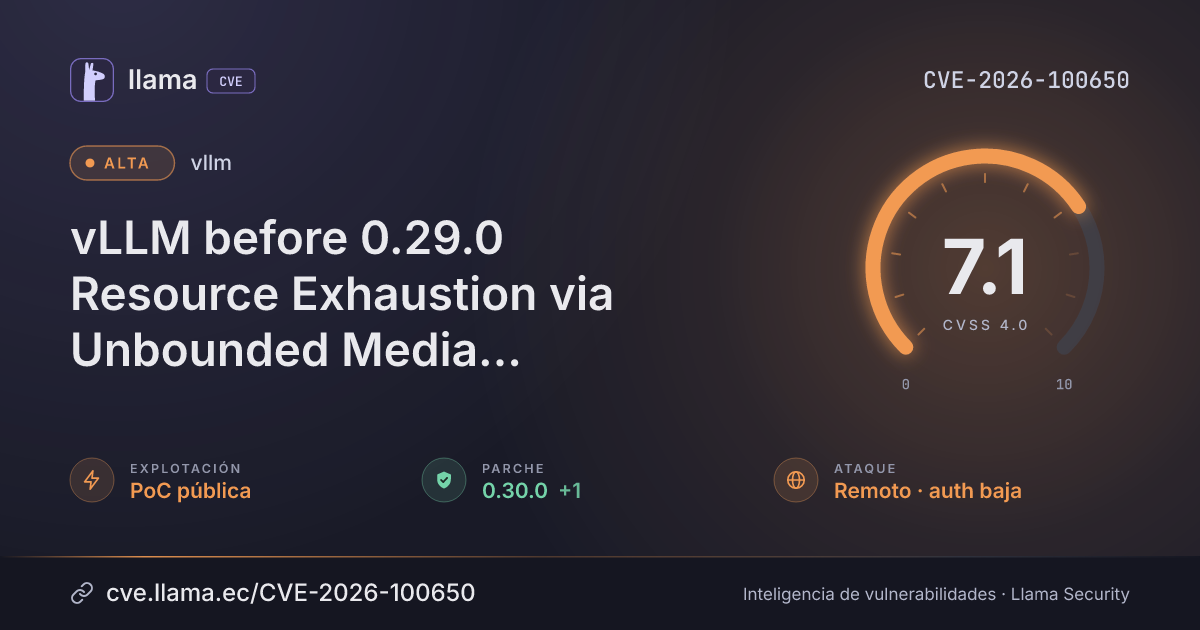
CVE-2026-100650
vLLM before 0.29.0 Resource Exhaustion via Unbounded Media Materialization
CVSS:4.0/AV:N/AC:L/AT:N/PR:L/UI:N/VC:N/VI:N/VA:H/SC:N/SI:N/SA:N
Fuente: CNA
Ciclo de vida de la vulnerabilidad
| Fecha | Fase | Evento | Detalle |
|---|---|---|---|
| Remediación | Parche 0.30.0 | vllm · -4 d desde divulgación | |
| Divulgación | Publicada | CVE-2026-100650 divulgada · CVSS 7.1 (CNA) | |
| Divulgación | Evaluación SSVC | CISA-ADP · explotación PoC pública | |
| Divulgación | Modificada | Última actualización del registro | |
| Monitoreo | Detectada | Ingresó al índice |
vLLM through 0.29.0 fetches and fully materializes remote or inline media before enforcing its documented media controls (the VLLM_MAX_AUDIO_CLIP_FILESIZE_MB compressed-audio size cap, default 25 MB, and the per-modality --limit-mm-per-prompt item limits). Across four ingress paths — the shared media-acquisition layer (HTTPConnection.get_bytes()/async_get_bytes()), the chat completions audio_url/base64 path, the batch speech runner, and the Rust frontend POST /tokenize route — the server reads the entire HTTP response body, base64-decodes the inline payload, or spawns one fetch/decode task per media part, and only then applies the limit (or, on some paths, never applies it). A remote attacker can therefore cause the API server or batch-runner process to allocate memory and consume outbound bandwidth proportional to an attacker-chosen body size or media item count before the request is rejected, resulting in pre-inference memory and bandwidth exhaustion (denial of service). The chat and batch surfaces require an API key when one is configured; the Rust frontend /tokenize route is unauthenticated by design. There is no code execution or data disclosure impact.
Desglose de métricas
Rangos afectados
Estado del parche por paquete
| Paquete / producto | Estado | Corregida en | Desde divulgación | Última versión |
|---|---|---|---|---|
pypivllm |
Corregida | 0.30.0 | -4 d | 0.33.0 no afectada |
0.29.00.30.0Arsenal público
Sin exploits, módulos ni PoC públicos conocidos a la fecha de verificación.
https://github.com/vllm-project/vllm/security/advisories/GHSA-p6g9-7v3x-m8mvhttps://github.com/vllm-project/vllm/commit/752a3a504485790a2e8491cacbb35c137339ad34https://www.vulncheck.com/advisories/vllm-before-0.29.0-resource-exhaustion-via-unbounded-media-materializationLas referencias externas se muestran para copiar: cve.llama.ec no lo redirige a otros sitios.