llamaCVEVulnerability Intelligence
/
netty

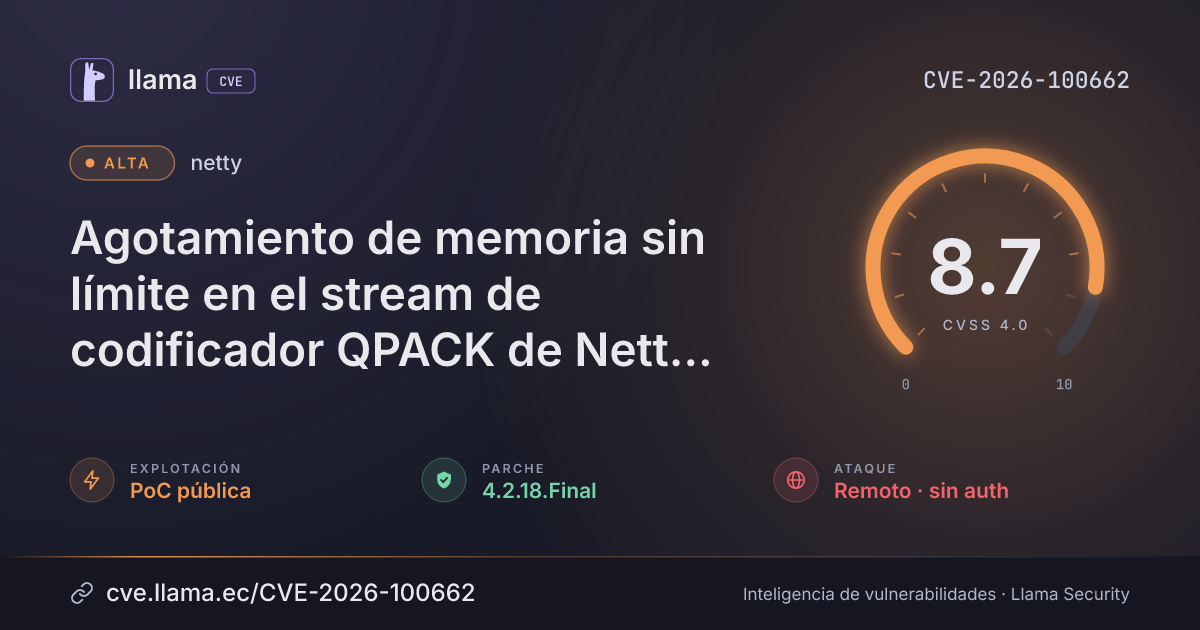
CVE-2026-100662

Netty HTTP/3 QPACK encoder-stream unbounded memory exhaustion DoS

Afecta la configuración por defectoParche disponible
Descargar PNG JSON
CVSS 4.0
8.7
Alta
CVSS:4.0/AV:N/AC:L/AT:N/PR:N/UI:N/VC:N/VI:N/VA:H/SC:N/SI:N/SA:N Fuente: CNA
ExplotaciónPoC públicaSSVC: PoC · no figura en CISA KEV
Exploits públicos0CISA-ADP reporta PoC; aún sin enlace público
Parche1 versiónPrimer parche a -17 d de la divulgación
Exposición55 dDesde la divulgación, 26 sept 2026, 8:23 a. m.
Detección26 dDesde la divulgación hasta su ingreso al índice
Decisión SSVCSeguir de cerca
Monitorear y programar la remediación
Existe PoC pública, automatizable e impacto técnico parcial. Hay versiones corregidas disponibles.
Timeline

Ciclo de vida de la vulnerabilidad

Hoy
Divulgación
Publicada
Evaluación SSVC +1
Explotación
Remediación
Parche 4.2.18.Final
Monitoreo
Detectada
Fuente: OSV
Verificada
9 sept 26
26 sept 26
30 sept 26
22 oct 26
24 oct 26
19 nov 26
21 nov 26
9 sept 26
27 sept 26
15 oct 26
3 nov 26
21 nov 26
FechaFaseEventoDetalle
Remediación Parche 4.2.18.Final io.netty:netty-codec-http3 · -17 d desde divulgación
Divulgación Publicada CVE-2026-100662 divulgada · CVSS 8.7 (CNA)
Divulgación Evaluación SSVC CISA-ADP · explotación PoC pública
Divulgación Modificada Última actualización del registro
Monitoreo Detectada Ingresó al índice
Monitoreo Fuente: OSV Registro visto por primera vez en OSV
Monitoreo Verificada Última verificación contra las fuentes
Resumen

Netty's HTTP/3 codec (io.netty:netty-codec-http3) versions 4.2.0.Final through 4.2.17.Final contain an uncontrolled resource consumption vulnerability in the QPACK encoder-stream instruction decoder (QpackEncoderHandler, installed on the peer-initiated unidirectional QPACK encoder stream, type 0x02). The handler accepts an attacker-declared string-literal length of up to Integer.MAX_VALUE (~2 GiB) for the Name Length and Value Length fields of the "Insert With Literal Name" instruction (RFC 9204 §4.3.3), with no per-instruction or per-literal length cap and no cumulation-size limit; the existing HTTP/3 limits (maxHeaderListSize, maxUnknownFramePayloadLength, DEFAULT_MAX_FIELD_SECTION_SIZE) are not applied to this handler. A remote, unauthenticated peer with an established HTTP/3 connection to a default Netty HTTP/3 server can declare a very large literal length and then trickle fewer bytes than declared, causing the ByteToMessageDecoder MERGE cumulator to retain and grow the per-connection buffer, and ultimately triggering a large byte-array allocation. This leads to unbounded per-connection heap growth and OutOfMemoryError, resulting in denial of service. Fixed in 4.2.18.Final.

Affects netty-codec-http3 4.2.0.Final through 4.2.17.Final when a peer with an established HTTP/3 connection opens a unidirectional QPACK encoder stream (type 0x02).

¿Qué significa?A peer with an established HTTP/3 connection can open a peer-initiated unidirectional QPACK encoder stream of type 0x02 that causes unbounded per-connection heap growth. This can lead to an OutOfMemoryError and denial of service.
¿Quién está afectado?The facts list netty-codec-http3 versions 4.2.0.Final through 4.2.17.Final. Check the netty-codec-http3 version in your build or dependency tree, and check whether your application uses the HTTP/3 codec for incoming connections.
¿Qué hacer?The product range lists 4.2.18.Final as the fixed version, so upgrade netty-codec-http3 to 4.2.18.Final or later. The facts do not include a separate vendor fix record or patch identifiers.
Contexto

Condiciones y alcance

Condiciones necesarias para que el fallo sea explotable
01
Affected netty-codec-http3 versions 4.2.0.Final through 4.2.17.Final“versions 4.2.0.Final through 4.2.17.Final”
02
Peer has an established HTTP/3 connection and opens a unidirectional QPACK encoder stream (type 0x02)“installed on the peer-initiated unidirectional QPACK encoder stream, type 0x02”
¿Quién debe revisar?Teams running Netty HTTP/3 (io.netty:netty-codec-http3) 4.2.0.Final through 4.2.17.Final, including default HTTP/3 servers
Vector CVSS 4.0

Desglose de métricas

Opción resaltada = valor del vector · izquierda = peor caso · CNA
Vector de ataqueAV:N
RedAdyacenteLocalFísica
ComplejidadAC:L
BajaAlta
Requisitos de ataqueAT:N
NingunoPresentes
PrivilegiosPR:N
NingunoBajosAltos
InteracciónUI:N
NingunaPasivaActiva
Confid. (sistema)VC:N
AltoBajoNinguno
Integridad (sistema)VI:N
AltoBajoNinguno
Disponib. (sistema)VA:H
AltoBajoNinguno
Confid. (posterior)SC:N
AltoBajoNinguno
Integridad (posterior)SI:N
AltoBajoNinguno
Disponib. (posterior)SA:N
AltoBajoNinguno
Score de explotaciónQué tan fácil y probable es que la exploten
10.0/ 10Muy alto
Vector 10.0 (muy fácil) · sin evidencia de explotación.
Versiones

Rangos afectados

Afectada Corregida Última
io.netty:netty-codec-http3≥ 4.2.0.Final ≤ 4.2.17.Final
netty≥ 4.2.0.Final < 4.2.18.Final
4.2.0.Final
4.2.17.Final
4.2.18.Final
4.2.20.Final
Remediación

Estado del parche por paquete

Paquete / productoEstadoCorregida enDesde divulgaciónÚltima versión
mavenio.netty:netty-codec-http3
Corregida 4.2.18.Final -17 d 4.2.20.Final no afectada
Versiones corregidas4.2.18.Final
Explotación

Arsenal público

Sin exploits, módulos ni PoC públicos conocidos a la fecha de verificación.

Referencias
Fabricantehttps://github.com/netty/netty/security/advisories/GHSA-f64r-x647-cg8w
Otrahttps://www.vulncheck.com/advisories/netty-http-3-qpack-encoder-stream-unbounded-memory-exhaustion-dos

Las referencias externas se muestran para copiar: cve.llama.ec no lo redirige a otros sitios.