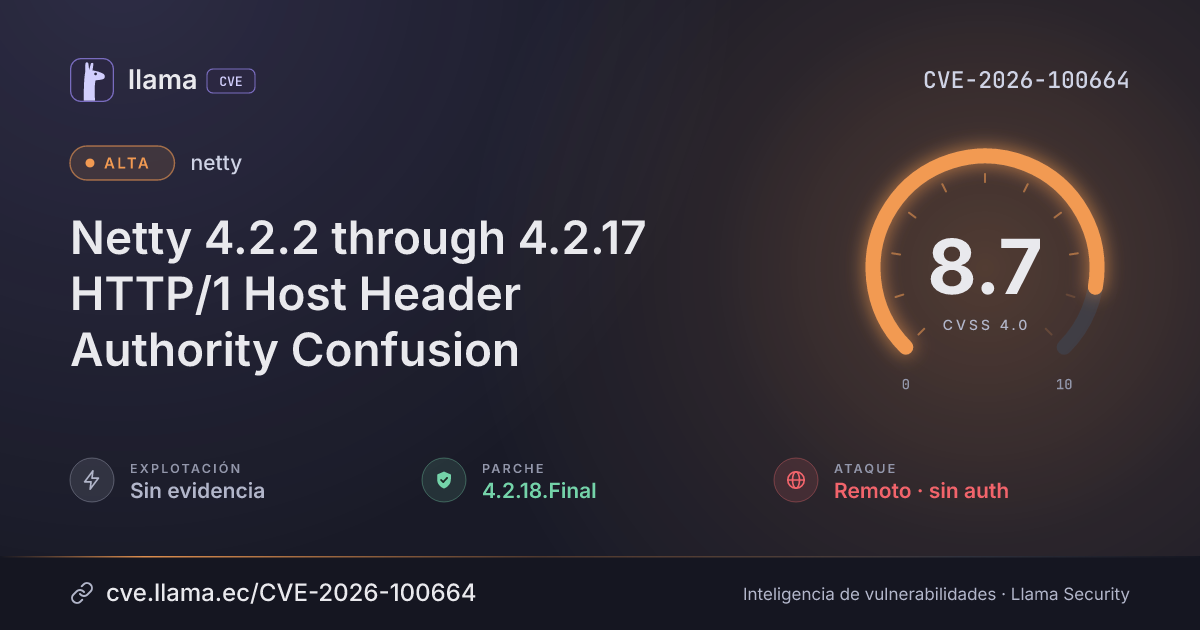
CVE-2026-100664
Netty 4.2.2 through 4.2.17 HTTP/1 Host Header Authority Confusion
CVSS:4.0/AV:N/AC:L/AT:N/PR:N/UI:N/VC:N/VI:H/VA:N/SC:N/SI:N/SA:N
Fuente: CNA
Ciclo de vida de la vulnerabilidad
| Fecha | Fase | Evento | Detalle |
|---|---|---|---|
| Divulgación | Publicada | CVE-2026-100664 divulgada · CVSS 8.7 (CNA) | |
| Divulgación | Evaluación SSVC | CISA-ADP · explotación ninguna | |
| Divulgación | Modificada | Última actualización del registro | |
| Monitoreo | Detectada | Ingresó al índice | |
| Monitoreo | Fuente: OSV | Registro visto por primera vez en OSV |
Netty's HTTP/3 codec (io.netty:netty-codec-http3) versions 4.2.2.Final through 4.2.17.Final builds the HTTP/3 :authority pseudo-header from the HTTP/1 Host header before considering the authority of an absolute-form HTTP/1 request-target. In HttpConversionUtil.toHttp3Headers(HttpMessage, boolean) — reached via Http3FrameToHttpObjectCodec(false) — a non-empty Host header takes precedence over the request-target authority, contrary to the HTTP/1.1 rule that a server receiving an absolute-form request-target must ignore the Host header. In a Netty-based HTTP/1-to-HTTP/3 gateway, proxy, or protocol bridge, a remote client can send a request such as "GET https://trusted.example/admin HTTP/1.1" with "Host: attacker.example", causing components that validate, authorize, or route on the RFC-defined request-target authority to reach a different decision than the upstream HTTP/3 peer, which receives :authority derived from the conflicting Host header. This authority confusion can affect virtual-host routing, allow-list checks, backend selection, cache keys, and URL generation. The advisory reports integrity impact only (no code execution, memory corruption, or availability impact). Fixed in 4.2.18.Final.
Desglose de métricas
Rangos afectados
Estado del parche por paquete
| Paquete / producto | Estado | Corregida en | Desde divulgación | Última versión |
|---|---|---|---|---|
netty |
Corregida | 4.2.18.Final | — | — |
4.2.18.FinalArsenal público
Sin exploits, módulos ni PoC públicos conocidos a la fecha de verificación.
https://github.com/netty/netty/security/advisories/GHSA-hfr2-x62w-v49hhttps://www.vulncheck.com/advisories/netty-4.2.2-through-4.2.15-http-1-host-header-authority-confusionLas referencias externas se muestran para copiar: cve.llama.ec no lo redirige a otros sitios.