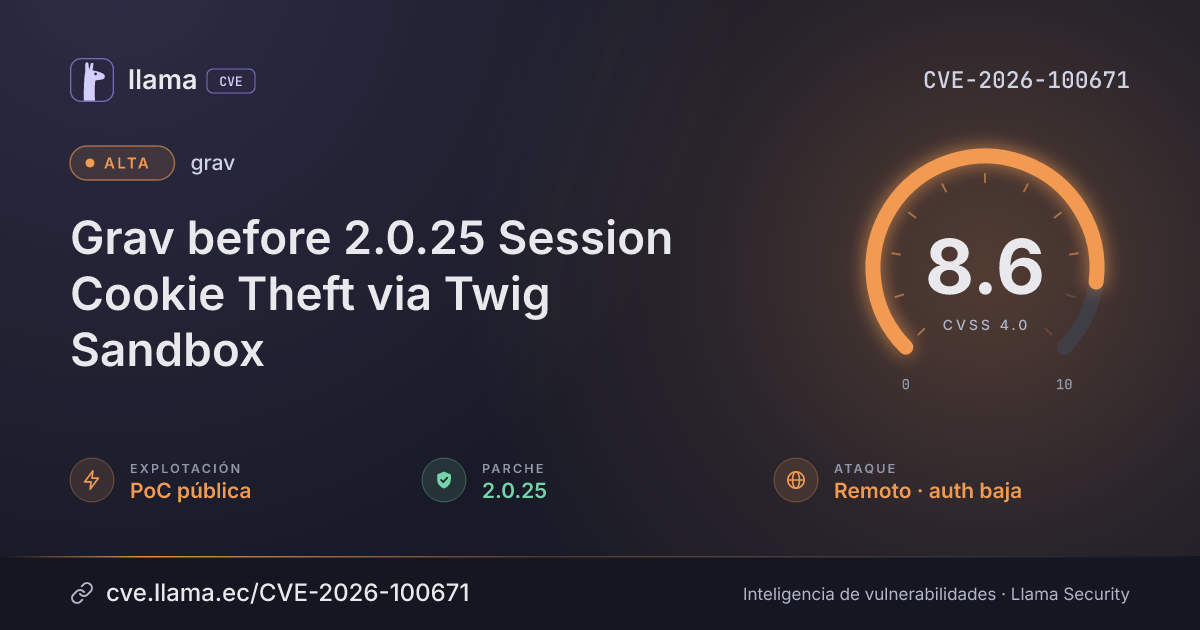
CVE-2026-100671
Grav before 2.0.25 Session Cookie Theft via Twig Sandbox
CVSS:4.0/AV:N/AC:L/AT:N/PR:L/UI:P/VC:H/VI:H/VA:H/SC:N/SI:N/SA:N
Fuente: CNA
Ciclo de vida de la vulnerabilidad
| Fecha | Fase | Evento | Detalle |
|---|---|---|---|
| Divulgación | Publicada | CVE-2026-100671 divulgada · CVSS 8.6 (CNA) | |
| Divulgación | Evaluación SSVC | CISA-ADP · explotación PoC pública | |
| Divulgación | Modificada | Última actualización del registro | |
| Monitoreo | Detectada | Ingresó al índice | |
| Monitoreo | Fuente: OSV | Registro visto por primera vez en OSV |
Grav is a flat-file CMS. In versions 2.0.19 through 2.0.24 — and in 2.0.0 through 2.0.18 and 1.7.x only where content Twig has been explicitly enabled — page content authored by a user holding only page-write permission is rendered through a Twig sandbox that allowlists get_cookie(), which returns any cookie sent with the current request, including the visitor's session cookie. Because the read occurs server-side via filter_input(INPUT_COOKIE, ...), the HttpOnly, Secure and SameSite attributes offer no protection. Grav then stores the finished post-Twig output in a page-content cache keyed only on page identity and the configuration checksum, with no session, user or request dimension and no bypass for authenticated visitors. A page published by a page-write user can therefore capture the session identifier of the next administrator who views it, after which the cached output serves that identifier to unauthenticated visitors, who can replay the cookie to authenticate as that administrator. Since 2.0.19, security.twig_content.process_enabled defaults to true and Security::applyTwigContentDefault() derives each page's process.twig flag from that gate, so content Twig runs on every page with no frontmatter or operator action. Fixed in 2.0.25; 1.7.x is outside the backport scope.
Desglose de métricas
Rangos afectados
Estado del parche por paquete
| Paquete / producto | Estado | Corregida en | Desde divulgación | Última versión |
|---|---|---|---|---|
grav |
Corregida | 2.0.25 | — | — |
2.0.25Arsenal público
Sin exploits, módulos ni PoC públicos conocidos a la fecha de verificación.
https://github.com/getgrav/grav/security/advisories/GHSA-pp89-h475-7gj6https://www.vulncheck.com/advisories/grav-before-2.0.25-session-cookie-theft-via-twig-sandboxLas referencias externas se muestran para copiar: cve.llama.ec no lo redirige a otros sitios.