llamaCVEVulnerability Intelligence
/
server

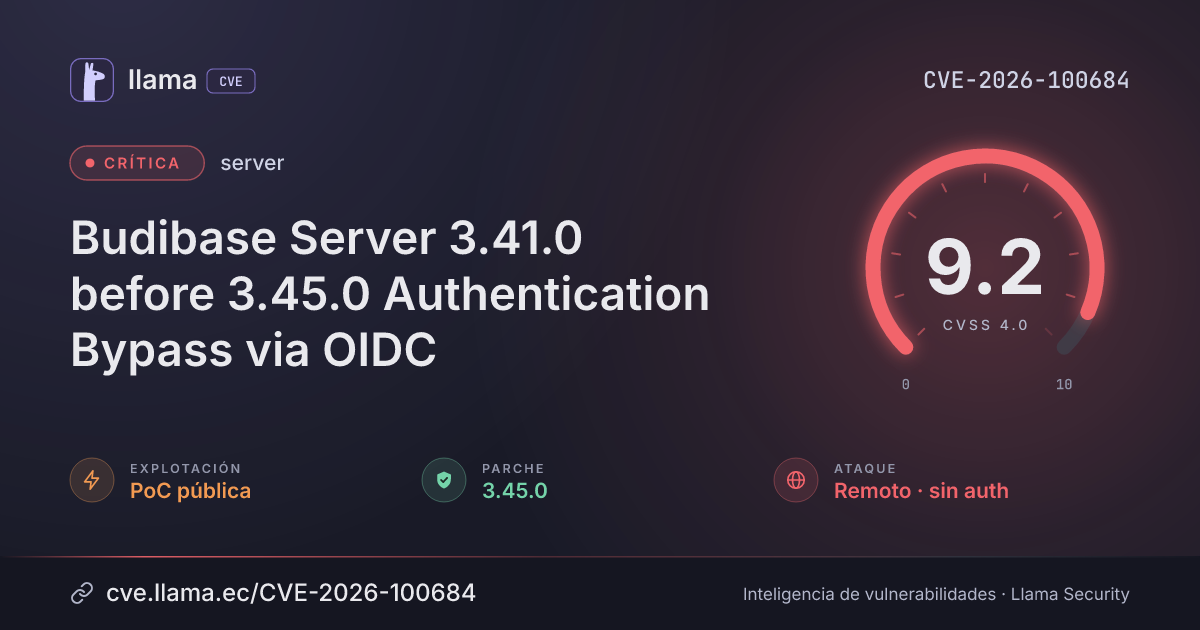
CVE-2026-100684

Budibase Server 3.41.0 before 3.45.0 Authentication Bypass via OIDC

Default setupsSin parche publicado
Descargar PNG JSON
CVSS 4.0
9.2
Crítica
CVSS:4.0/AV:N/AC:L/AT:P/PR:N/UI:N/VC:H/VI:H/VA:H/SC:N/SI:N/SA:N Fuente: CNA
ExplotaciónPoC públicaSSVC: poc · no figura en CISA KEV
Exploits públicos0Ninguno conocido
ParcheSin parcheEl fabricante no ha publicado corrección
Exposición54 dDesde la divulgación, 26 sept 2026, 8:23 a. m.
Detección26 dDesde la divulgación hasta su ingreso al índice
Decisión SSVCSeguir de cerca
Monitorear y programar la remediación
Existe PoC pública, no automatizable e impacto técnico total. No hay versión corregida: aplique mitigaciones.
Timeline

Ciclo de vida de la vulnerabilidad

Hoy
Divulgación
Publicada
Evaluación SSVC
Modificada
Explotación
Remediación
Monitoreo
Detectada
Fuente: OSV
Verificada
26 sept 26
28 sept 26
8 oct 26
22 oct 26
24 oct 26
18 nov 26
19 nov 26
26 sept 26
10 oct 26
23 oct 26
6 nov 26
19 nov 26
FechaFaseEventoDetalle
Divulgación Publicada CVE-2026-100684 divulgada · CVSS 9.2 (CNA)
Divulgación Evaluación SSVC CISA-ADP · explotación PoC pública
Divulgación Modificada Última actualización del registro
Monitoreo Detectada Ingresó al índice
Monitoreo Fuente: OSV Registro visto por primera vez en OSV
Monitoreo Verificada Última verificación contra las fuentes
Resumen

Budibase versions 3.41.0 before 3.45.0 contain an authentication bypass in the OIDC/SSO login path of @budibase/server. In sso.authenticate, when no existing user matches the incoming SSO subject, the server looks up pending user invites by the IdP-asserted email address alone — without validating an invite code and without an email_verified check (the email_verified gate protects only the existing-account lookup). An attacker who can register at an IdP that the tenant trusts for OIDC and assert a victim's invited email address (even with email_verified=false) claims the pending invite and inherits all of its granted privileges, including builder and admin.global, with no admin exclusion. This results in takeover of the invited principal and, for admin invites, full tenant compromise (access to all apps, datasources including production credentials, and automations); the invite is consumed, denying onboarding to the legitimate invitee.

Only affects Budibase Server 3.41.0 before 3.45.0 with the OIDC/SSO login path, where a pending user invite exists for the victim's email. Fixed in 3.45.0.

¿Qué significa?The server looks up pending user invites using only the email address asserted by the identity provider. An attacker who can register at an identity provider the tenant trusts for OIDC can assert the invited person's email and take over that invite, inheriting its privileges up to global admin. For admin invites this means full tenant compromise, and the legitimate invitee is denied onboarding.
¿Quién está afectado?Budibase Server versions 3.41.0 up to but not including 3.45.0 are affected when the OIDC/SSO login path is in use and a pending user invite exists for an email address. Check the Budibase Server version in use and whether OIDC/SSO login is enabled.
¿Qué hacer?Upgrade Budibase Server to 3.45.0 or later, which is the fixed version listed for this vulnerability.
Contexto

Condiciones y alcance

Condiciones necesarias para que el fallo sea explotable
01
Budibase Server 3.41.0 up to but not including 3.45.0, with the OIDC/SSO login path“Budibase versions 3.41.0 before 3.45.0 contain an authentication bypass in the OIDC/SSO login path”
02
An IdP the tenant trusts for OIDC where the attacker can register and assert the victim's invited email“An attacker who can register at an IdP that the tenant trusts for OIDC”
03
A pending user invite exists for the victim's email address“the server looks up pending user invites by the IdP-asserted email address alone”
¿Quién debe revisar?Teams running Budibase Server 3.41.0 through 3.44.x with OIDC/SSO login enabled and pending user invites outstanding
Vector CVSS 4.0

Desglose de métricas

Opción resaltada = valor del vector · izquierda = peor caso · CNA
Vector de ataqueAV:N
RedAdyacenteLocalFísica
ComplejidadAC:L
BajaAlta
Requisitos de ataqueAT:P
NingunoPresentes
PrivilegiosPR:N
NingunoBajosAltos
InteracciónUI:N
NingunaPasivaActiva
Confid. (sistema)VC:H
AltoBajoNinguno
Integridad (sistema)VI:H
AltoBajoNinguno
Disponib. (sistema)VA:H
AltoBajoNinguno
Confid. (posterior)SC:N
AltoBajoNinguno
Integridad (posterior)SI:N
AltoBajoNinguno
Disponib. (posterior)SA:N
AltoBajoNinguno
Versiones

Rangos afectados

Afectada Corregida Última
@budibase/server< 3.45.0
server≥ 3.41.0 < 3.45.0
3.38.1
3.41.0
3.45.0
Remediación

Estado del parche por paquete

Paquete / productoEstadoCorregida enDesde divulgaciónÚltima versión
npm@budibase/server
Sin parche — — 3.38.1 afectada
Versiones corregidas3.45.0
Explotación

Arsenal público

Sin exploits, módulos ni PoC públicos conocidos a la fecha de verificación.

Referencias
Fabricantehttps://github.com/Budibase/budibase/security/advisories/GHSA-35ch-57g2-3g98
Otrahttps://www.vulncheck.com/advisories/budibase-server-3.41.0-before-3.45.0-authentication-bypass-via-oidc

Las referencias externas se muestran para copiar: cve.llama.ec no lo redirige a otros sitios.