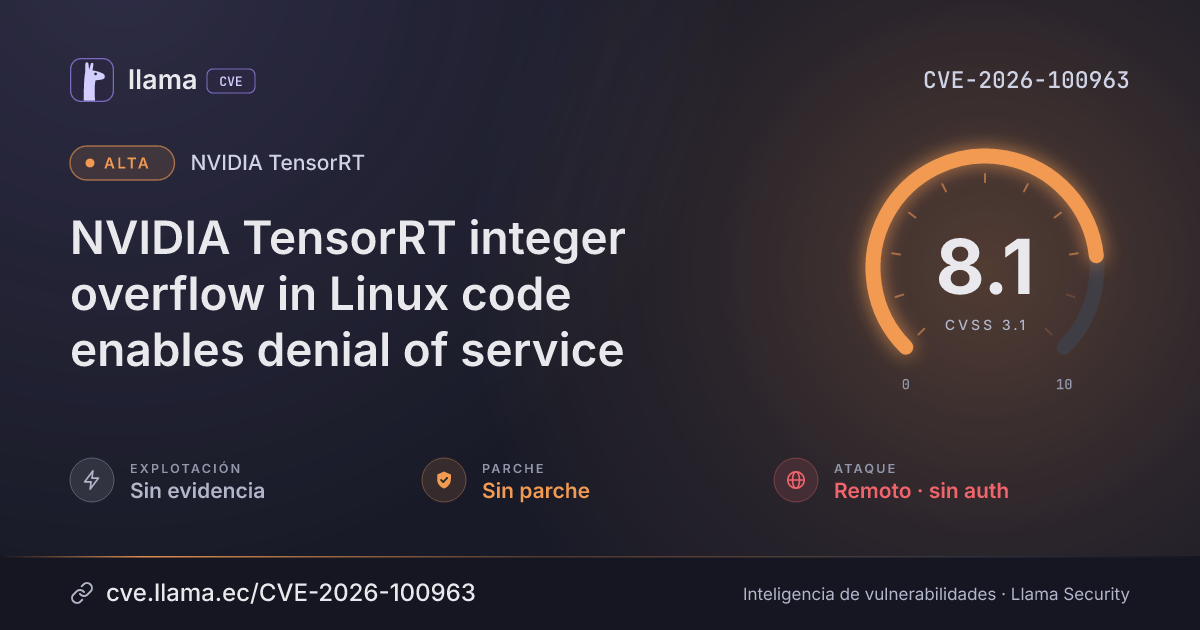
CVE-2026-100963
NVIDIA TensorRT integer overflow in Linux code enables denial of service
A remote attacker can crash the software or tamper with data by tricking a user into opening a crafted file.
CVSS:3.1/AV:N/AC:L/PR:N/UI:R/S:U/C:N/I:H/A:H
Fuente: CNA
Ciclo de vida de la vulnerabilidad
| Fecha | Fase | Evento | Detalle |
|---|---|---|---|
| Divulgación | Publicada | CVE-2026-100963 divulgada · CVSS 8.1 (CNA) | |
| Divulgación | Evaluación SSVC | CISA-ADP · explotación ninguna | |
| Divulgación | Modificada | Última actualización del registro | |
| Monitoreo | Detectada | Ingresó al índice | |
| Monitoreo | Verificada | Última verificación contra las fuentes |
NVIDIA TensorRT for Linux has an integer overflow flaw that a user can trigger remotely, without logging in, though the attack requires someone to take an action such as opening a crafted file. A successful attack could cause denial of service and allow data to be tampered with.
Descripción original del registro (nvidia)
NVIDIA TensorRT for Linux contains a vulnerability where a user could cause an integer overflow issue. A successful exploit of this vulnerability might lead to denial of service and data tampering.
Desglose de métricas
Versiones afectadas
0 to 11.2Estado del parche por paquete
| Paquete / producto | Estado | Corregida en | Desde divulgación | Última versión |
|---|---|---|---|---|
TensorRT |
Sin parche | — | — | — |
Arsenal público
Sin exploits, módulos ni PoC públicos conocidos a la fecha de verificación.
https://github.com/NVIDIA/product-security/tree/main/2026/5921https://nvd.nist.gov/vuln/detail/CVE-2026-100963https://www.cve.org/CVERecord?id=CVE-2026-100963Las referencias externas se muestran para copiar: cve.llama.ec no lo redirige a otros sitios.