llamaCVEVulnerability Intelligence
/
TeamPass

CVE-2026-103035

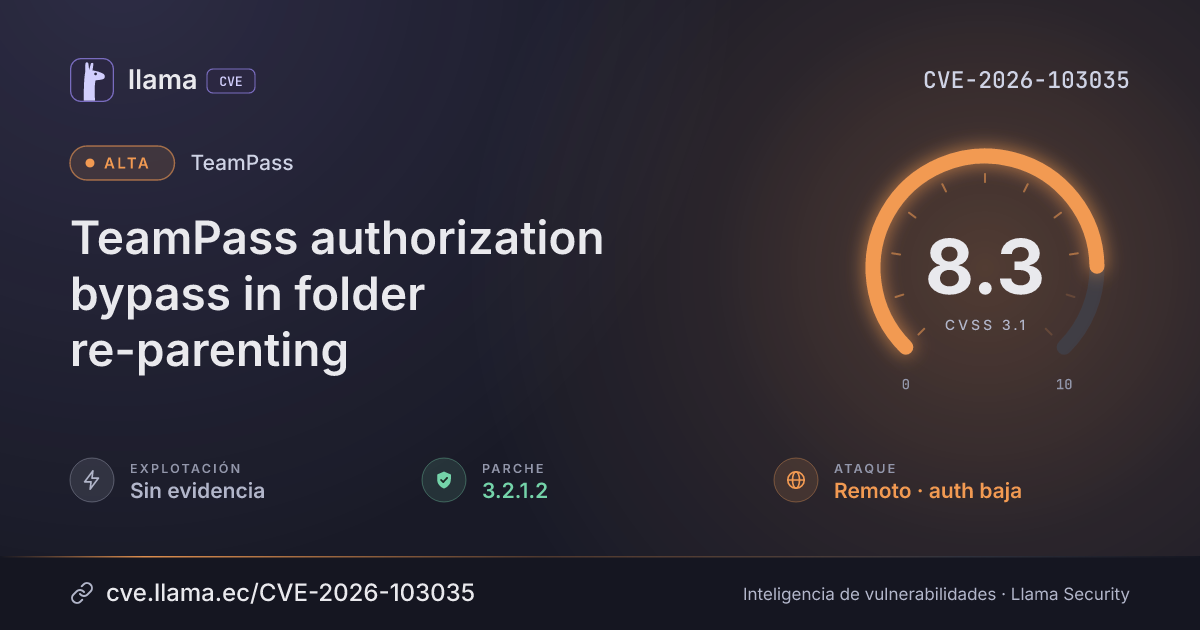
TeamPass authorization bypass in folder re-parenting

Logged-in users with write access can hide credential folders from admins and view logins, URLs, and emails.

Solo en configuraciones específicasParche disponibleinsecure direct object reference (IDOR)
Descargar PNG JSON
CVSS 3.1
8.3
Alta
CVSS:3.1/AV:N/AC:L/PR:L/UI:N/S:U/C:L/I:H/A:H Fuente: CNA
ExplotaciónSin evidenciaNo figura en CISA KEV
Exploits públicos0Ninguno conocido
Parche1 versión3.2.1.2
Exposición1 dDesde la divulgación, 19 nov 2026, 1:22 p. m.
Detección11 minDesde la divulgación hasta su ingreso al índice
Decisión estimadaSeguir
Remediar en la ventana regular de mantenimiento
Estimación de Llama con el árbol SSVC de CISA a partir de vector CVSS 3.1 y la evidencia de explotación (sin evaluación oficial): sin explotación conocida, no automatizable e impacto técnico parcial. Hay versiones corregidas disponibles.
Revisa si tu versión cae en el rango. Te espero.Si el fabricante actualiza el aviso, vuelve a mirar.
Timeline

Ciclo de vida de la vulnerabilidad

Hoy
Divulgación
Publicada
Explotación
Remediación
Monitoreo
Detectada
Fuente: NIST NVD +1
01:22 p. m.
02:25 p. m.
12:39 p. m.
01:22 p. m.
01:12 a. m.
01:01 p. m.
12:50 a. m.
12:39 p. m.
FechaFaseEventoDetalle
Divulgación Publicada CVE-2026-103035 divulgada · CVSS 8.3 (CNA)
Monitoreo Detectada Ingresó al índice
Monitoreo Fuente: NIST NVD Registro visto por primera vez en NIST NVD
Monitoreo Verificada Última verificación contra las fuentes
Resumen
Resumen generado por IA · CC-BY 4.0 · 19 nov 2026

TeamPass, a self-hosted collaborative password manager from nilsteampassnet, lets a logged-in user with non-read-only access, reached remotely over the network, move a folder of stored credentials into their own personal space, hiding it from the organization, including administrators. The move exposes entry labels, logins, URLs, email addresses, and descriptions, though passwords protected by sharekeys stay hidden.

Affects TeamPass up to 3.2.1.1 for authenticated users who are not read-only. Fixed in 3.2.1.2.

¿Qué significa?An authenticated, non-read-only TeamPass user can re-parent any folder into their own personal space. The plaintext labels, logins, URLs, emails and descriptions of credentials in that subtree then become accessible to them and are hidden from the organization, including administrators. Item passwords stay protected by sharekeys.
¿Quién está afectado?TeamPass versions up to 3.2.1.1 are affected, and the advisory also confirms that 3.1.3.1 and 3.1.7.6 contain the flaw. The attacker needs an authenticated account that is not read-only, and no administrative role is required. The installed version and the account's read-only status are the things to check.
¿Qué hacer?Upgrade TeamPass to 3.2.1.2, the fixed version listed for this vulnerability.
Descripción original del registro (GitHub_M)

TeamPass is a self-hosted collaborative password manager. Prior to 3.2.1.2, the update_folder action in app/sources/folders.queries.php allowed an authenticated, non-read-only user to re-parent a folder without checking whether the target folder or submitted parentId belonged to the caller's user-accessible_folders set. Selecting a personal folder as the new parent passed the personal-folder guard and set personal_folder on the target, transferring the credential subtree into the attacker's accessible space after the next login and hiding it from the organization, including administrators. The change exposed credential labels, logins, URLs, email addresses, and descriptions, while sharekey-protected passwords remained protected; hiding the subtree also denied other users access. This issue is fixed in version 3.2.1.2.

Contexto

Condiciones y alcance

Condiciones necesarias para que el fallo sea explotable
01
TeamPass versions up to 3.2.1.1 (the advisory also confirms 3.1.3.1 and 3.1.7.6 contain the flaw)“Confirmed at HEAD 2f271cd (3.2.1.1), and present at 3.1.3.1 and 3.1.7.6.”
02
Attacker must be an authenticated user who is not read-only“An authenticated TeamPass user who is not read-only (no administrative role required).”
¿Quién debe revisar?Teams running TeamPass 3.2.1.1 or earlier, where any authenticated non-read-only user can manage folders and personal folders.
Vector CVSS 3.1

Desglose de métricas

Opción resaltada = valor del vector · izquierda = peor caso · CNA
Vector de ataqueAV:N
RedAdyacenteLocalFísica
ComplejidadAC:L
BajaAlta
PrivilegiosPR:L
NingunoBajosAltos
InteracciónUI:N
NingunaRequerida
AlcanceS:U
CambiadoSin cambio
ConfidencialidadC:L
AltoBajoNinguno
IntegridadI:H
AltoBajoNinguno
DisponibilidadA:H
AltoBajoNinguno
Score de explotaciónQué tan fácil y probable es que la exploten
8.3/ 10Alto
Vector 8.3 (muy fácil) · sin evidencia de explotación.
Versiones

Rangos afectados

Afectada Corregida
TeamPass< 3.2.1.2
nilsteampassnet/TeamPass< 3.2.2.0
3.2.1.2
3.2.2.0
Remediación

Estado del parche por paquete

Paquete / productoEstadoCorregida enDesde divulgaciónÚltima versión
TeamPass
Corregida 3.2.1.2 — —
Versiones corregidas3.2.1.2
Explotación

Arsenal público

Sin exploits, módulos ni PoC públicos conocidos a la fecha de verificación.

Referencias
Fabricantehttps://github.com/nilsteampassnet/TeamPass/security/advisories/GHSA-66q9-mxf2-xqw6
Otrahttps://github.com/nilsteampassnet/TeamPass/commit/e022b27f99149995c90a81f83b8e0ae8b48f5a20
Otrahttps://github.com/nilsteampassnet/TeamPass/releases/tag/3.2.1.2

Las referencias externas se muestran para copiar: cve.llama.ec no lo redirige a otros sitios.