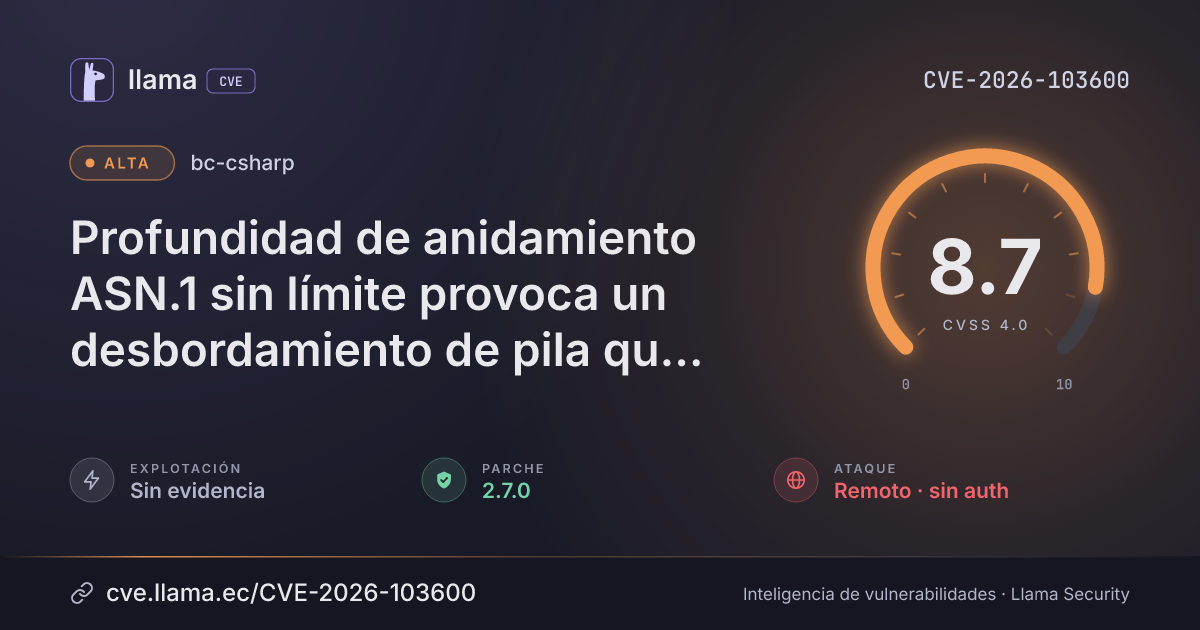
CVE-2026-103600
Unbounded ASN.1 nesting depth causes process-terminating stack overflow
CVSS:4.0/AV:N/AC:L/AT:N/PR:N/UI:N/VC:N/VI:N/VA:H/SC:N/SI:N/SA:N
Fuente: CNA
Ciclo de vida de la vulnerabilidad
| Fecha | Fase | Evento | Detalle |
|---|---|---|---|
| Divulgación | Publicada | CVE-2026-103600 divulgada · CVSS 8.7 (CNA) | |
| Divulgación | Evaluación SSVC | CISA-ADP · explotación ninguna | |
| Divulgación | Modificada | Última actualización del registro | |
| Monitoreo | Detectada | Ingresó al índice | |
| Monitoreo | Fuente: OSV | Registro visto por primera vez en OSV | |
| Monitoreo | Fuente: NIST NVD | Registro visto por primera vez en NIST NVD |
Uncontrolled recursion in the ASN.1 parser (Asn1InputStream, Asn1StreamParser) in Legion of the Bouncy Castle Inc. bc-csharp before 2.7.0 allows a remote unauthenticated attacker to cause a denial of service via a crafted ASN.1 encoding of deeply nested constructed elements (for example SEQUENCE inside SEQUENCE, in definite-length DER or indefinite-length BER form), because each nesting level is parsed by a further recursive call with no bound on depth. About 2,000 levels (8 KB of DER) are enough to exhaust a 1.5 MB thread stack, the .NET main-thread default on Windows, and raise a StackOverflowException, which .NET cannot catch and which terminates the whole process; on threads with larger stacks, parse time instead grows quadratically with depth (about 9 seconds of CPU for a 64 KB input). Any path that parses untrusted ASN.1 is exposed, including X.509 certificates and CRLs, CMS/PKCS#7, PKCS#8/PKCS#12, OCSP and TLS Certificate messages.
Desglose de métricas
Rangos afectados
Estado del parche por paquete
| Paquete / producto | Estado | Corregida en | Desde divulgación | Última versión |
|---|---|---|---|---|
bc-csharp |
Corregida | 2.7.0 | — | — |
2.7.0Arsenal público
Sin exploits, módulos ni PoC públicos conocidos a la fecha de verificación.
https://github.com/bcgit/bc-csharp/wiki/CVE-2026-103600https://github.com/bcgit/bc-csharp/commit/89c81b0da7fe11cd70013285560bbc472cb73901https://github.com/bcgit/bc-csharp/commit/b99f4e3dcea05b57becc79dfa6ad91a54c778d65Las referencias externas se muestran para copiar: cve.llama.ec no lo redirige a otros sitios.