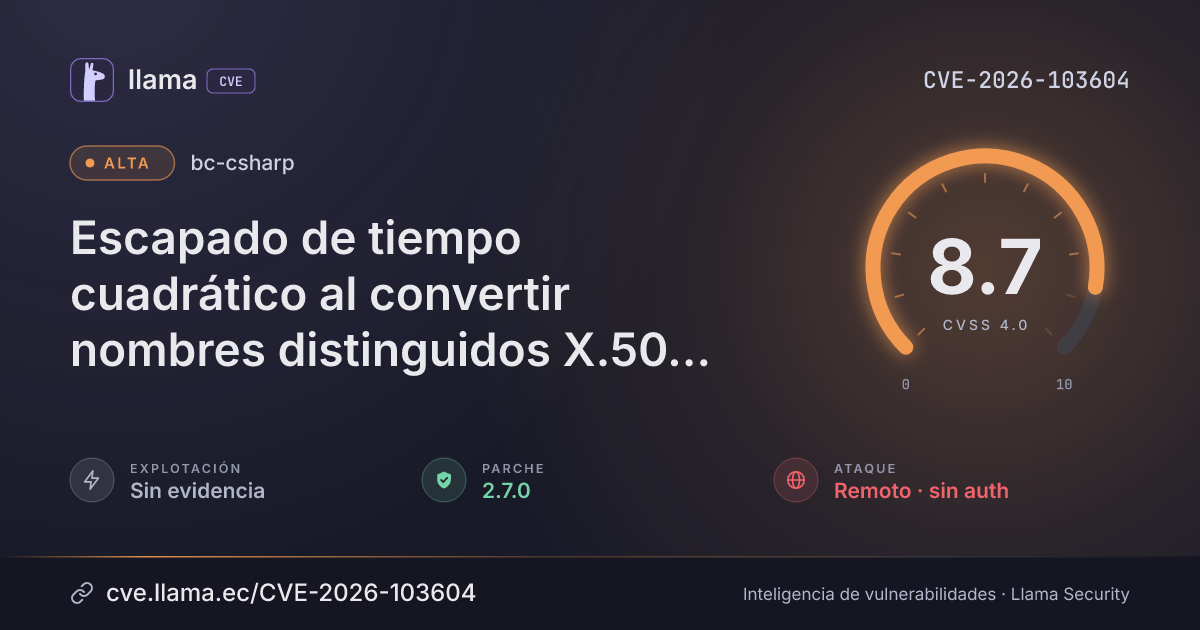
CVE-2026-103604
Quadratic-time escaping when converting X.509 distinguished names to strings
CVSS:4.0/AV:N/AC:L/AT:N/PR:N/UI:N/VC:N/VI:N/VA:H/SC:N/SI:N/SA:N
Fuente: CNA
Ciclo de vida de la vulnerabilidad
| Fecha | Fase | Evento | Detalle |
|---|---|---|---|
| Divulgación | Publicada | CVE-2026-103604 divulgada · CVSS 8.7 (CNA) | |
| Divulgación | Evaluación SSVC | CISA-ADP · explotación ninguna | |
| Divulgación | Modificada | Última actualización del registro | |
| Monitoreo | Detectada | Ingresó al índice | |
| Monitoreo | Fuente: OSV | Registro visto por primera vez en OSV | |
| Monitoreo | Fuente: NIST NVD | Registro visto por primera vez en NIST NVD |
Inefficient algorithmic complexity in X.509 distinguished name string conversion (X509Name.ToString and IetfUtilities.ValueToString) in Legion of the Bouncy Castle Inc. bc-csharp before 2.7.0 allows a remote unauthenticated attacker to cause a denial of service through CPU exhaustion via a certificate, CRL, certification request or other structure whose name contains a long attribute value made up of characters that must be escaped, such as commas, or of leading or trailing spaces, because each escaping backslash was inserted into the buffer being scanned, so the work grew quadratically with the length of the value. Applications are exposed when they convert such a name to a string, for example to log or display it, or compare it with IetfUtilities.RdnAreEqual, as PKIX path validation does for directoryName name constraints.
Desglose de métricas
Rangos afectados
Estado del parche por paquete
| Paquete / producto | Estado | Corregida en | Desde divulgación | Última versión |
|---|---|---|---|---|
bc-csharp |
Corregida | 2.7.0 | — | — |
2.7.0Arsenal público
Sin exploits, módulos ni PoC públicos conocidos a la fecha de verificación.
https://github.com/bcgit/bc-csharp/wiki/CVE-2026-103604https://github.com/bcgit/bc-csharp/commit/bd03e38bbb49db5be33f4463fc40997400c545ccLas referencias externas se muestran para copiar: cve.llama.ec no lo redirige a otros sitios.