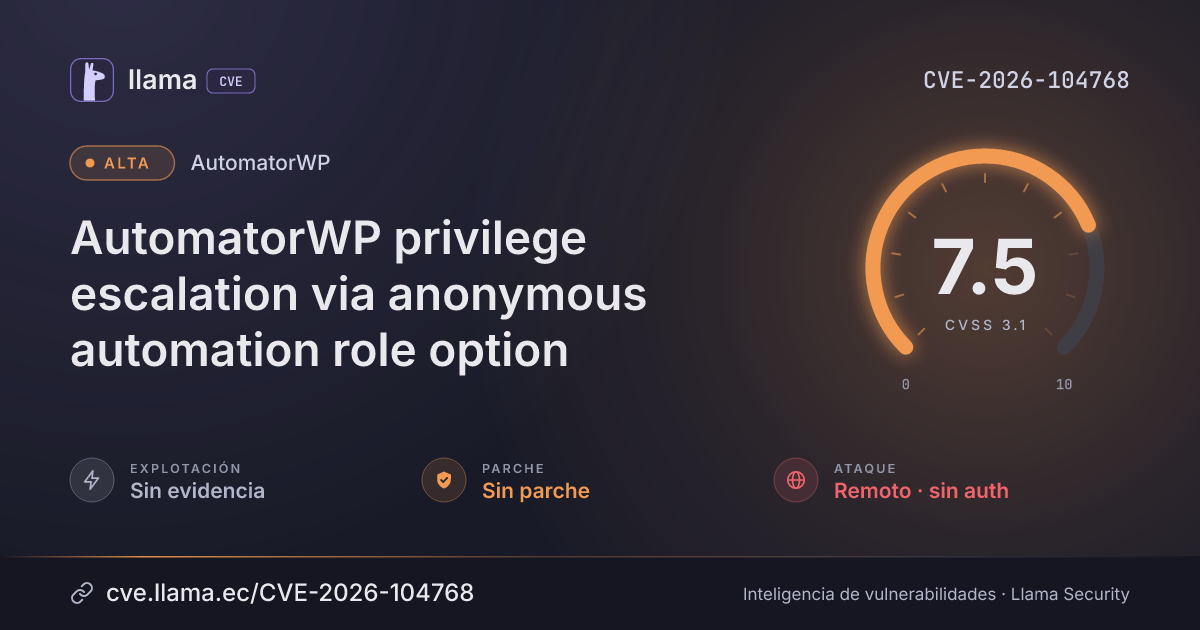
CVE-2026-104768
AutomatorWP privilege escalation via anonymous automation role option
Remote attackers without a login can gain administrator rights and full site control if an admin approves a comment.
CVSS:3.1/AV:N/AC:H/PR:N/UI:R/S:U/C:H/I:H/A:H
Fuente: CNA
Ciclo de vida de la vulnerabilidad
| Fecha | Fase | Evento | Detalle |
|---|---|---|---|
| Divulgación | Publicada | CVE-2026-104768 divulgada · CVSS 7.5 (CNA) | |
| Monitoreo | Detectada | Ingresó al índice | |
| Monitoreo | Fuente: NIST NVD | Registro visto por primera vez en NIST NVD | |
| Monitoreo | Fuente: ENISA EUVD | Registro visto por primera vez en ENISA EUVD | |
| Divulgación | Evaluación SSVC | CISA-ADP · explotación ninguna | |
| Divulgación | Modificada | Última actualización del registro | |
| Monitoreo | Verificada | Última verificación contra las fuentes |
Affected software is the AutomatorWP WordPress plugin (version 6.0.4 and earlier), which contains a flaw in how it validates roles for anonymous automations. An attacker can reach it remotely without logging in, but it only works if a site administrator approves a comment, and the attacker can then use it to create an administrator account and gain full control of the site.
Descripción original del registro (Wordfence)
The AutomatorWP – No-Code Workflow Automation, Integration & Webhooks Plugin, now with AI plugin for WordPress is vulnerable to Privilege Escalation in all versions up to, and including, 6.0.4. This is due to missing privilege-ceiling validation in the `create_user()` function within the anonymous-user action (and equally in the Create User and Add/Change Role WordPress-integration actions), which verify only that the submitted role exists via `automatorwp_get_editable_roles()` without confirming the role falls at or below the acting context's privilege level — allowing attacker-controlled trigger tag data (e.g., a `{comment_author}` tag bound to the Role option) to supply any role, including `administrator`, unchallenged. This makes it possible for unauthenticated attackers to create a new administrator-role account tied to an attacker-controlled email address, receiving the generated password via WordPress's new-user notification email and thereby gaining full administrative access to the site. Exploitation requires the site to have an anonymous automation configured with the Role option bound to a dynamic trigger tag such as `{comment_author}`, and is triggered when a site administrator performs the routine action of approving a comment — an action that provides no in-UI indication that it will mint a new privileged account from the comment author field.
Desglose de métricas
Rangos afectados
Estado del parche por paquete
| Paquete / producto | Estado | Corregida en | Desde divulgación | Última versión |
|---|---|---|---|---|
AutomatorWP – No-Code Workflow Automation, Integration & Webhooks Plugin, now with AI |
Sin parche | — | — | — |
Arsenal público
Sin exploits, módulos ni PoC públicos conocidos a la fecha de verificación.
https://www.wordfence.com/threat-intel/vulnerabilities/id/6138f184-4475-4288-835f-9bf8c21f9147?source=cvehttps://plugins.trac.wordpress.org/browser/automatorwp/tags/6.0.3/integrations/automatorwp/actions/anonymous-user.php#L500https://plugins.trac.wordpress.org/browser/automatorwp/tags/6.0.3/integrations/automatorwp/actions/anonymous-user.php#L487https://plugins.trac.wordpress.org/browser/automatorwp/tags/6.0.3/includes/events.php#L1303https://plugins.trac.wordpress.org/browser/automatorwp/tags/6.0.3/integrations/wordpress/triggers/anonymous-comment-post-type.php#L111https://plugins.trac.wordpress.org/browser/automatorwp/tags/6.0.3/integrations/wordpress/actions/create-user.php#L174https://plugins.trac.wordpress.org/browser/automatorwp/tags/6.0.3/integrations/wordpress/actions/user-role.php#L149https://plugins.trac.wordpress.org/changeset?reponame=&old=3754573%40automatorwp&new=3754573%40automatorwpLas referencias externas se muestran para copiar: cve.llama.ec no lo redirige a otros sitios.