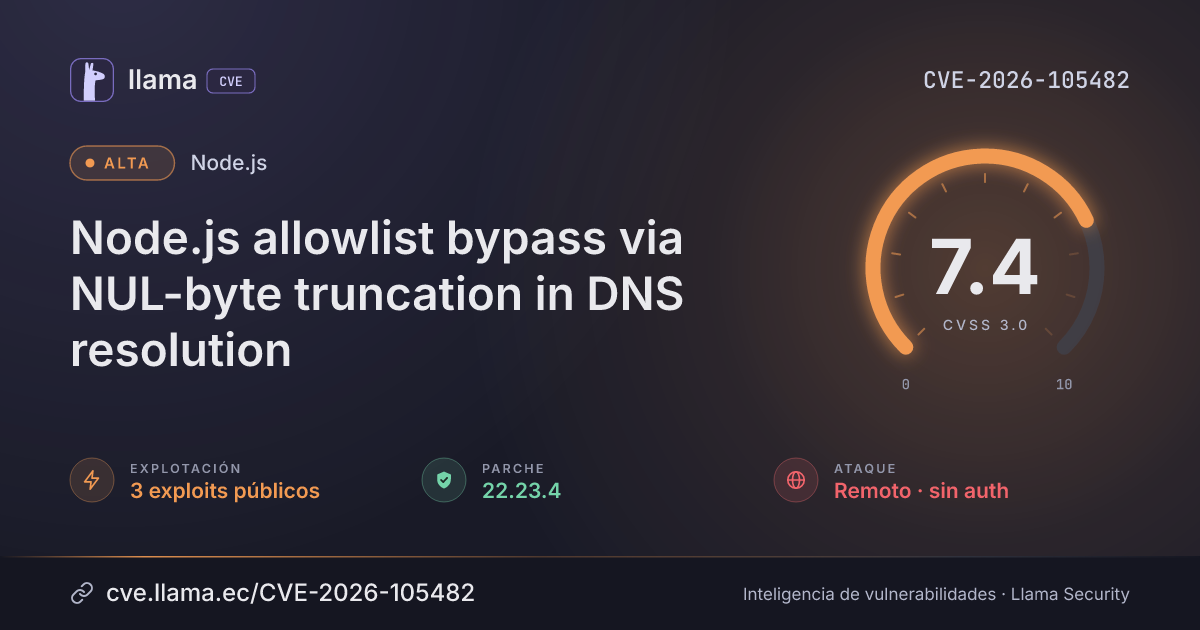
CVE-2026-105482
Node.js allowlist bypass via NUL-byte truncation in DNS resolution
An attacker can use a hostname with an embedded NUL byte to get DNS records for a different, unvalidated domain.
CVSS:3.0/AV:N/AC:H/PR:N/UI:N/S:U/C:H/I:H/A:N
Fuente: CNA
Ciclo de vida de la vulnerabilidad
| Fecha | Fase | Evento | Detalle |
|---|---|---|---|
| Divulgación | Publicada | CVE-2026-105482 divulgada · CVSS 7.4 (CNA) | |
| Monitoreo | Detectada | Ingresó al índice | |
| Monitoreo | Fuente: NIST NVD | Registro visto por primera vez en NIST NVD | |
| Monitoreo | Fuente: ENISA EUVD | Registro visto por primera vez en ENISA EUVD | |
| Divulgación | Evaluación SSVC | CISA-ADP · explotación ninguna | |
| Divulgación | Modificada | Última actualización del registro | |
| Monitoreo | Fuente: PoC-in-GitHub | Registro visto por primera vez en PoC-in-GitHub | |
| Monitoreo | Verificada | Última verificación contra las fuentes |
A flaw in the DNS resolution functions of Node.js (the dns.resolve*() family and dns.reverse()) causes hostnames containing a NUL byte to be silently cut short, so lookups return records for a different name than the one requested. Applications that check a hostname against an allowlist and then resolve it with these functions may end up acting on data belonging to an unvalidated domain.
Affects Node.js 22.23.3, 24.22.0 and 26.12.0 apps that pass hostnames to dns.resolve*() or dns.reverse(). The listed fix is Node.js 22.23.4.
Descripción original del registro (hackerone)
A flaw in Node.js DNS resolution allows hostnames containing a NUL byte to be silently truncated by the dns.resolve*() functions and dns.reverse(). This is an incomplete fix of CVE-2026-48930, which only covered dns.lookup() and the net/tls host options. Because the name is passed to c-ares as a C string, resolving attacker.example\0.trusted.example queries attacker.example and returns its records without any error. Applications that validate a hostname, for example against a domain allowlist, and then resolve it with dns.resolve*() can act on records for a different name than the one they validated. This vulnerability affects Node.js 26.x, 24.x, and 22.x.
Condiciones y alcance
Desglose de métricas
Rangos afectados
Estado del parche por paquete
| Paquete / producto | Estado | Corregida en | Desde divulgación | Última versión |
|---|---|---|---|---|
node |
Corregida | 22.23.4 | — | — |
22.23.4Arsenal público
Ver los 3 repositorios de GitHub
Los repositorios públicos incluyen exploits, escáneres, laboratorios y reglas de detección. No ejecute código de terceros sin revisarlo en un entorno aislado.
https://nodejs.org/en/blog/vulnerability/october-2026-security-releaseshttps://github.com/CaterMaoZi/CVE-2026-105482-POChttps://github.com/CompleteTech-Security/node-cve-2026-105482-checkhttps://github.com/EthanTech-Offical/CVE-2026-105482-ReproduceLas referencias externas se muestran para copiar: cve.llama.ec no lo redirige a otros sitios.