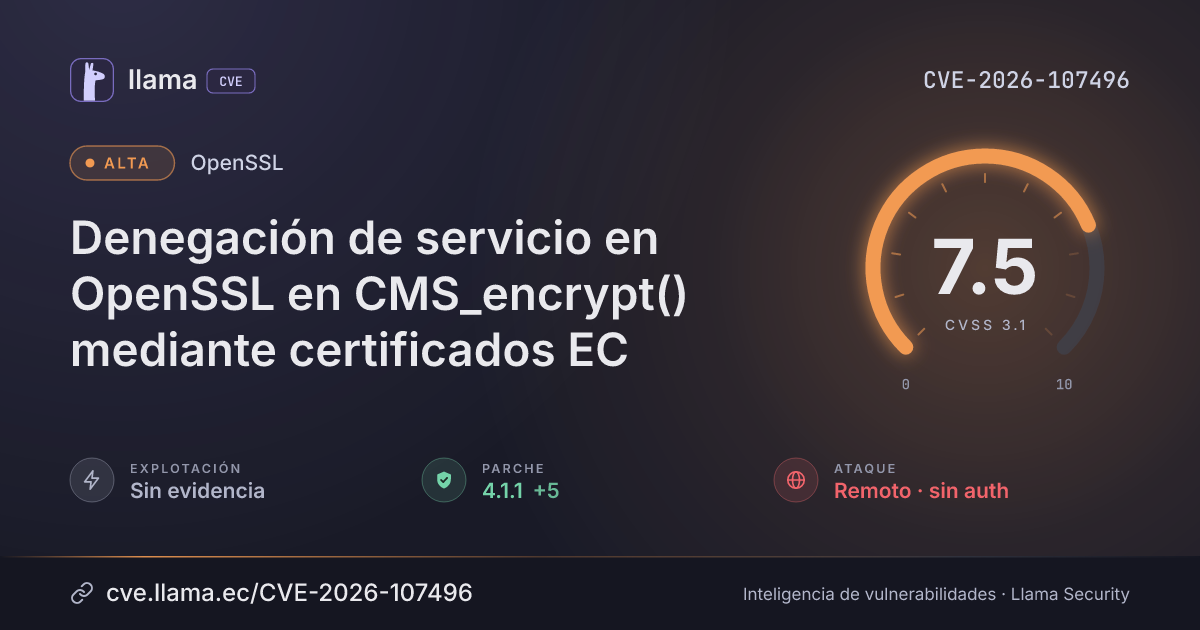
CVE-2026-107496
OpenSSL denial of service in CMS_encrypt() via EC certificates
An attacker can supply an EC recipient certificate that makes CMS encryption hang and consume CPU.
CVSS:3.1/AV:N/AC:L/PR:N/UI:N/S:U/C:N/I:N/A:H
Fuente: CISA-ADP
Ciclo de vida de la vulnerabilidad
| Fecha | Fase | Evento | Detalle |
|---|---|---|---|
| Divulgación | Publicada | CVE-2026-107496 divulgada · CVSS 7.5 (CISA-ADP) | |
| Monitoreo | Detectada | Ingresó al índice | |
| Monitoreo | Fuente: NIST NVD | Registro visto por primera vez en NIST NVD | |
| Monitoreo | Fuente: ENISA EUVD | Registro visto por primera vez en ENISA EUVD | |
| Divulgación | Evaluación SSVC | CISA-ADP · explotación ninguna | |
| Divulgación | Modificada | Última actualización del registro | |
| Monitoreo | Verificada | Última verificación contra las fuentes |
OpenSSL's CMS_encrypt() and CMS_encrypt_ex() functions can loop indefinitely when encrypting to an EC recipient certificate whose group order is 1. An attacker who can supply that recipient certificate to an application that performs CMS encryption can make the application hang and consume CPU, causing a denial of service.
Affects OpenSSL 4.0 and later builds configured with enable-ec_explicit_curves, only when an application calls CMS_encrypt() or CMS_encrypt_ex() with an attacker-controlled EC recipient certificate. Fixed in 4.1.1.
Descripción original del registro (openssl)
Issue summary: Encrypting a CMS message to an EC certificate whose group order is 1 may cause CMS_encrypt() or CMS_encrypt_ex() to loop indefinitely. Impact summary: An attacker able to supply the recipient certificate to an application performing CMS encryption can cause that application to loop indefinitely, consuming CPU and resulting in Denial of Service. CWE: CWE-835: Loop with Unreachable Exit Condition ('Infinite Loop') Description: CMS_encrypt() and CMS_encrypt_ex() encrypt a message to one or more recipient certificates and, for an EC recipient, generate an ephemeral key in the recipient's group. If the certificate declares a group order of 1, random scalar generation can only produce zero. The key generation routine then retries without limit while waiting for a nonzero private scalar, so the call never returns. The OpenSSL TLS and QUIC implementations do not use this path. An application is exposed only if it calls CMS_encrypt() or CMS_encrypt_ex() with a recipient certificate whose EC parameters are attacker-controlled. Certificates with normal EC group orders do not trigger the loop. OpenSSL 4.0 and later reject unknown explicit EC groups in default builds. These versions are affected only when configured with the enable-ec_explicit_curves option. The result is a hang that consumes a CPU core until the process is interrupted, a Denial of Service. The severity is Low because the attacker must supply the recipient certificate and the application must choose to encrypt to it; ordinary CMS encryption to trusted recipients is unaffected. The fix makes EC key generation fail when the group has no valid nonzero private scalar, instead of retrying indefinitely. FIPS impact: no The FIPS modules in 4.1, 4.0, 3.5 and 3.0 are not affected. The FIPS provider does not support arbitrary explicit EC domain parameters, so an order-1 group is rejected during key import before the vulnerable key generation path is reached.
Condiciones y alcance
Desglose de métricas
Rangos afectados
Estado del parche por paquete
| Paquete / producto | Estado | Corregida en | Desde divulgación | Última versión |
|---|---|---|---|---|
OpenSSL |
Corregida | 1.0.2zt, 1.1.1zk, 3.0.24, 3.5.10, 4.0.4, 4.1.1 | — | — |
1.0.2zt1.1.1zk3.0.243.5.104.0.44.1.1Arsenal público
Sin exploits, módulos ni PoC públicos conocidos a la fecha de verificación.
https://openssl-library.org/news/secadv/20261110.txthttps://github.com/openssl/openssl/commit/36e15b618decdff1b116eead6747718e6e729ad2https://github.com/openssl/openssl/commit/a8531368ddb1f86d2a2782a8b693926bb67b59e7https://github.com/openssl/openssl/commit/a0051cfe699bf5a047bc1c4faef65f80f7987366Las referencias externas se muestran para copiar: cve.llama.ec no lo redirige a otros sitios.