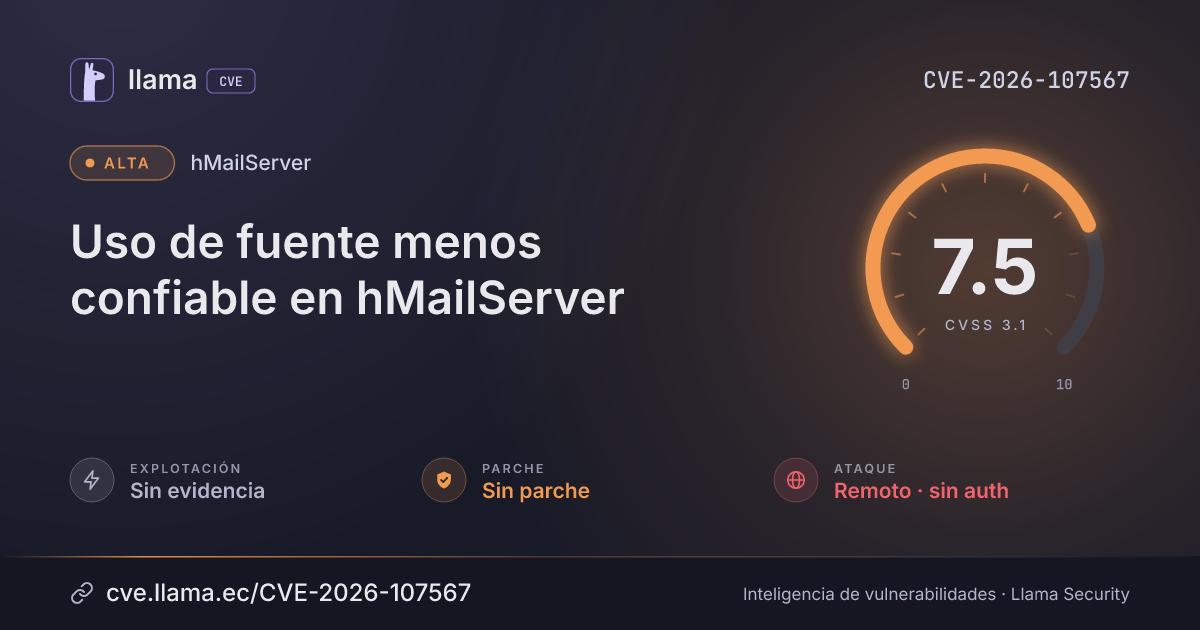
CVE-2026-107567
Use of Less Trusted Source in hMailServer
Texto original en inglés · Ver en español
CVSS:3.1/AV:N/AC:L/PR:N/UI:N/S:U/C:N/I:H/A:N
Fuente: CNA
Ciclo de vida de la vulnerabilidad
| Fecha | Fase | Evento | Detalle |
|---|---|---|---|
| Divulgación | Publicada | CVE-2026-107567 divulgada · CVSS 7.5 (CNA) | |
| Divulgación | Evaluación SSVC | CISA-ADP · explotación ninguna | |
| Divulgación | Modificada | Última actualización del registro | |
| Monitoreo | Detectada | Ingresó al índice | |
| Monitoreo | Fuente: OSV | Registro visto por primera vez en OSV | |
| Monitoreo | Verificada | Última verificación contra las fuentes |
Use of a less trusted source in the DKIM signing of Progressive Robot hMailServer 6.0.0 through 6.3.6 allows a remote unauthenticated attacker to have mail they write signed with the DKIM key of a domain the server hosts, so that it passes DKIM and DMARC for that domain at other receivers. With DKIM signing enabled for a hosted domain, the server signed every message on its first delivery pass as the domain named in its From header, before local delivery, whatever the message's origin and without checking that its sender had authenticated. A sender anywhere could therefore send the server, as ordinary inbound mail, a message whose From is any address at such a domain, and the server signed it with that domain's key. Every copy the server then sent on to an address outside carried a valid signature aligned with the forged From, whatever the domain's DMARC policy: an account's forward, a mail rule's forward or copy, a Sieve redirect, an alias or distribution list with an outside member, the mirror copy, a managed-list or journal copy, or a message released from quarantine. A signed copy can also be re-sent to other recipients while the domain's key is unchanged. Exploitation needs DKIM signing to be enabled for the hosted domain (it is off until configured) and, for the forgery to leave the server, a forward, alias, list or rule that carries the domain's mail to an outside address. The signer likewise signed a message submitted over authenticated SMTP as whatever hosted domain its From header named, a header authenticated SMTP does not hold to the submitting account, so that an account of one hosted domain could have mail written in the name of another hosted domain signed with that domain's key; this mattered where the server holds signed-in senders to their own envelope addresses (SmtpAuthenticatedSenderCheck, off by default), as the signature was then the remaining way for such mail to pass the other domain's DMARC policy.
Desglose de métricas
Rangos afectados
Estado del parche por paquete
| Paquete / producto | Estado | Corregida en | Desde divulgación | Última versión |
|---|---|---|---|---|
hMailServer |
Sin parche | — | — | — |
Arsenal público
Sin exploits, módulos ni PoC públicos conocidos a la fecha de verificación.
https://gitlab.com/hmailserver/hmailserver/-/work_items/84https://gitlab.com/hmailserver/hmailserver/-/releases/v6.3.7Las referencias externas se muestran para copiar: cve.llama.ec no lo redirige a otros sitios.