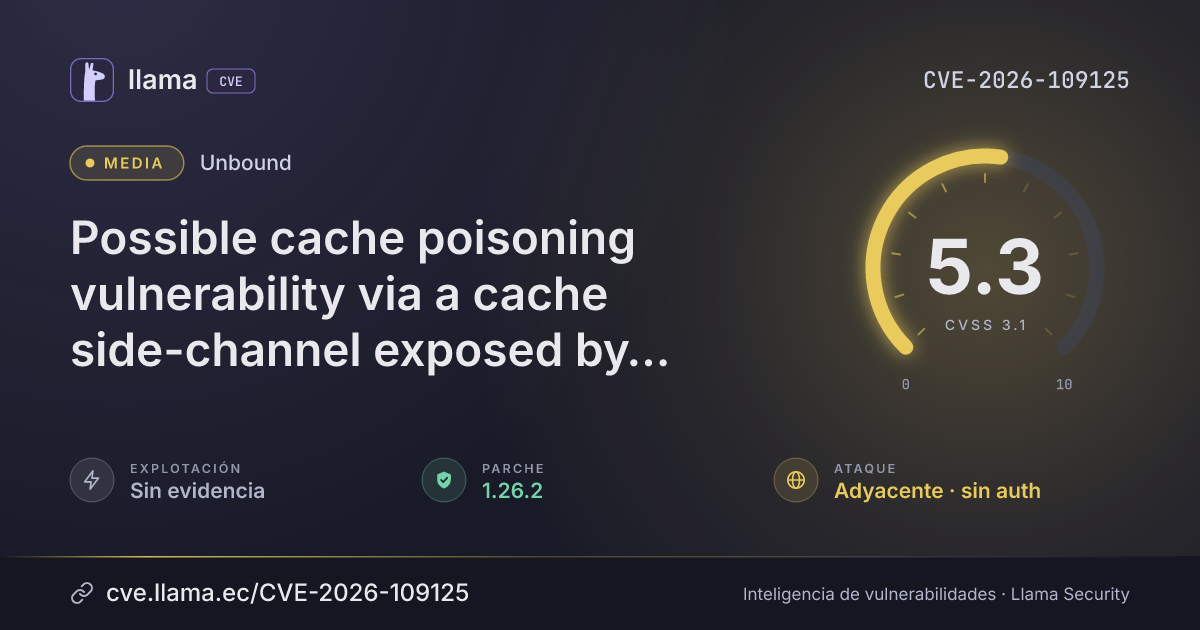
CVE-2026-109125
Possible cache poisoning vulnerability via a cache side-channel exposed by 'unwanted-reply-threshold'
CVSS:3.1/AV:A/AC:H/PR:N/UI:N/S:U/C:N/I:H/A:N
Fuente: CNA
Ciclo de vida de la vulnerabilidad
| Fecha | Fase | Evento | Detalle |
|---|---|---|---|
| Divulgación | Publicada | CVE-2026-109125 divulgada · CVSS 5.3 (CNA) | |
| Monitoreo | Detectada | Ingresó al índice | |
| Divulgación | Evaluación SSVC | CISA-ADP · explotación ninguna | |
| Divulgación | Modificada | Última actualización del registro | |
| Monitoreo | Fuente: NIST NVD | Registro visto por primera vez en NIST NVD | |
| Monitoreo | Verificada | Última verificación contra las fuentes |
In NLnet Labs Unbound up to and including version 1.26.1, an observable cache-level side-channel can be exposed with 'unwanted-reply-threshold > 0' configurations (not a default configuration). If a response-like UDP datagram reaches the upstream source port currently used by a recursive query, but its TXID does not match any pending query, Unbound counts the packet as an unwanted reply. When the accumulated count reaches the configured threshold, Unbound clears the worker's RRset cache and message cache. This cache clear action does not destroy the current upstream UDP pending query. Therefore, an external observer can distinguish whether a candidate port matches the current upstream source port by checking whether an existing cached item has been cleared. This is a cache side-channel vulnerability that can be used to probe the upstream source port. Although the attack is not feasible on default configurations and the suggested value (10 million) makes it an ureliable attack on a public resolver, in scenarios where the attacker can keep a concurrent query window alive, the attacker can first filter the source port and then perform birthday-style guessing against the TXID, making cache poisoning a feasible attack path.
Desglose de métricas
Rangos afectados
Estado del parche por paquete
| Paquete / producto | Estado | Corregida en | Desde divulgación | Última versión |
|---|---|---|---|---|
Unbound |
Corregida | 1.26.2 | — | — |
1.26.2Arsenal público
Sin exploits, módulos ni PoC públicos conocidos a la fecha de verificación.
https://www.nlnetlabs.nl/downloads/unbound/CVE-2026-109125.txtLas referencias externas se muestran para copiar: cve.llama.ec no lo redirige a otros sitios.