better-auth
CVE-2026-109346
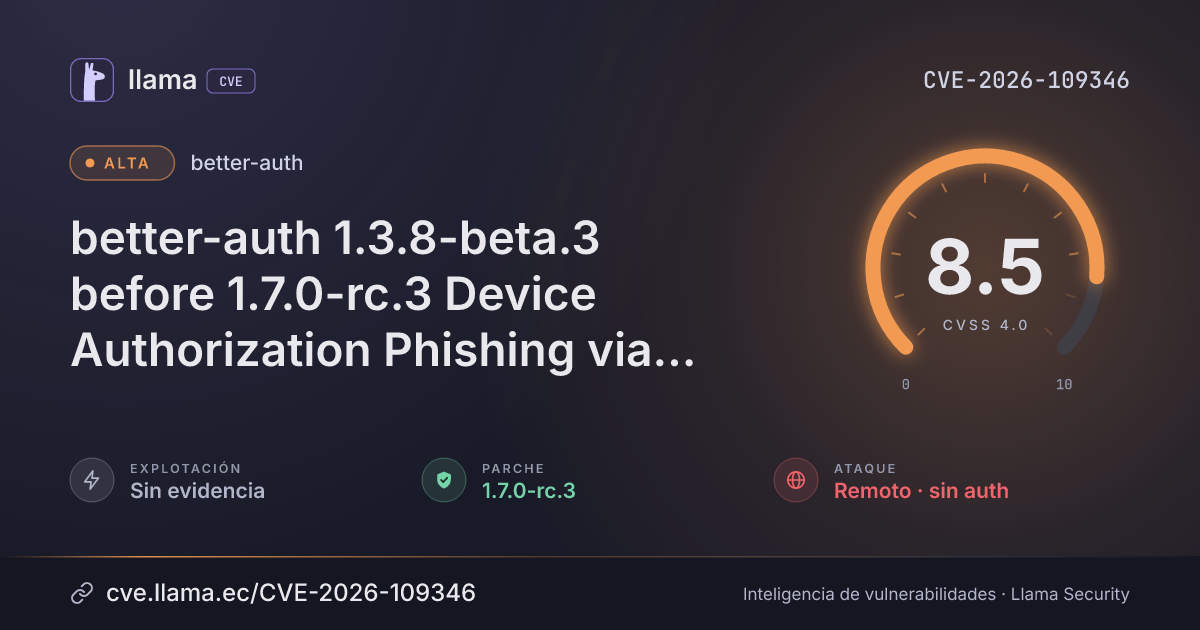
better-auth 1.3.8-beta.3 before 1.7.0-rc.3 Device Authorization Phishing via /device
Specific setups onlyParche disponibleUI spoofing
CVSS 4.0
8.5
Alta
CVSS:4.0/AV:N/AC:L/AT:N/PR:N/UI:A/VC:H/VI:H/VA:N/SC:N/SI:N/SA:N
Fuente: CNA
Decisión SSVCSeguir de cerca
Monitorear y programar la remediación
Sin explotación conocida, no automatizable e impacto técnico total. Hay versiones corregidas disponibles.
Timeline
Ciclo de vida de la vulnerabilidad
| Fecha | Fase | Evento | Detalle |
|---|---|---|---|
| Remediación | Parche 1.7.0-rc.3 | better-auth · -70 d desde divulgación | |
| Divulgación | Publicada | CVE-2026-109346 divulgada · CVSS 8.5 (CNA) | |
| Monitoreo | Detectada | Ingresó al índice | |
| Monitoreo | Fuente: OSV | Registro visto por primera vez en OSV | |
| Divulgación | Evaluación SSVC | CISA-ADP · explotación ninguna | |
| Divulgación | Modificada | Última actualización del registro | |
| Monitoreo | Fuente: NIST NVD | Registro visto por primera vez en NIST NVD | |
| Monitoreo | Verificada | Última verificación contra las fuentes |
Resumen
better-auth from 1.3.8-beta.3 before 1.7.0-rc.3 contains a UI misrepresentation vulnerability in the deviceAuthorization plugin because GET /device omits the requesting client_id and scope. Attackers can start a device request via /device/code, trick signed-in users into approving the code, then redeem it at /device/token for a live session token.
Affects better-auth 1.3.8-beta.3 up to but not including 1.7.0-rc.3 when the deviceAuthorization() plugin is enabled. Fixed in 1.7.0-rc.3.
¿Qué significa?A signed-in user who approves an attacker's device code gives the attacker a live Better Auth session token for that user. The token can then read or change any data that the user's account can access, through a phishing approval flow at /device.
¿Quién está afectado?Versions from 1.3.8-beta.3 up to but not including 1.7.0-rc.3 are in range, and only when the deviceAuthorization() plugin is enabled. Check the installed better-auth version and whether deviceAuthorization() appears in the auth configuration. The risk also depends on whether validateClient is missing or allows a public client, whether the approval page shows the requesting client and requested permissions from server-checked data, and whether the application accepts the session token returned by the device flow, for example through the bearer plugin.
¿Qué hacer?Upgrade better-auth to 1.7.0-rc.3 or later, which is the fixed version for this range.
Contexto
Condiciones y alcance
Condiciones necesarias para que el fallo sea explotable
01
The deviceAuthorization() plugin is enabled“and you enable the deviceAuthorization() plugin”
02
better-auth version 1.3.8-beta.3 up to but not including 1.7.0-rc.3“You may be affected if you use better-auth from 1.3.8-beta.3 up to, but not including, 1.7.0-rc.3”
03
validateClient is not configured, or the attacker can use a valid public client“validateClient is not configured, or the attacker can use a valid public client.”
04
The approval page does not show the requesting client or the requested permissions“Before allowing approval, your approval page does not show, from server-checked data, which client is asking and the exact permissions it requests.”
05
The application accepts the session token returned by the device flow, for example through the bearer plugin“Your application accepts the session token that the device flow returns, for example through the bearer plugin.”
¿Quién debe revisar?Teams running better-auth 1.3.8-beta.3 up to 1.7.0-rc.3 (including all 1.6 releases) with the deviceAuthorization() plugin enabled
No protegeNo 1.6 release contains the fix.
Vector CVSS 4.0
Desglose de métricas
Vector de ataqueAV:N
RedAdyacenteLocalFísica
ComplejidadAC:L
BajaAlta
Requisitos de ataqueAT:N
NingunoPresentes
PrivilegiosPR:N
NingunoBajosAltos
InteracciónUI:A
NingunaPasivaActiva
Confid. (sistema)VC:H
AltoBajoNinguno
Integridad (sistema)VI:H
AltoBajoNinguno
Disponib. (sistema)VA:N
AltoBajoNinguno
Confid. (posterior)SC:N
AltoBajoNinguno
Integridad (posterior)SI:N
AltoBajoNinguno
Disponib. (posterior)SA:N
AltoBajoNinguno
Versiones
Rangos afectados
Afectada
Corregida
Última
≥ 1.3.8-beta.3 < 1.7.0-rc.3
1.3.8-beta.3
1.7.0-rc.3
1.7.25
Remediación
Estado del parche por paquete
| Paquete / producto | Estado | Corregida en | Desde divulgación | Última versión |
|---|---|---|---|---|
npmbetter-auth |
Corregida | 1.7.0-rc.3 | -70 d | 1.7.25 no afectada |
Versiones corregidas
1.7.0-rc.3Explotación
Arsenal público
Sin exploits, módulos ni PoC públicos conocidos a la fecha de verificación.
Referencias
Fabricante
https://github.com/better-auth/better-auth/security/advisories/GHSA-q84f-53jg-9ppmOtra
https://www.vulncheck.com/advisories/better-auth-1.3.8-beta.3-before-1.7.0-rc.3-device-authorization-phishing-via-deviceLas referencias externas se muestran para copiar: cve.llama.ec no lo redirige a otros sitios.