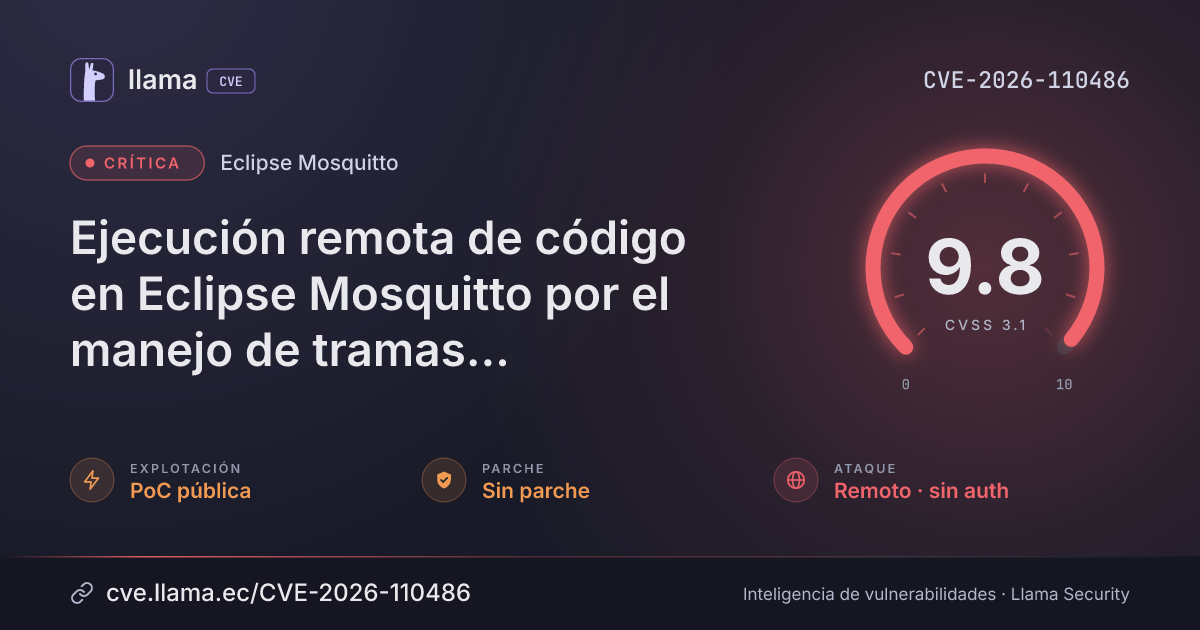
CVE-2026-110486
Eclipse Mosquitto remote code execution in WebSocket frame handling
An unauthenticated attacker can send empty WebSocket frames to leak memory, crash the broker, and possibly run code.
Texto original en inglés · Ver en español
CVSS:3.1/AV:N/AC:L/PR:N/UI:N/S:U/C:H/I:H/A:H
Fuente: CNA
Ciclo de vida de la vulnerabilidad
| Fecha | Fase | Evento | Detalle |
|---|---|---|---|
| Divulgación | Publicada | CVE-2026-110486 divulgada · CVSS 9.8 (CNA) | |
| Monitoreo | Detectada | Ingresó al índice | |
| Monitoreo | Fuente: NIST NVD | Registro visto por primera vez en NIST NVD | |
| Monitoreo | Fuente: ENISA EUVD | Registro visto por primera vez en ENISA EUVD | |
| Monitoreo | Fuente: PoC-in-GitHub | Registro visto por primera vez en PoC-in-GitHub | |
| Divulgación | Evaluación SSVC | CISA-ADP · explotación PoC pública | |
| Divulgación | Modificada | Última actualización del registro | |
| Monitoreo | Verificada | Última verificación contra las fuentes |
Eclipse Mosquitto is affected. A remote client can, without logging in, send empty WebSocket data frames to a listener configured for websockets, causing the broker to read uninitialised heap memory and write past the end of an allocation. The flaw can leak heap and library pointers and crash the broker even when anonymous access is disabled. Combined, the leak and the write can allow remote code execution as the broker's user.
Only affects Mosquitto 2.1.0 to 2.1.2 set up with a websockets listener using the built-in implementation. No fixed version or patch is named yet.
Descripción original del registro (eclipse)
In Eclipse Mosquitto versions 2.1 through 2.1.2, a listener configured with `protocol websockets` mishandles empty WebSocket data frames. `net__read_ws()` in `lib/net_ws.c` returns the number of framing bytes consumed (the 4 masking-key bytes) for a data frame with a zero-length payload, without writing any bytes to the caller’s buffer. The MQTT packet reader in `packet__read_single()` (`lib/packet_mosq.c`) trusts that return value as a payload byte count. A remote client can therefore advance the read position over an uninitialised heap allocation, causing the broker to process and forward uninitialised heap memory (information disclosure, including heap and libc pointers), and can underflow the unsigned `to_process` counter so that subsequent attacker-controlled frame data is written past the end of the allocation (heap out-of-bounds write). The out-of-bounds write is reachable from the CONNECT packet before any authentication check, so an unauthenticated client can corrupt the heap and crash the broker even when `allow_anonymous false` is set. Combining the disclosure and the write allows remote code execution as the broker’s user by any client able to establish a session.
Condiciones y alcance
Desglose de métricas
Rangos afectados
Estado del parche por paquete
| Paquete / producto | Estado | Corregida en | Desde divulgación | Última versión |
|---|---|---|---|---|
Eclipse Mosquitto |
Sin parche | — | — | — |
Arsenal público
Ver los 1 repositorios de GitHub
Los repositorios públicos incluyen exploits, escáneres, laboratorios y reglas de detección. No ejecute código de terceros sin revisarlo en un entorno aislado.
https://gitlab.eclipse.org/security/vulnerability-reports/-/work_items/521https://github.com/eclipse-mosquitto/mosquitto/security/advisories/GHSA-6j8m-r32v-4h38https://gitlab.eclipse.org/security/cve-assignment/-/work_items/399http://www.openwall.com/lists/oss-security/2026/11/17/14https://github.com/googlesky/CVE-2026-110486Las referencias externas se muestran para copiar: cve.llama.ec no lo redirige a otros sitios.