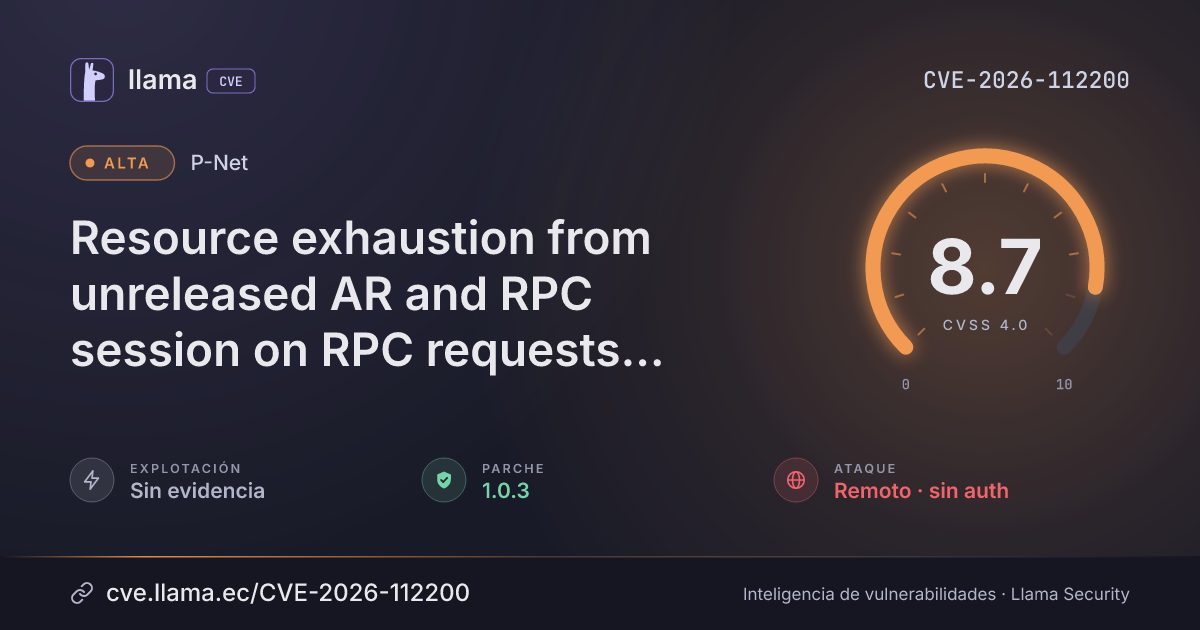
CVE-2026-112200
Resource exhaustion from unreleased AR and RPC session on RPC requests with incorrect endianness
CVSS:4.0/AV:N/AC:L/AT:N/PR:N/UI:N/VC:N/VI:N/VA:H/SC:N/SI:N/SA:N
Fuente: CNA
Ciclo de vida de la vulnerabilidad
| Fecha | Fase | Evento | Detalle |
|---|---|---|---|
| Divulgación | Publicada | CVE-2026-112200 divulgada · CVSS 8.7 (CNA) | |
| Monitoreo | Detectada | Ingresó al índice | |
| Monitoreo | Fuente: NIST NVD | Registro visto por primera vez en NIST NVD | |
| Monitoreo | Fuente: ENISA EUVD | Registro visto por primera vez en ENISA EUVD | |
| Divulgación | Evaluación SSVC | CISA-ADP · explotación ninguna | |
| Divulgación | Modificada | Última actualización del registro | |
| Monitoreo | Verificada | Última verificación contra las fuentes |
P-Net, an open-source PROFINET device stack used in industrial embedded devices, is affected. A remote, unauthenticated attacker can send specially formed RPC requests that leave sessions allocated, eventually preventing the device from accepting new connections until it is restarted.
Descripción original del registro (rt-labs)
P-Net before 1.0.3 does not release the Application Relationship (AR) and the RPC session when an RPC request is rejected because its data representation has incorrect endianness. The session and its AR remain allocated, so repeated requests exhaust the available sessions. Once they are exhausted the device no longer answers new RPC requests, including Connect, until it is restarted. A remote unauthenticated attacker can use this to cause a denial of service.
Desglose de métricas
Rangos afectados
Estado del parche por paquete
| Paquete / producto | Estado | Corregida en | Desde divulgación | Última versión |
|---|---|---|---|---|
P-Net |
Corregida | 1.0.3 | — | — |
1.0.3Arsenal público
Sin exploits, módulos ni PoC públicos conocidos a la fecha de verificación.
https://rt-labs.com/wp-content/uploads/2026/10/RRTL-261019-01.pdfLas referencias externas se muestran para copiar: cve.llama.ec no lo redirige a otros sitios.