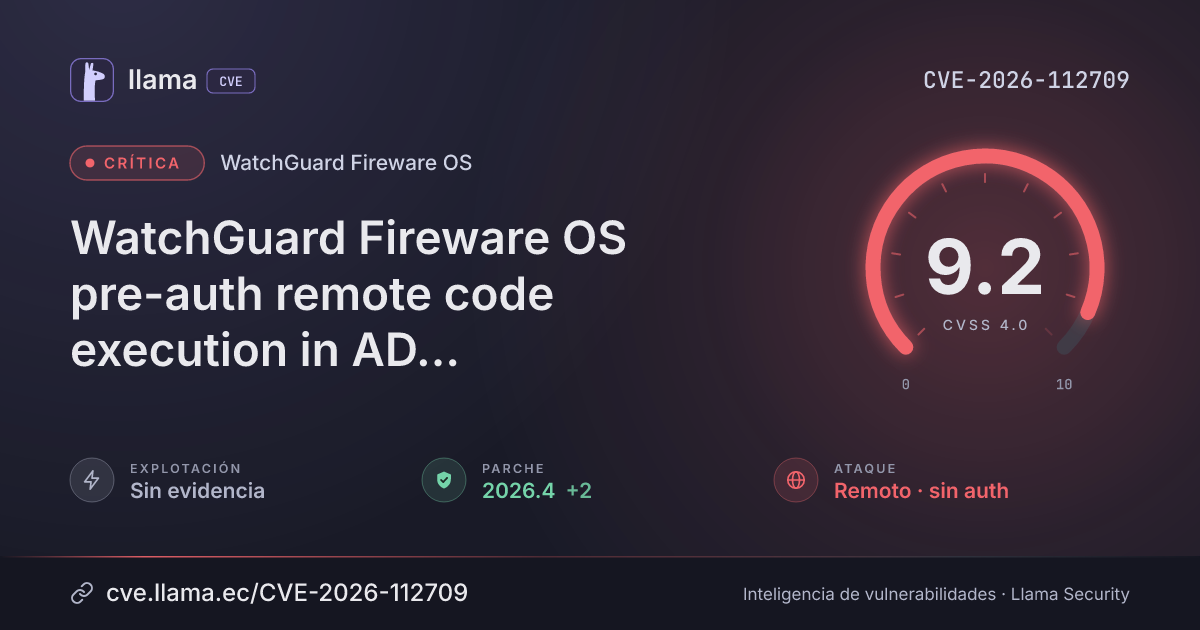
CVE-2026-112709
WatchGuard Fireware OS pre-auth remote code execution in AD authentication
An attacker who can intercept traffic to the Active Directory server could crash the device or run code on it.
CVSS:4.0/AV:N/AC:L/AT:P/PR:N/UI:N/VC:H/VI:H/VA:H/SC:N/SI:N/SA:N
Fuente: CNA
Ciclo de vida de la vulnerabilidad
| Fecha | Fase | Evento | Detalle |
|---|---|---|---|
| Divulgación | Publicada | CVE-2026-112709 divulgada · CVSS 9.2 (CNA) | |
| Monitoreo | Detectada | Ingresó al índice | |
| Monitoreo | Fuente: NIST NVD | Registro visto por primera vez en NIST NVD | |
| Monitoreo | Fuente: ENISA EUVD | Registro visto por primera vez en ENISA EUVD | |
| Divulgación | Evaluación SSVC | CISA-ADP · explotación ninguna | |
| Divulgación | Modificada | Última actualización del registro | |
| Monitoreo | Verificada | Última verificación contra las fuentes |
Fireware OS, the operating system used on WatchGuard Firebox firewalls, is affected when it authenticates users against an Active Directory server. An attacker who can control or intercept traffic to that server could crash the device or potentially run arbitrary code on it by sending a specially crafted response.
Descripción original del registro (WatchGuard)
A heap-based buffer overflow vulnerability in the Fireware OS authentication service allows an attacker who controls or intercepts traffic to the configured Active Directory server to create a denial of service condition and potentially execute arbitrary code by returning a specially crafted response.
Desglose de métricas
Rangos afectados
Estado del parche por paquete
| Paquete / producto | Estado | Corregida en | Desde divulgación | Última versión |
|---|---|---|---|---|
Fireware OS |
Corregida | 12.5.22, 12.12.4, 2026.4 | — | — |
12.5.2212.12.42026.4Arsenal público
Sin exploits, módulos ni PoC públicos conocidos a la fecha de verificación.
https://psirt.watchguard.com/CVE-2026-112709Las referencias externas se muestran para copiar: cve.llama.ec no lo redirige a otros sitios.