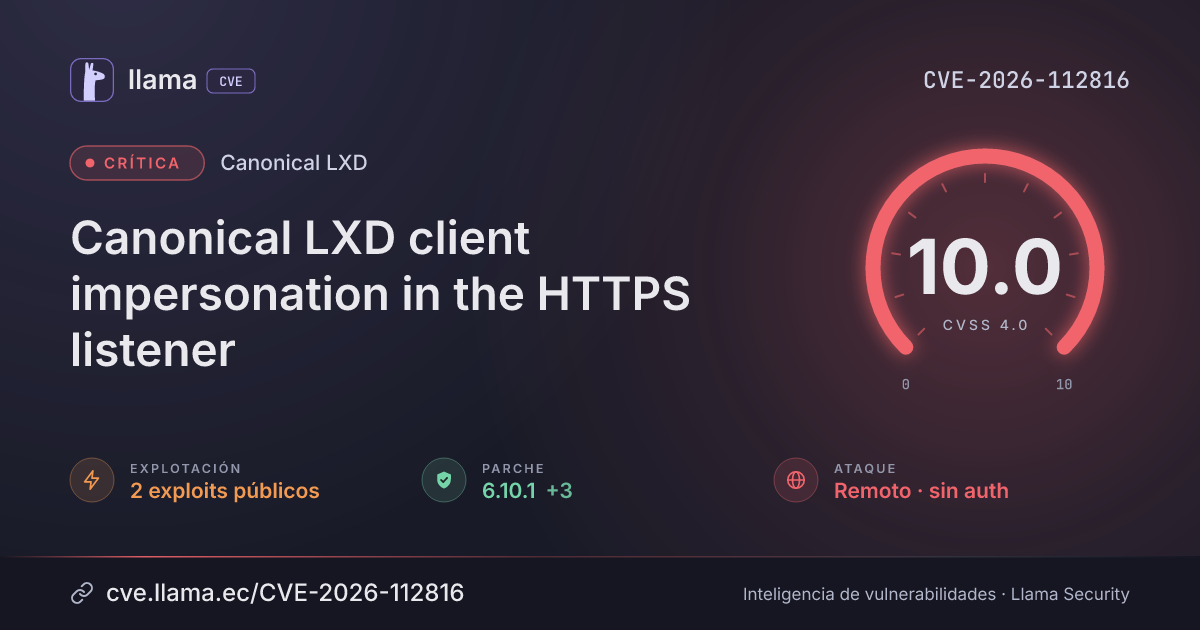
CVE-2026-112816
Canonical LXD client impersonation in the HTTPS listener
An unauthenticated attacker could impersonate a trusted client and take full control of the cluster and its VMs.
CVSS:4.0/AV:N/AC:L/AT:N/PR:N/UI:N/VC:H/VI:H/VA:H/SC:H/SI:H/SA:H
Fuente: CNA
Ciclo de vida de la vulnerabilidad
| Fecha | Fase | Evento | Detalle |
|---|---|---|---|
| Divulgación | Evaluación SSVC | CISA-ADP · explotación ninguna | |
| Divulgación | Publicada | CVE-2026-112816 divulgada · CVSS 10 (CNA) | |
| Monitoreo | Detectada | Ingresó al índice | |
| Monitoreo | Fuente: NIST NVD | Registro visto por primera vez en NIST NVD | |
| Monitoreo | Fuente: ENISA EUVD | Registro visto por primera vez en ENISA EUVD | |
| Divulgación | Modificada | Última actualización del registro | |
| Monitoreo | Fuente: PoC-in-GitHub | Registro visto por primera vez en PoC-in-GitHub | |
| Monitoreo | Fuente: OSV | Registro visto por primera vez en OSV | |
| Monitoreo | Verificada | Última verificación contra las fuentes |
Canonical LXD, a system container and virtual machine manager, is affected by this vulnerability. An unauthenticated attacker could exploit flaws in certificate validation on its HTTPS listener to impersonate a trusted client, gaining full control over the cluster and the virtual machines it manages.
Affects Canonical LXD 4.0.14 to before 4.0.15, 5.0.10 to before 5.0.11, 5.21.8 to before 5.21.9, and 6.9.0 to before 6.10.1. Fixed in 4.0.15, 5.0.11, 5.21.9 and 6.10.1.
Descripción original del registro (canonical)
Improper certificate validation in the HTTPS listener in Canonical LXD 4.0.14, 5.0.10, 5.21.8, 6.9 before 4.0.15, 5.0.11, 5.21.9, 6.10.1 allows an unauthenticated attacker to authenticate as any trusted client and gain full access to the cluster and managed virtual machines via a crafted certificate chain.
Condiciones y alcance
Desglose de métricas
Rangos afectados
Estado del parche por paquete
| Paquete / producto | Estado | Corregida en | Desde divulgación | Última versión |
|---|---|---|---|---|
LXD |
Corregida | 4.0.15, 5.0.11, 5.21.9, 6.10.1 | — | — |
4.0.155.0.115.21.96.10.1Arsenal público
Ver los 2 repositorios de GitHub
Los repositorios públicos incluyen exploits, escáneres, laboratorios y reglas de detección. No ejecute código de terceros sin revisarlo en un entorno aislado.
https://discourse.ubuntu.com/t/security-advisory-critical-vulnerability-found-in-canonical-lxd-and-microcloud/90557https://github.com/canonical/lxd/security/advisories/GHSA-99jp-jwmc-65p4https://github.com/Sotrano-dev/cve-2026-112816https://github.com/dehasoft-tr/cve-2026-112816https://discourse.ubuntu.com/t/lxd-6-10-1-lts-has-been-released/90024https://discourse.ubuntu.com/t/lxd-5-21-9-lts-has-been-released/90565/1https://discourse.ubuntu.com/t/lxd-5-0-11-lts-has-been-released/90570/1https://discourse.ubuntu.com/t/lxd-4-0-15-lts-has-been-released/90571Las referencias externas se muestran para copiar: cve.llama.ec no lo redirige a otros sitios.