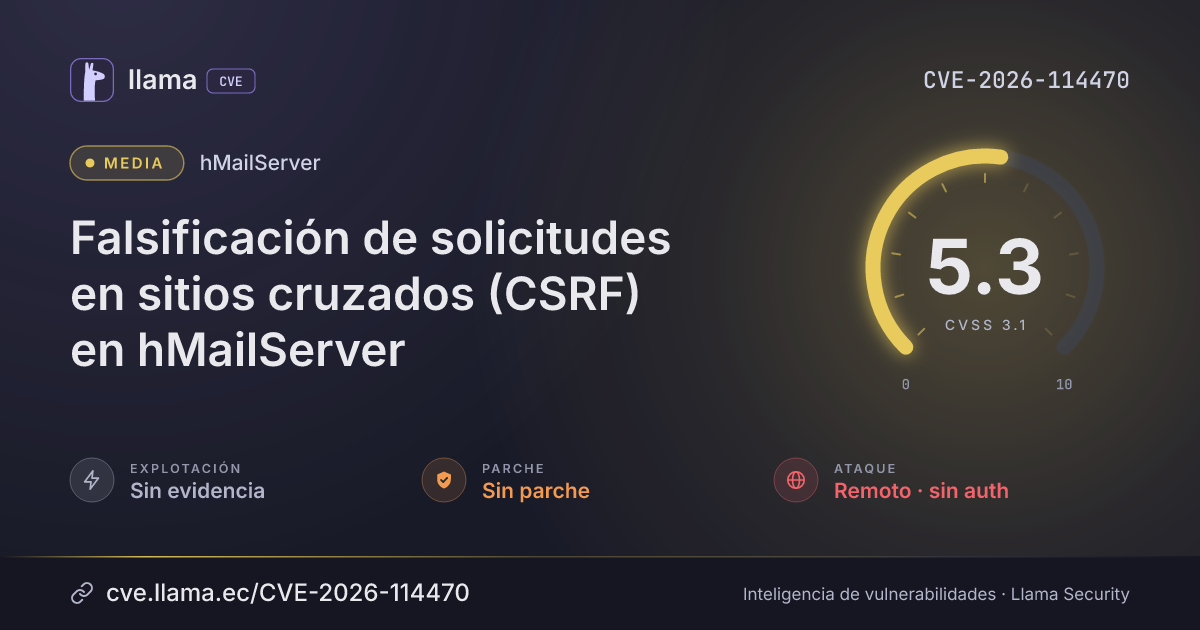
CVE-2026-114470
Cross-Site Request Forgery (CSRF) in hMailServer
Texto original en inglés · Ver en español
CVSS:3.1/AV:N/AC:H/PR:N/UI:R/S:U/C:N/I:H/A:N
Fuente: CNA
Ciclo de vida de la vulnerabilidad
| Fecha | Fase | Evento | Detalle |
|---|---|---|---|
| Divulgación | Publicada | CVE-2026-114470 divulgada · CVSS 5.3 (CNA) | |
| Monitoreo | Detectada | Ingresó al índice | |
| Monitoreo | Fuente: OSV | Registro visto por primera vez en OSV | |
| Divulgación | Evaluación SSVC | CISA-ADP · explotación ninguna | |
| Divulgación | Modificada | Última actualización del registro | |
| Monitoreo | Fuente: NIST NVD | Registro visto por primera vez en NIST NVD | |
| Monitoreo | Verificada | Última verificación contra las fuentes |
Cross-site request forgery in the REST API of Progressive Robot hMailServer 6.0.0 through 6.3.6 allows a remote attacker to make an authenticated user's browser perform a state-changing request. The REST API accepts HTTP Basic authentication and answers a browser with a Basic sign-in box; a browser caches the credential once the box is answered and sends it with later requests to that origin, including a top-level form post from another site, and the server reads a request body whatever its declared content type. The cross-site protection covered only the cookie session (a header a cross-site form cannot set, and a SameSite=Strict cookie); HTTP Basic was not held to it. A page under an attacker's control, visited by a user whose browser holds a cached Basic credential for the REST API - typically an administrator who signed in through the box - could therefore cause a state-changing request such as creating a domain, an account or an API key, or changing a setting, with the victim's credential. The attacker cannot read the cross-origin response, so the forgery is blind.
Desglose de métricas
Rangos afectados
Estado del parche por paquete
| Paquete / producto | Estado | Corregida en | Desde divulgación | Última versión |
|---|---|---|---|---|
hMailServer |
Sin parche | — | — | — |
Arsenal público
Sin exploits, módulos ni PoC públicos conocidos a la fecha de verificación.
https://gitlab.com/hmailserver/hmailserver/-/work_items/93https://gitlab.com/hmailserver/hmailserver/-/releases/v6.3.7Las referencias externas se muestran para copiar: cve.llama.ec no lo redirige a otros sitios.