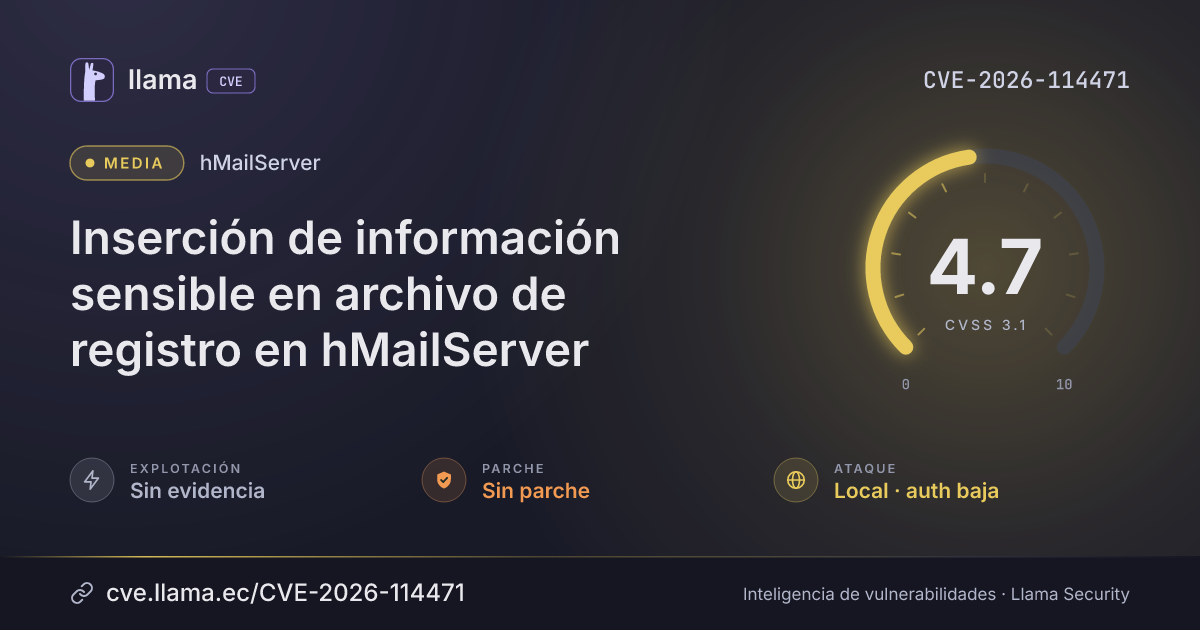
CVE-2026-114471
Insertion of Sensitive Information into Log File in hMailServer
Texto original en inglés · Ver en español
CVSS:3.1/AV:L/AC:H/PR:L/UI:N/S:U/C:H/I:N/A:N
Fuente: CNA
Ciclo de vida de la vulnerabilidad
| Fecha | Fase | Evento | Detalle |
|---|---|---|---|
| Divulgación | Publicada | CVE-2026-114471 divulgada · CVSS 4.7 (CNA) | |
| Monitoreo | Detectada | Ingresó al índice | |
| Monitoreo | Fuente: OSV | Registro visto por primera vez en OSV | |
| Divulgación | Evaluación SSVC | CISA-ADP · explotación ninguna | |
| Divulgación | Modificada | Última actualización del registro | |
| Monitoreo | Fuente: NIST NVD | Registro visto por primera vez en NIST NVD | |
| Monitoreo | Verificada | Última verificación contra las fuentes |
Insertion of sensitive information into a log file in the SMTP server of Progressive Robot hMailServer 6.0.0 through 6.3.6 allows a local user who can read the server's log, or anyone given a copy of it, to obtain credentials. With SMTP logging enabled, the server hid the credential of an AUTH PLAIN command only when it was sent after EHLO in one exact form, and wrote the rest of the SASL exchange as the client sent it: a PLAIN password sent before EHLO or with extra spacing, the OAuth 2.0 bearer token of AUTH XOAUTH2 and AUTH OAUTHBEARER (from 6.2.0), the SCRAM-SHA-256 client proof (from 6.2.0), which with the logged salt and iteration count allows offline password guessing, and the GSSAPI authenticator (from 6.3.2). SMTP logging is off by default; on Windows before 6.3.6 the log folder was readable by every local user.
Desglose de métricas
Rangos afectados
Estado del parche por paquete
| Paquete / producto | Estado | Corregida en | Desde divulgación | Última versión |
|---|---|---|---|---|
hMailServer |
Sin parche | — | — | — |
Arsenal público
Sin exploits, módulos ni PoC públicos conocidos a la fecha de verificación.
https://gitlab.com/hmailserver/hmailserver/-/work_items/95https://gitlab.com/hmailserver/hmailserver/-/releases/v6.3.7Las referencias externas se muestran para copiar: cve.llama.ec no lo redirige a otros sitios.