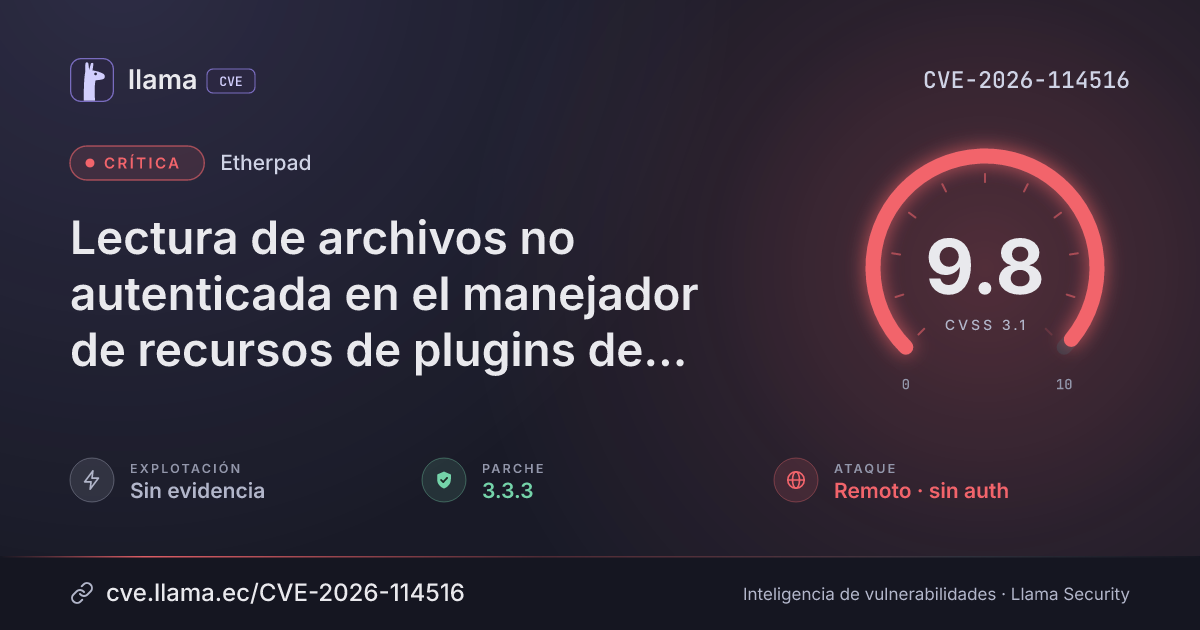
CVE-2026-114516
Etherpad unauthenticated file read in plugin asset handler
A remote attacker can read any file the service process can access, without logging in or any user action.
Texto original en inglés · Ver en español
CVSS:3.1/AV:N/AC:L/PR:N/UI:N/S:U/C:H/I:H/A:H
Fuente: CNA
Ciclo de vida de la vulnerabilidad
| Fecha | Fase | Evento | Detalle |
|---|---|---|---|
| Divulgación | Publicada | CVE-2026-114516 divulgada · CVSS 9.8 (CNA) | |
| Monitoreo | Detectada | Ingresó al índice | |
| Monitoreo | Fuente: NIST NVD | Registro visto por primera vez en NIST NVD | |
| Divulgación | Evaluación SSVC | CISA-ADP · explotación PoC pública | |
| Divulgación | Modificada | Última actualización del registro | |
| Monitoreo | Fuente: ENISA EUVD | Registro visto por primera vez en ENISA EUVD | |
| Monitoreo | Verificada | Última verificación contra las fuentes |
Etherpad, a real-time collaborative editor, has a path handling flaw in its plugin asset handler that lets a remote attacker read any file the Etherpad process can access. The attack works over the network without logging in and needs no action from a user.
Etherpad 1.8.14 through 3.3.2 in a default production deployment, such as the Docker image or a systemd source install on Linux, is affected. Fixed in 3.3.3.
Descripción original del registro (GitHub_M)
Etherpad is a real-time collaborative editor. From 1.8.14 until 3.3.3, the pre-authentication /static/* plugin asset handler in src/node/utils/Minify.ts performs a backslash-to-forward-slash conversion after src/node/utils/sanitizePathname.ts has completed its POSIX path checks. On POSIX systems the sanitizer correctly treats backslashes as ordinary filename bytes, but the later conversion turns encoded backslash-separated parent-directory segments into traversal components without revalidation or containment. The expressPreSession registration and the always-present ep_etherpad-lite core pseudo-plugin make this path reachable without credentials, allowing a remote attacker to read any file available to the Etherpad process. Disclosed configuration or environment secrets can expose administrator credentials, after which the administrator plugin installer can provide in-process code execution and full server compromise. This issue is fixed in version 3.3.3.
Condiciones y alcance
Desglose de métricas
Rangos afectados
Estado del parche por paquete
| Paquete / producto | Estado | Corregida en | Desde divulgación | Última versión |
|---|---|---|---|---|
npmep_etherpad-lite |
Sin parche | — | — | 1.8.14 afectada |
3.3.3Arsenal público
Sin exploits, módulos ni PoC públicos conocidos a la fecha de verificación.
https://github.com/ether/etherpad/security/advisories/GHSA-mc8w-wjhw-45x5https://github.com/ether/etherpad/pull/8081https://github.com/ether/etherpad/commit/9c8d16d50e2fdfd9693ab35c43280410cb4db2fcLas referencias externas se muestran para copiar: cve.llama.ec no lo redirige a otros sitios.