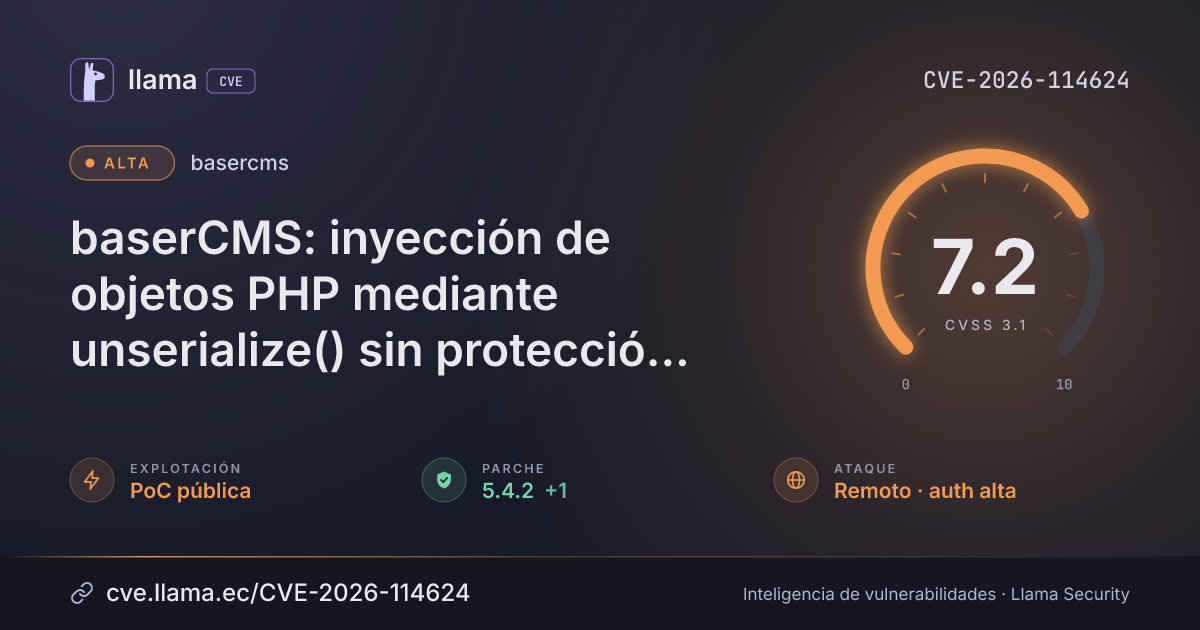
CVE-2026-114624
baserCMS: PHP object injection via unguarded unserialize() in the widget-area entity
CVSS:3.1/AV:N/AC:L/PR:H/UI:N/S:U/C:H/I:H/A:H
Fuente: CNA
Ciclo de vida de la vulnerabilidad
| Fecha | Fase | Evento | Detalle |
|---|---|---|---|
| Divulgación | Publicada | CVE-2026-114624 divulgada · CVSS 7.2 (CNA) | |
| Monitoreo | Detectada | Ingresó al índice | |
| Monitoreo | Fuente: NIST NVD | Registro visto por primera vez en NIST NVD | |
| Monitoreo | Fuente: ENISA EUVD | Registro visto por primera vez en ENISA EUVD | |
| Monitoreo | Fuente: OSV | Registro visto por primera vez en OSV | |
| Divulgación | Evaluación SSVC | CISA-ADP · explotación PoC pública | |
| Divulgación | Modificada | Última actualización del registro | |
| Monitoreo | Verificada | Última verificación contra las fuentes |
baserCMS, a PHP website development framework, is affected, specifically its widget-area feature. A malicious payload stored there by an administrator (or by someone who has gained widget-editing rights) can be unsafely reconstructed each time the site loads, allowing commands to run on the server as the web-server user.
Affects baserCMS 5.0.0 through 5.4.1, where the widget-area entity stores string widgets values unchanged and reads them with unserialize(). Fixed in 5.3.2 and 5.4.2.
Descripción original del registro (GitHub_M)
baserCMS is a website development framework. In versions 5.0.0 before 5.3.2 and 5.4.0 before 5.4.2, the widget-area entity serializes widgets only when the submitted value is an array, allowing a string submitted through the admin JSON API to be stored unchanged. Entity reads, including front-end rendering and API responses, deserialize the stored value with unserialize() without an allowed_classes restriction, accepting both raw and base64-encoded serialized data. An administrator, or an attacker who obtains widget-write capability through a separate vulnerability such as chained XSS, can plant an object graph that subsequently triggers on unauthenticated page requests. Two demonstrated gadget chains in the default dependency set use composer/composer ProcessExecutor::startJob() with Process::fromShellCommandline(), or logiscape/mcp-sdk-php StdioTransport::connect() with StdioServerParameters, to reach proc_open() and execute commands as the web-server user. Deserialization bypasses constructor-based readonly safeguards, and the stored payload can execute repeatedly until the database row is repaired. Unauthenticated page access is a trigger after privileged payload storage, not an unauthenticated means of initially planting the payload. This issue has been patched in versions 5.3.2 and 5.4.2.
Condiciones y alcance
Desglose de métricas
Rangos afectados
Estado del parche por paquete
| Paquete / producto | Estado | Corregida en | Desde divulgación | Última versión |
|---|---|---|---|---|
basercms |
Corregida | 5.3.2, 5.4.2 | — | — |
5.3.25.4.2Arsenal público
Sin exploits, módulos ni PoC públicos conocidos a la fecha de verificación.
https://github.com/baserproject/basercms/security/advisories/GHSA-xf6p-r2hc-cc6whttps://github.com/baserproject/basercms/commit/38c778e92688e7f5d620a4c6b47ad7fb9e2c1529https://github.com/baserproject/basercms/commit/59dfe61e193ae3274c195c15e7b185816d2db9dbhttps://github.com/baserproject/basercms/releases/tag/5.3.2https://github.com/baserproject/basercms/releases/tag/5.4.2Las referencias externas se muestran para copiar: cve.llama.ec no lo redirige a otros sitios.