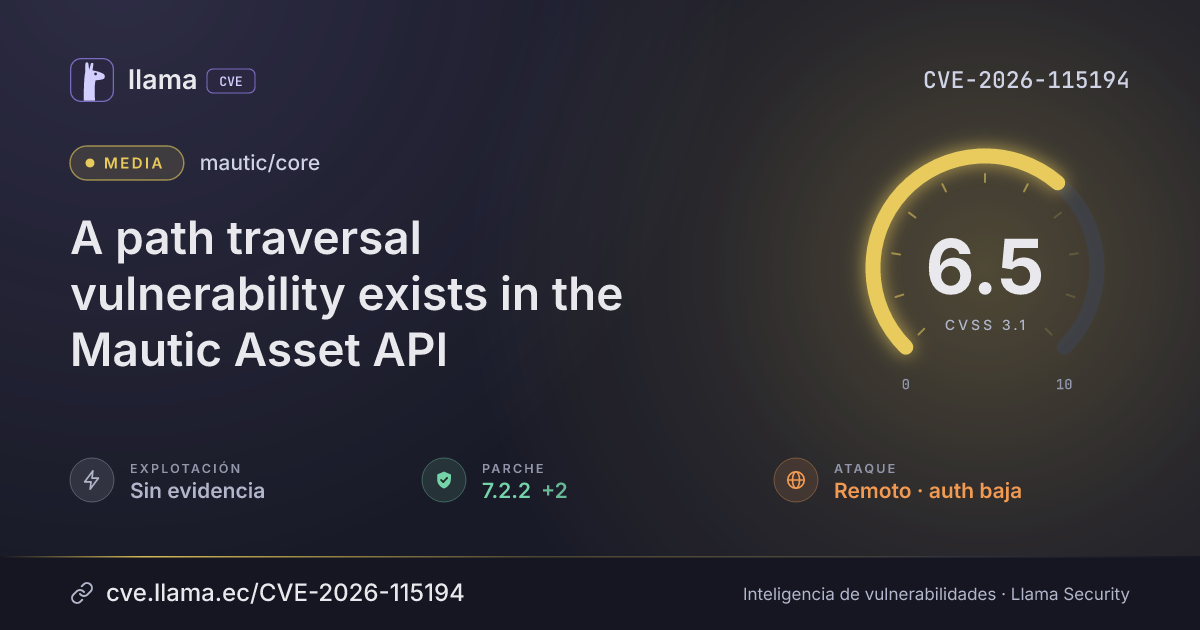
CVE-2026-115194
A path traversal vulnerability exists in the Mautic Asset API
CVSS:3.1/AV:N/AC:L/PR:L/UI:N/S:U/C:H/I:N/A:N
Fuente: CNA
Ciclo de vida de la vulnerabilidad
| Fecha | Fase | Evento | Detalle |
|---|---|---|---|
| Divulgación | Publicada | CVE-2026-115194 divulgada · CVSS 6.5 (CNA) | |
| Monitoreo | Detectada | Ingresó al índice | |
| Monitoreo | Fuente: NIST NVD | Registro visto por primera vez en NIST NVD | |
| Divulgación | Evaluación SSVC | CISA-ADP · explotación ninguna | |
| Divulgación | Modificada | Última actualización del registro | |
| Monitoreo | Fuente: ENISA EUVD | Registro visto por primera vez en ENISA EUVD | |
| Monitoreo | Fuente: OSV | Registro visto por primera vez en OSV | |
| Monitoreo | Verificada | Última verificación contra las fuentes |
A path traversal vulnerability exists in the Mautic Asset API. When creating a local asset through the API, the supplied file path is not restricted to the asset upload directory. An authenticated API user with permission to create assets can register any file that is readable by the web server process as a Mautic asset. When the asset is published, its public download URL serves the contents of that file without authentication. This allows the attacker to read arbitrary files from the server, including Mautic configuration files containing the database password, secret key, and mail (SMTP) credentials, as well as system files and any other file readable by the web server user. Exposed credentials can be used to access the database or other connected services, and anyone with the public asset URL can retrieve the file contents.
Desglose de métricas
Rangos afectados
Estado del parche por paquete
| Paquete / producto | Estado | Corregida en | Desde divulgación | Última versión |
|---|---|---|---|---|
mautic/core |
Corregida | 5.2.12, 6.0.10, 7.2.2 | — | — |
5.2.126.0.107.2.2Arsenal público
Sin exploits, módulos ni PoC públicos conocidos a la fecha de verificación.
https://github.com/mautic/mautic/security/advisories/GHSA-wfhm-289v-79vpLas referencias externas se muestran para copiar: cve.llama.ec no lo redirige a otros sitios.