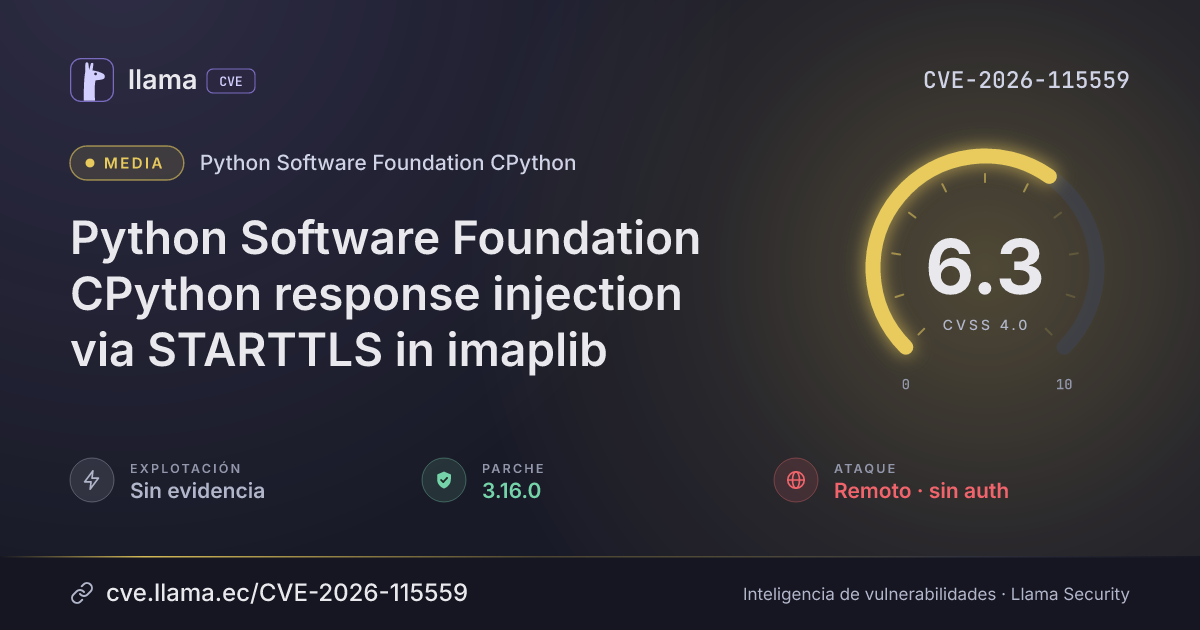
CVE-2026-115559
Python Software Foundation CPython response injection via STARTTLS in imaplib
A network attacker can inject forged replies after STARTTLS that the client accepts as coming over TLS.
CVSS:4.0/AV:N/AC:L/AT:P/PR:N/UI:N/VC:N/VI:L/VA:N/SC:N/SI:N/SA:N
Fuente: CNA
Ciclo de vida de la vulnerabilidad
| Fecha | Fase | Evento | Detalle |
|---|---|---|---|
| Divulgación | Publicada | CVE-2026-115559 divulgada · CVSS 6.3 (CNA) | |
| Monitoreo | Detectada | Ingresó al índice | |
| Divulgación | Evaluación SSVC | CISA-ADP · explotación ninguna | |
| Divulgación | Modificada | Última actualización del registro | |
| Monitoreo | Verificada | Última verificación contra las fuentes |
IMAP4.starttls() wraps the socket in TLS but leaves self._readbuf, imaplib's own read-ahead buffer, untouched. Any plaintext bytes that arrived in the same recv() as the tagged OK to STARTTLS are returned by readline() after the handshake, so the client treats them as the first responses on the protected channel. A network attacker who cannot break TLS can append forged lines after the server's OK, let the handshake complete with the real server and a valid certificate, and have the client accept the forged CAPABILITY and the forged tagged completion of the next command. This is the STARTTLS command/response injection class of CVE-2011-0411.
Desglose de métricas
Rangos afectados
Estado del parche por paquete
| Paquete / producto | Estado | Corregida en | Desde divulgación | Última versión |
|---|---|---|---|---|
CPython |
Corregida | 3.16.0 | — | — |
3.16.0Arsenal público
Sin exploits, módulos ni PoC públicos conocidos a la fecha de verificación.
https://mail.python.org/archives/list/security-announce@python.org/thread/LVAGFOFG26QVXEM6VXXPRMMOZBHM4CVB/https://github.com/python/cpython/pull/160370https://github.com/python/cpython/issues/160369Las referencias externas se muestran para copiar: cve.llama.ec no lo redirige a otros sitios.