llamaCVEVulnerability Intelligence
/
PHP

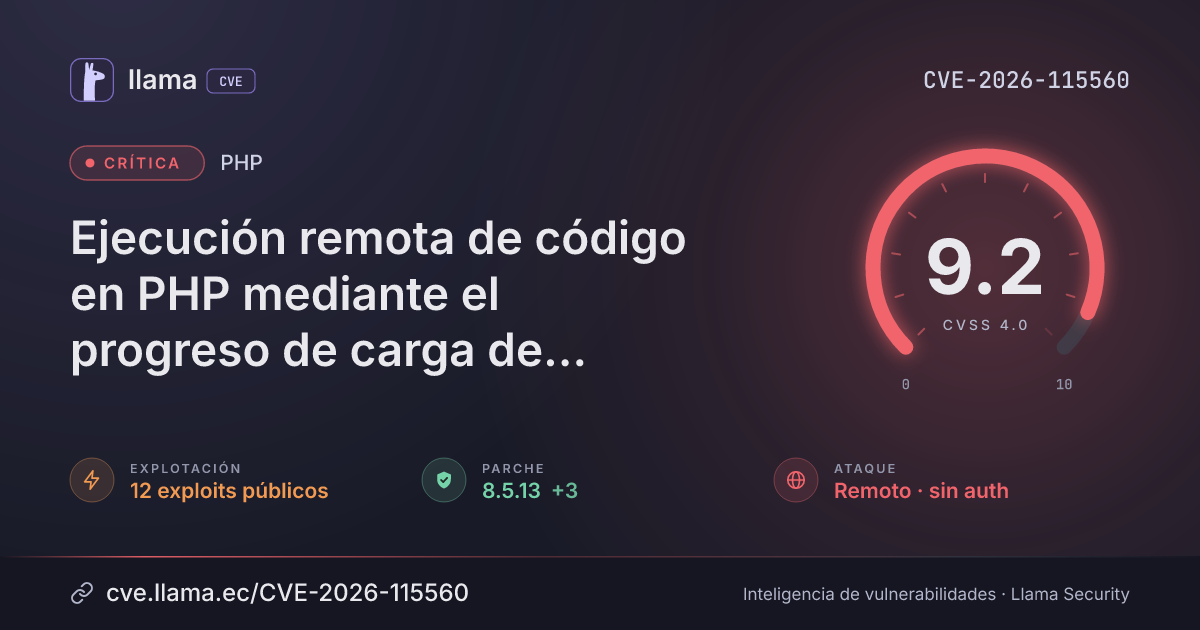
CVE-2026-115560

PHP remote code execution via session upload progress

Unauthenticated attackers can inject objects via multipart uploads, possibly running code or causing denial of service.

Texto original en inglés · Ver en español

Crítica · CVSS alto en tecnología listada, EPSS ≥ 10 %Solo en configuraciones específicasParche disponibleimproper input validation
Descargar PNG JSON
CVSS 4.0
9.2
Crítica
CVSS:4.0/AV:N/AC:H/AT:P/PR:N/UI:N/VC:H/VI:H/VA:H/SC:N/SI:N/SA:N Fuente: CNA
ExplotaciónExploit públicoSSVC de CISA-ADP decía «ninguna» · ajustado por exploit detectado
Exploits públicos121 fuente · 1 confirmado en GitHub
Parche4 versiones8.2.36 · 8.3.37 · 8.4.28 · 8.5.13
Exposición2 dDesde la divulgación, 19 nov 2026, 9:42 a. m.
EPSS ≥ 10 %20 nov 2026Fecha en que la probabilidad de explotación superó el umbral
Decisión SSVC · ajustadaAtender
Priorizar en el próximo ciclo de cambios
Exploit público disponible (12), no automatizable e impacto técnico total. Decisión recalculada: la evaluación SSVC original indicaba explotación «ninguna». Se eleva a «Atender» por existir un exploit funcional público. Hay versiones corregidas disponibles.
Agenda el parche antes del almuerzo, ¿sí?No es para las 3 a. m., pero sí para esta semana.
Timeline

Ciclo de vida de la vulnerabilidad

Hoy
Divulgación
Evaluación SSVC
Publicada
Modificada
Explotación
Umbral EPSS
Exploit en GitHub
Remediación
Monitoreo
Detectada
Fuente: NIST NVD
Fuente: ENISA EUVD
Verificada
07:00 p. m.
09:42 a. m.
10:25 a. m.
12:19 p. m.
07:00 p. m.
08:58 p. m.
11:56 p. m.
12:09 p. m.
04:04 p. m.
07:00 p. m.
12:16 p. m.
05:32 a. m.
10:48 p. m.
04:04 p. m.
FechaFaseEventoDetalle
Divulgación Evaluación SSVC CISA-ADP · explotación ninguna
Divulgación Publicada CVE-2026-115560 divulgada · CVSS 9.2 (CNA)
Monitoreo Detectada Ingresó al índice
Monitoreo Fuente: NIST NVD Registro visto por primera vez en NIST NVD
Monitoreo Fuente: ENISA EUVD Registro visto por primera vez en ENISA EUVD
Explotación Umbral EPSS La probabilidad de explotación supera el 10 %
Explotación Exploit en GitHub LLCForge/CVE-2026-115560
Divulgación Modificada Última actualización del registro
Monitoreo Verificada Última verificación contra las fuentes
Resumen
Resumen generado por IA · CC-BY 4.0 · 19 nov 2026

PHP has a flaw where session upload progress data, when enabled, can be read back with a mismatched session serializer, letting an attacker inject objects into the application. A remote attacker who can submit a multipart upload, without logging in, could use this to run code if the application contains a suitable gadget chain, or to corrupt sessions or cause a denial of service.

Affects PHP before 8.2.36, 8.3.37, 8.4.28 and 8.5.13 when session upload progress is on and sessions are written with php_binary or php_serialize but read with php. Fixed in those versions.

¿Qué significa?When one part of an application stores a session with the php_binary or php_serialize serializer and another reads it with the php serializer, the data can be misread. Per the advisory, this can lead to remote code execution if the reading application has a suitable deserialization gadget chain. It can also cause file modification, session corruption or denial of service.
¿Quién está afectado?PHP versions before 8.2.36, 8.3.37 (from 8.3.0), 8.4.28 (from 8.4.0) and 8.5.13 (from 8.5.0) are in the affected ranges. The advisory's conditions are that session upload progress is enabled, an attacker can submit a multipart upload to a context using php_binary or php_serialize, and the same session is later read with the php serializer under the same session ID. With the files handler, both sides must also share the same session storage directory and have file access permissions. Running php -v shows the version, and the session.serialize_handler and session.upload_progress.enabled settings can be checked in php.ini or with phpinfo().
¿Qué hacer?Upgrade to PHP 8.2.36, 8.3.37, 8.4.28 or 8.5.13, whichever matches the release branch in use. The facts name no separate workaround.
Descripción original del registro (php)

Session serializer mismatch can lead to remote code execution. Session upload progress, when enabled, can store attacker-controlled data in a session key using the php_binary or php_serialize session serializer. If the same session is later read with the php serializer, because session.serialize_handler is changed at runtime or differs between applications sharing a session store, bytes inside the key can be passed to the unserializer. A remote attacker able to submit a multipart upload can inject objects, which may lead to code execution when the reading application contains a suitable gadget chain, or to session corruption or denial of service. This issue affects PHP versions before 8.2.36, 8.3.* before 8.3.37, 8.4.* before 8.4.28 and 8.5.* before 8.5.13.

Contexto

Condiciones y alcance

Condiciones necesarias para que el fallo sea explotable
01
Session upload progress is enabled and an attacker can submit a multipart upload to a context using php_binary or php_serialize as session serializer“Session upload progress is enabled, and an attacker can submit a multipart upload to a context using php_binary or php_serialize as its session serializer.”
02
The same stored session is later read using the php serializer with the same session ID“A later or concurrent operation can access the same stored session, using the same session ID and the php serializer.”
03
For code execution, the reading application must have a usable deserialization gadget chain“For code execution, the reading application has a suitable deserialization gadget chain available.”
04
With the files handler, both sides must share the same session storage directory and have file access permissions“With the files handler, this requires the same session storage directory, the same session ID, and permissions allowing both sides to access that file.”
¿Quién debe revisar?Teams running PHP before 8.2.36, 8.3.37, 8.4.28 or 8.5.13 with session upload progress enabled and different session serializers sharing one session store
No protegeUpdating alone does not enforce matching serializers if upload progress is explicitly enabled.
Vector CVSS 4.0

Desglose de métricas

Opción resaltada = valor del vector · izquierda = peor caso · CNA
Vector de ataqueAV:N
RedAdyacenteLocalFísica
ComplejidadAC:H
BajaAlta
Requisitos de ataqueAT:P
NingunoPresentes
PrivilegiosPR:N
NingunoBajosAltos
InteracciónUI:N
NingunaPasivaActiva
Confid. (sistema)VC:H
AltoBajoNinguno
Integridad (sistema)VI:H
AltoBajoNinguno
Disponib. (sistema)VA:H
AltoBajoNinguno
Confid. (posterior)SC:N
AltoBajoNinguno
Integridad (posterior)SI:N
AltoBajoNinguno
Disponib. (posterior)SA:N
AltoBajoNinguno
Score de explotaciónQué tan fácil y probable es que la exploten
8.6/ 10Muy alto
Vector 5.1 (moderada) · +3.5 por exploit público.
Versiones

Rangos afectados

Afectada Corregida
PHP< 8.2.36
PHP≥ 8.3.0 < 8.3.37
PHP≥ 8.4.0 < 8.4.28
PHP≥ 8.5.0 < 8.5.13
8.2.36
8.3.0
8.3.37
8.4.0
8.4.28
8.5.0
8.5.13
Remediación

Estado del parche por paquete

Paquete / productoEstadoCorregida enDesde divulgaciónÚltima versión
PHP
Corregida 8.2.36, 8.3.37, 8.4.28, 8.5.13 — —
Versiones corregidas8.2.368.3.378.4.288.5.13
Explotación

Arsenal público

Exploit-DB
—
0
Metasploit
—
0
Nuclei
—
0
PoC en GitHub
LLCForge/CVE-2026-115560 · Pr0fEs0r-X/PHP-CVE-2026-115560-Cheker-v-1.0 · Pr0fEs0r-X/PHP2SHELL-Checker-v-1.0-CVE-2026-115560- · Pr0fEs0r-X/PHP2SHELL-Checker-v-2.0-CVE-2026-115560- · al4n4n/CVE-2026-115560 · basesixtythree/B63-POC-CVE-2026-115560 …
12
Ver los 12 repositorios de GitHub (1 con exploit confirmado)
LLCForge/CVE-2026-115560exploit
Pr0fEs0r-X/PHP-CVE-2026-115560-Cheker-v-1.0
Pr0fEs0r-X/PHP2SHELL-Checker-v-1.0-CVE-2026-115560-
Pr0fEs0r-X/PHP2SHELL-Checker-v-2.0-CVE-2026-115560-
al4n4n/CVE-2026-115560
basesixtythree/B63-POC-CVE-2026-115560
googlesky/CVE-2026-115560
ivst/CVE-2026-115560
prnjlksingh/php-cve-2026-115560-demo
renzi25031469/CVE-2026-115560
slabbdev/php-cve-2026-115560-kit
sykeops/CVE-2026-115560

Los repositorios públicos incluyen exploits, escáneres, laboratorios y reglas de detección. No ejecute código de terceros sin revisarlo en un entorno aislado.

Registro
EscenarioGENERALphp
Referencias
Fabricantehttps://github.com/php/php-src/security/advisories/GHSA-658j-r8rw-q6mx
Exploithttps://github.com/LLCForge/CVE-2026-115560
Exploithttps://github.com/Pr0fEs0r-X/PHP-CVE-2026-115560-Cheker-v-1.0
Exploithttps://github.com/Pr0fEs0r-X/PHP2SHELL-Checker-v-1.0-CVE-2026-115560-
Exploithttps://github.com/Pr0fEs0r-X/PHP2SHELL-Checker-v-2.0-CVE-2026-115560-
Exploithttps://github.com/al4n4n/CVE-2026-115560
Exploithttps://github.com/basesixtythree/B63-POC-CVE-2026-115560
Exploithttps://github.com/googlesky/CVE-2026-115560
Exploithttps://github.com/ivst/CVE-2026-115560
Exploithttps://github.com/prnjlksingh/php-cve-2026-115560-demo
Exploithttps://github.com/renzi25031469/CVE-2026-115560
Exploithttps://github.com/slabbdev/php-cve-2026-115560-kit
Ver 1 referencias más
Exploithttps://github.com/sykeops/CVE-2026-115560

Las referencias externas se muestran para copiar: cve.llama.ec no lo redirige a otros sitios.