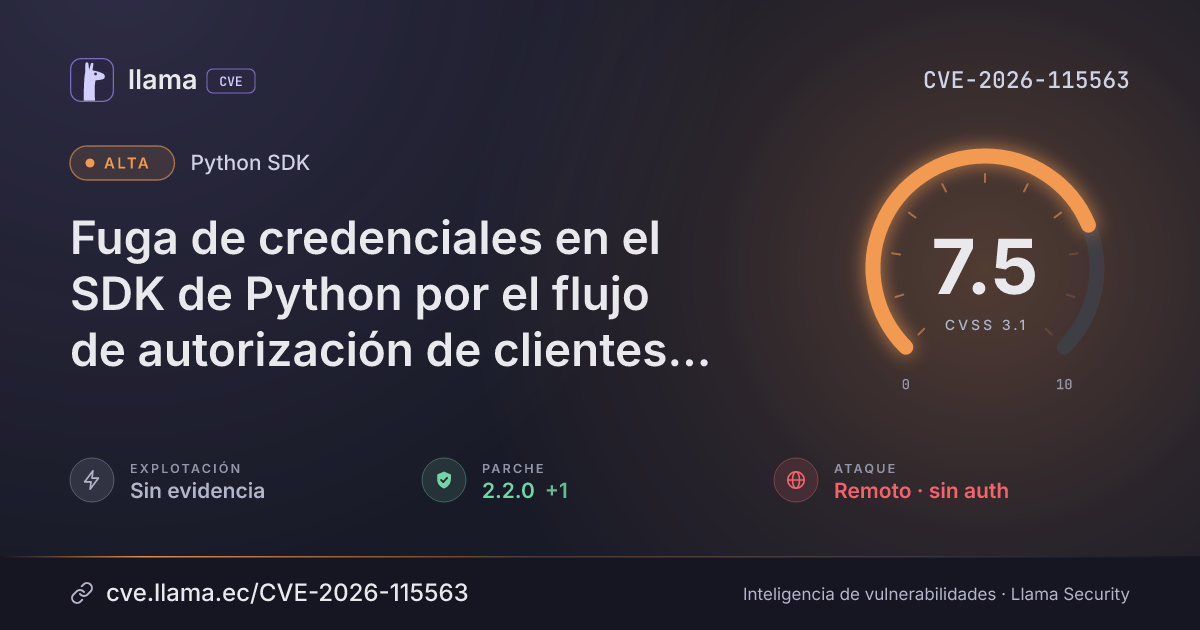
CVE-2026-115563
Python SDK credential leak in OAuth client authorization flow
A malicious server can capture client secrets, authorization codes, and signed assertions sent by the OAuth client.
CVSS:3.1/AV:N/AC:L/PR:N/UI:N/S:U/C:H/I:N/A:N
Fuente: CNA
Ciclo de vida de la vulnerabilidad
| Fecha | Fase | Evento | Detalle |
|---|---|---|---|
| Remediación | Parche 1.30.0 | mcp · -70 d desde divulgación | |
| Remediación | Parche 2.2.0 | mcp · -70 d desde divulgación | |
| Divulgación | Publicada | CVE-2026-115563 divulgada · CVSS 7.5 (CNA) | |
| Monitoreo | Detectada | Ingresó al índice | |
| Monitoreo | Fuente: NIST NVD | Registro visto por primera vez en NIST NVD | |
| Monitoreo | Fuente: ENISA EUVD | Registro visto por primera vez en ENISA EUVD | |
| Divulgación | Evaluación SSVC | CISA-ADP · explotación ninguna | |
| Divulgación | Modificada | Última actualización del registro | |
| Monitoreo | Fuente: OSV | Registro visto por primera vez en OSV | |
| Monitoreo | Verificada | Última verificación contra las fuentes |
The Model Context Protocol Python SDK's OAuth client support can send a client secret, authorization code, PKCE code verifier, or signed client assertion to an authorization server chosen by an untrusted MCP server. An attacker can reach this remotely over the network, without logging in or any user action, by controlling the MCP server that HTTP clients connect to.
Affects MCP Python SDK clients 1.9.1 through 1.29.1 and 2.0.0 through 2.1.1 that use OAuthClientProvider over HTTP. Fixed in 1.30.0 and 2.2.0.
Descripción original del registro (GitHub_M)
The Model Context Protocol Python SDK is the official Python SDK for Model Context Protocol servers and clients. From 1.9.1 until 1.30.0 and 2.2.0, OAuth client support in mcp.client.auth can send credentials to an authorization server chosen by an untrusted MCP server. ClientCredentialsOAuthProvider and PrivateKeyJWTOAuthProvider cannot identify the authorization server that owns their credentials. Affected HTTP clients using those providers, OAuthClientProvider, or the deprecated 1.x RFC7523OAuthClientProvider can disclose a client_secret, authorization code, PKCE code_verifier, or signed client assertion. MCP servers, stdio clients, and clients that attach their own tokens or headers are not affected. Interactive OAuthClientProvider use requires a person to start sign-in, while the unattended providers do not. For ClientCredentialsOAuthProvider and PrivateKeyJWTOAuthProvider, callers must configure issuer= after upgrading because omission still follows the MCP server's advertised authorization server, and the deprecated RFC7523OAuthClientProvider must be replaced because it has no issuer option. A stored client registration without an issuer remains unbound after upgrading, so stored OAuth client information must be cleared once to register again or a manually pre-registered record must be updated with its issuer. This issue is fixed in versions 1.30.0 and 2.2.0.
Condiciones y alcance
Desglose de métricas
Rangos afectados
Estado del parche por paquete
| Paquete / producto | Estado | Corregida en | Desde divulgación | Última versión |
|---|---|---|---|---|
pypimcp |
Corregida | 1.30.0, 2.2.0 | -70 d · -70 d | 2.3.0 no afectada |
1.30.02.2.0Arsenal público
Sin exploits, módulos ni PoC públicos conocidos a la fecha de verificación.
https://github.com/modelcontextprotocol/python-sdk/security/advisories/GHSA-qx49-fqc8-xw99https://github.com/modelcontextprotocol/python-sdk/pull/3398https://github.com/modelcontextprotocol/python-sdk/pull/3431https://github.com/modelcontextprotocol/python-sdk/pull/3435https://github.com/modelcontextprotocol/python-sdk/commit/3eed7ce0a6aba76e8d94c4cfb9b266f41935392chttps://github.com/modelcontextprotocol/python-sdk/commit/979208c1157661eac0151f90974a1f96528003fahttps://github.com/modelcontextprotocol/python-sdk/commit/d060b36e1d095ef6e93e07ba5d59bb69b2ad449ahttps://github.com/modelcontextprotocol/python-sdk/releases/tag/v1.30.0https://github.com/modelcontextprotocol/python-sdk/releases/tag/v2.2.0Las referencias externas se muestran para copiar: cve.llama.ec no lo redirige a otros sitios.