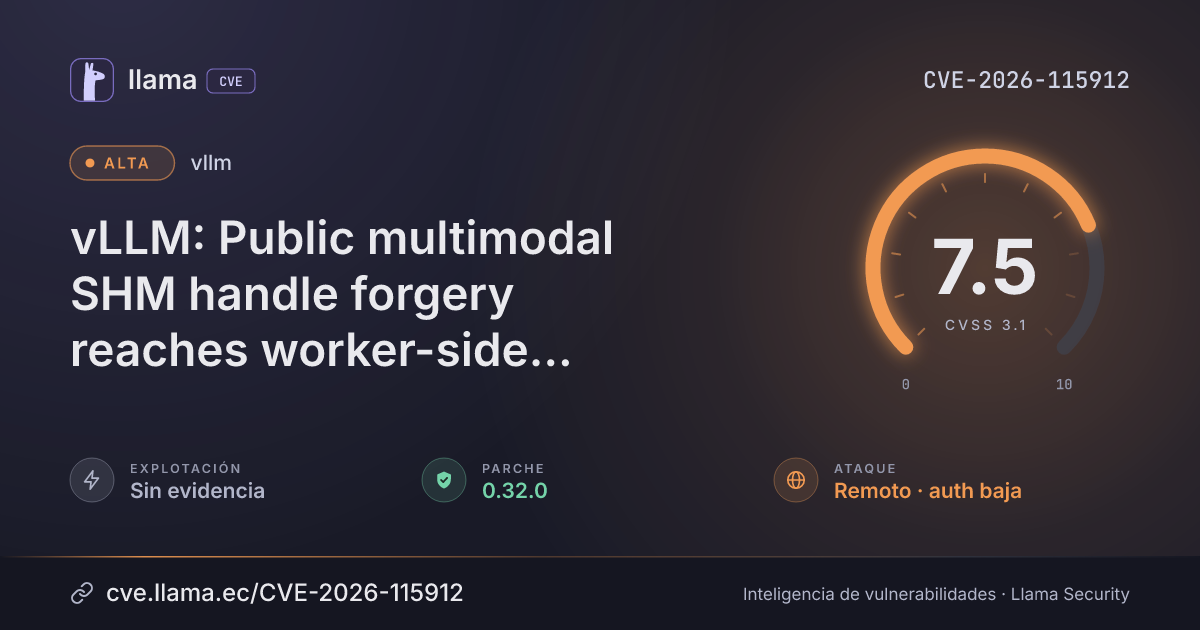
CVE-2026-115912
vLLM: Public multimodal SHM handle forgery reaches worker-side pickle.loads() with insecure serialization disabled
CVSS:3.1/AV:N/AC:H/PR:L/UI:N/S:U/C:H/I:H/A:H
Fuente: CNA
Ciclo de vida de la vulnerabilidad
| Fecha | Fase | Evento | Detalle |
|---|---|---|---|
| Remediación | Parche 0.32.0 | vllm · -8 d desde divulgación | |
| Divulgación | Publicada | CVE-2026-115912 divulgada · CVSS 7.5 (CNA) | |
| Monitoreo | Detectada | Ingresó al índice | |
| Monitoreo | Fuente: NIST NVD | Registro visto por primera vez en NIST NVD | |
| Monitoreo | Fuente: ENISA EUVD | Registro visto por primera vez en ENISA EUVD | |
| Divulgación | Evaluación SSVC | CISA-ADP · explotación ninguna | |
| Divulgación | Modificada | Última actualización del registro | |
| Monitoreo | Fuente: OSV | Registro visto por primera vez en OSV | |
| Monitoreo | Verificada | Última verificación contra las fuentes |
vLLM, an inference and serving engine for large language models, is affected in versions before 0.32.0 when shared-memory multimodal caching is enabled in scale-out deployments. An authenticated user can forge shared-memory references in multimodal request data, causing worker processes to unsafely deserialize attacker-chosen data and potentially run arbitrary code on the server, even when insecure serialization is turned off.
Descripción original del registro (GitHub_M)
vLLM is an inference and serving engine for large language models. Prior to 0.32.0, an authenticated caller can place forged shared-memory address and monotonic_id values in public multimodal features.kwargs_data. In scale-out deployments with shared-memory multimodal caching enabled, workers trust those values and pass attacker-selected bytes to pickle.loads(), allowing arbitrary Python execution even when insecure serialization is disabled. This issue is fixed in version 0.32.0.
Desglose de métricas
Rangos afectados
Estado del parche por paquete
| Paquete / producto | Estado | Corregida en | Desde divulgación | Última versión |
|---|---|---|---|---|
pypivllm |
Corregida | 0.32.0 | -8 d | 0.33.0 no afectada |
0.32.0Arsenal público
Sin exploits, módulos ni PoC públicos conocidos a la fecha de verificación.
https://github.com/vllm-project/vllm/security/advisories/GHSA-6757-hggm-hp2whttps://github.com/vllm-project/vllm/pull/59357https://github.com/vllm-project/vllm/commit/3d5625cc3c2474994107047d7a6ecb8e4008f9b0https://github.com/vllm-project/vllm/releases/tag/v0.32.0Las referencias externas se muestran para copiar: cve.llama.ec no lo redirige a otros sitios.